Fundamental Baptist Fellowship International (FBFI) Conference Audio
Body
- The Church: The Pillar & Ground of the Truth -Ed Nelson
- Who Will Be Your King? -John Vaughn
- Hope Deferred -Christopher Williams
- Earnestly Contend for the Faith -Ed
As iron sharpens iron,
one person sharpens another. (Proverbs 27:17)
[amazon 9780825429309 thumbnail]
Being unsure if he would ever see them again, Paul called together the elders of the church at Ephesus (Acts 20:17-38). He reminded them of their duty to protect God’s flock. He told them to be on guard because he knew savage wolves would eventually try to feed off the flock. These wolves in sheep’s clothing, with their perverse gospel, would seek to gather as many sheep around them as they could. Paul doesn’t say exactly what this perverse gospel would be, but perhaps he had it in mind as he concluded his words to the elders. “I have coveted no one’s silver or gold or clothes.” He then left them with the words of the Lord Jesus, “It is more blessed to give than to receive.”
Some years later, Paul sent Timothy to Ephesus to combat these wolves that Paul had warned of. Prominent among the false teaching being used to fleece the sheep was “that godliness is a means of gain” (1 Tim. 6:5). These depraved men, deprived of the truth, had discovered a way to make money off ministry. By practicing what they preached, they were getting rich off Jesus. This prosperity teaching however was ruining people’s faith (1 Tim. 6:9-10).
Today’s church is also confronted with this perverse gospel. Ironically, while claiming to encourage faith, the “Prosperity Gospel” actually destroys people’s faith by substituting faith in the real gospel with faith in faith. As David Jones and Russell Woodbridge point out in Health, Wealth & Happiness, the prosperity gospel’s roots are found in the “New Thought” movement of the early twentieth century. “In the New Thought works, one can discern some of the key recurring elements of the prosperity gospel: speaking the right words, invoking a universal law of success with words, and having faith in oneself” (p. 31).
Jones and Woodbridge have PhDs from and teach at Southeastern Baptist Theological Seminary. They are both uniquely qualified in the areas of finance and Christianity. They have produced a very informative and readable critique of the prosperity movement within evangelicalism.
The book’s six chapters are grouped under two headings. Chapters one through three offer a critique of the prosperity gospel and prosperity preachers. Chapters four through six offer a correction of the false teaching of prosperity. Chapter one excavates the foundations of the prosperity gospel as being built upon “New Thought Philosophy.” In chapter two one can readily see the link between this philosophy and the unorthodoxy of the prosperity message. They conclude, “while many prosperity teachers offer the plan of salvation, they undermine the gospel with their teaching” (p. 71). Jones and Woodbridge use Joel Osteen as an example. “While Osteen certainly appears genuine and sincere in his faith, his prosperity message is anything but harmless” (p. 73). They go on to demonstrate how Osteen “misinterprets Scripture, misunderstands the gospel, and lacks theological conviction” (p. 73). Chapter three exposes the errors of prosperity theology by examining how it perverts Scripture’s teaching on: the gospel, faith, atonement, the Abrahamic Covenant, the mind, prayer, the Bible, and giving.
First appeared at SharperIron Oct. 15, 2007 with the permission of Brookside Baptist Church.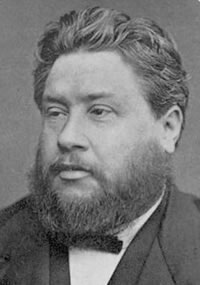
The true minister of Christ feels impelled to preach the whole truth, because it and it alone can meet the wants of man. What evils has this world seen through a distorted, mangled, man-moulded gospel. What mischiefs have been done to the souls of men by men who have preached only one part and not all the counsel of God!
—C.H. Spurgeon, Metropolitan Tabernacle, 1859
Hyper-Calvinsim is all house and no door; Arminianism is all door and no house.
—John Duncan
On April 28, 1854, a 19-year-old boy-preacher assumed the pastorate of New Park Street Chapel in London, England. He remained in this ministry for more than four decades. Throughout the course of his ministry, God did mighty works, and unusual advances were made for the gospel of Jesus Christ. During his ministry, Charles Spurgeon saw more than 14,000 new members added to New Park Street Chapel. He enjoyed the blessing and provision of the Lord through several expansions and building programs. He founded an orphanage and a college for training ministers. He preached to thousands each week. On one occasion, he preached to more than 30,000 people at one time. His was a household name, and even hansom (cab) drivers instinctively knew to take people over the river to “Charlie’s.” Two thousand two hundred and forty-one of his sermons were in print at the time of his death. Today, more than 300 million copies of his sermons and books are in print, making him one of the most prolific authors in the English-speaking world.
The preceding details of Spurgeon’s ministry are well known to most preachers who have had any measure of exposure to Church history. His rich spiritual heritage has been chronicled in scores of biographies and other literature related to his life. One aspect of his ministry, however, has received little or no attention until recently—the prolonged doctrinal controversy surrounding his practice of openly inviting all men to respond to the invitation of the gospel. The details and ramifications of this controversy can be found in a fairly recent book by Iain Murray entitled Spurgeon v. Hyper-Calvinism: The Battle for Gospel Preaching. Published in 1995 by Banner of Truth, this work provides an understanding of the nature, extent, and doctrinal issues surrounding the controversy.
[amazon 1453843752 thumbnail]
For over 75 years, a small, independent newspaper has been the face of fundamentalism in America. John R. Rice founded The Sword of the Lord in 1934 and continued to manage the paper until his death in 1980. After Rice’s death the fundamentalist movement fragmented and the paper has lessened in influence, although it still represents an old-fashioned, fundamentalist faith.
In a new book released this week, one of John R. Rice’s grandsons, Andrew Himes, takes up his pen to tell the story of fundamentalism from an insider’s perspective. Himes grew up within a leading fundamentalist family in the hey day of American fundamentalism. His book [amazon 1453843752] includes personal encounters with several big names widely known even outside of fundamentalism. Himes tells a story his mom related of Billy Graham moving a piano in their home when he was a sophomore at Wheaton College. On the occasion of John R. Rice’s death, Himes himself attended the funeral and ate a meal afterward with Jerry Falwell, then just embarking on his dream of establishing the Moral Majority, soon to be known as the Religious Right.
Himes traces the roots of the Rice family back to the Revolutionary War and interweaves personal accounts of his ancestors’ lives with an account of the historical background of fundamentalism. He explores the sociological elements of the Scots-Irish people and the Southern mindset during and after the Civil War. His family ended up in Texas, where the Civil War lived on as the great lost cause. Himes also details the beginnings of American evangelicalism and the influence of the 18th century revivals on fundamentalism.
The book is more intriguing when John R. Rice comes on the scene and we hear of his mentor, J. Frank Norris. When William Jennings Bryan died suddenly after the conclusion of the Scopes trial, J. Frank Norris picked up the mantle of the leadership of the fundamentalist movement. Norris’ fights with the Southern Baptist Convention eventually included his young protege, who followed Norris out of the SBC. Himes traces the career of John R. Rice from his early days of evangelistic crusades in various towns in Texas to his national prominence as a leader in fundamentalism and even a member of the National Association of Evangelicals. Rice’s early days included numerous revival crusades in small towns throughout the South. It seems he often built a tabernacle for the meetings, and a few months later would leave behind a new Fundamentalist Baptist Church (they always had the same name), unaffiliated with any convention. Rice eventually took to radio and various newspapers to help expand his reach. He moved to Wheaton soon after he broke with Norris (who seemed to grow jealous of John R. Rice’s influence). Rice then became a mentor for Billy Graham, and the tale of Rice’s painful parting with Graham is told from Rice’s vantage point. We then learn of Rice’s conflict with Bob Jones in the 1970s.
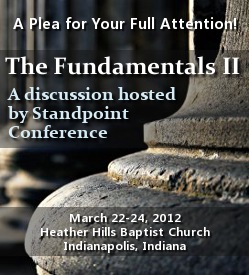
The first thing Aaron Blumer (publisher, SharperIron) said to me when we talked about our next conference was “I’m pretty skeptical of the idea of convergence.” Convergence—the idea that fundamentalism and conservative evangelicalism are heading toward, or should be working toward, convergence into one movement—has certainly been what some have perceived Standpoint Conference to be about. We would argue that’s an oversimplification of what we’re about. As our last Standpoint Conference concluded, we made a conscious choice to leave previous issues behind and move on to more critical issues.
Specifically, we believe that fundamentalism and evangelicalism face similar crises. For different reasons, fundamentalism has lurking at its most conservative end some who are less concerned with doctrine than they should be. Evangelicalism has, in the mainstream, those who are also less concerned with doctrine than they should be. On the extreme right of fundamentalism, this expresses itself with a near-obsessive attention to stylistic details that distracts from doctrinal issues. On the left of evangelicalism, church growth, political activism and social influence provide similar distractions.
The alarming result is that both are disengaged from issues that have serious doctrinal consequences. Among those on the far right of fundamentalism, the disengagement results from a feeling that the larger problems of Christianity are irrelevant to them. (“All who are to the left of us are ‘liberals’ anyway.”) Among those on the left of evangelicalism, the disengagement results from a feeling that all must be well because their churches are growing numerically.
Meanwhile, battles are being waged over ideas that represent vast theological shifts. These shifts are happening not just in institutions of higher learning, but in the pews. Rob Bell preaches a form of universalism, and thousands don’t know how to respond—or feel the need to soft-pedal their rejection. N.T. Wright’s New Perspective on Paul is only dimly understood (if at all) by the vast majority of those reading this article. The gay theologians advance their theories and they are uniformly rejected—but few realize that they are using hermeneutical models that are only slightly more radical than the ones taught in our colleges and seminaries. Ground is given, or freedom granted, on the roles of women in leadership, hermeneutics, creation models, eschatological views, all without recognizing that all of the changes are attached to theological structures that mean something and that changes in one area are harbingers of other changes to come—or changes that have already been made in theological viewpoints.

I grew up in Winston Salem, NC, a city of roughly 230,000. Not large, but by North Carolina standards, in the top five. Over the years, I’ve bumped into people from rural towns who have noted, sometimes with genuine deference, “Oh, you’re from the big city.” This makes me chuckle considering Winston would probably fit inside of Donald Trump’s living room. Our worldview is potently molded to our experiences such that it affects our perception of objective data and propositional truth.
If your experience of the Christian faith has been primarily independent, fundamentalist, traditional and conservative, operating in small to medium-sized churches, then your perception of evangelicalism may be similar to a small town resident visiting a large city. Bigger doesn’t mean better, but it is certainly different with diverse and multiple choices. This is not to denigrate traditional conservatives (whom I have affectionately nicknamed Tracons) or small towns. It is to illustrate perceptual distinctions. Why write about this? Let me explain.
Our church staff and elders attended the Gospel Coalition 2011 conference in Chicago this past week. What we experienced was simple, but profound, gracious, yet powerful. The subject matter, Preaching Christ from the Old Testament, was well crafted and delivered from many regions of the older testament by gifted pastors and leaders. Some of you may have read the updates. While writing the updates and ruminating on the spectrum of participants and contributors at SharperIron, I considered the many articles and comments deliberating the topics of conservative evangelicals, culture, cooperation, fences, separation, etc. It occurred to me that “small town/large city” perceptions exist that skew an appreciation of the believers some have termed “fundagelicals.”
I thoroughly enjoyed my time at The Gospel Coalition Conference. The event was organized well and the layout of the convention center was easy to follow. I wish I had had more time to take in some of the extra panel discussions sprinkled throughout and the post-conference event. Apparently an extra session was called Thursday morning, where D.A. Carson addressed the Rob Bell issue, speaking on what universalism is and why it isn’t a confessionally Christian position.
Discussion