Q & A With Dr. Warren VanHetloo

Compiled from Dr. Warren VanHetloo’s “Cogitations” October 13-21, 2009.

Question

Dr. Van, In looking at the history of the Bible as we know it today, there seems to have frequently been a distrust of the laity to handle (understand) the Word of God. Obviously, only the more wealthy people were able to provide enough education so they could read or teach their children to read. But beyond that, religious leaders seemed reluctant to open the door to the common person to use the Bible in a way to gain understanding about God’s Ways. We look back and say that there were issues of power, politics, etc. But even today in Bible believing churches, you can hear home study groups described as “shared ignorance.” Not too many decades ago, home Bible study groups were publicly discouraged, often from the pulpit. It is almost as if there is fear among the Bible believing pastors that the dangers far outweigh the benefits (or at least threaten their authority). Small groups have become a bit of fad recently, but to deny their potential in spiritual growth, in spite of some risk, seems to underestimate the ability of the Holy Spirit to work through the Word in the hearts of people. What is your evaluation?

Discussion

Historical survey of views on sanctification

Anyone know a good place to find a historical survey of views on sanctification? Either in writing or maybe audio as a lecture or workshop or something.

I’m doing some work on this for an article or two, and there is plenty out there on various views, but not so much from the “concise history” angle.

Discussion

1950s and Christian America

So, I recently found out that two elements of our “Christian nation” are of relatively recent origin. The pledge of allegiance was composed in 1892, but the words “under God” were added in 1954. Further, the motto “In God We Trust” started appearing on coins and such after the Civil War, but didn’t become the U.S. official motto until 1956. So, my question is, what was going on in the 1950’s that resulted in these Christianizing acts of state?

Discussion

How does your congregation handle "Benevolent Assistance"?

Our congregation maintains a “Benevolence Fund” to offer help to those in need. As the economy has turned “south”, we have experienced a significant increase in requests for help.

If your congregation is actively involved in helping others (financially, materially, etc.), I would be interested in knowing how you handle this.

Discussion

Philosophers and Children

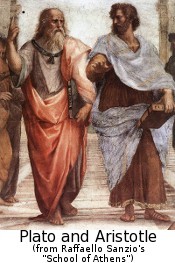
My doctoral studies during the past several years have been quite a challenge, since I have been forced to study (with good comprehension) many ideas and disciplines that were somewhat new to me. The thinking and writing of lots of theologians and philosophers is anything but simple. Take, for example, this explanation of man’s existence by Paul Tillich:

Discussion

Looking for scripture

I am looking for anything in the Bible that seems to even come close to being about the following-

Rev 9:14 Saying to the sixth angel which had the trumpet, Loose the four angels which are bound in the great river Euphrates.

What I am looking for is something I read at one time that I seem to recall being about how those angels ended up being bound there. I have no clue what or where and would be grateful for any help.

Thanks in advance.

Discussion

We Interrupt This Series, Part Doi

NickOfTime

Read Part Unu.

I’m Back

Romanians know how to hold a graduation service. Combined with a Sunday morning worship service, the commencement lasted, non-stop, somewhere north of four hours. It featured two full-length sermons and a half-dozen or more exhortations and extended testimonies, including one in which the Old Testament professor quoted the entire first psalm in Hebrew from memory. A mixed choir and a mandolin orchestra each presented three musical selections. The service, which ended at 1:00 PM, was followed by a formal dinner and then an afternoon service at 4:00. Uncharacteristically, the Romanians kept the afternoon service under two hours in length, but compensated with another feast afterwards.

Twenty-one men received seminary degrees. These men were almost all pastors, and they came from all across the country of Romania. They minister in different contexts: some to Romanians, some to Hungarians, some to the Roma. A few of them are assistant pastors or co-pastors of large churches, but most of them pastor multiple congregations.

Most Baptists in Romania are affiliated with that nation’s Baptist Union. American missionaries often prefer to limit their contact with Baptist Union pastors. As an educational institution, however, we have chosen to train pastors of Baptist Union churches. The line between Union and unregistered churches was not clear, even under communism. One pastor might be ministering to Baptist Union churches and unregistered churches at the same time. After the dictatorship was overthrown, virtually all of the unregistered churches entered the Baptist Union. Today, Romania has few unaffiliated Baptist churches except those that have been organized under foreign (usually American) auspices.

In fact, Romanian law makes unaffiliated churches impossible. Only recognized church bodies have a legal right to hold property or perform “churchly” functions such as baptism and communion. These laws are not always enforced, but they are on the books. In order to organize unaffiliated churches, missionaries often register them as “religious associations,” a separate, non-church category under Romanian law. Most Romanian Baptist pastors view this tactic as deceitful and unethical, so they prefer to maintain a connection with the Baptist Union.

Discussion