Come into My Heart, Lord Jesus? A Plea for Biblical Accuracy in Child Evangelism
 First published at SI May 1, 2006.
Into my heart, into my heart,
Come into my heart, Lord Jesus.
Come in today; come in to stay.
Come into my heart, Lord Jesus.
As iron sharpens iron,
one person sharpens another. (Proverbs 27:17)
First published at SI May 1, 2006.
Into my heart, into my heart,
Come into my heart, Lord Jesus.
Come in today; come in to stay.
Come into my heart, Lord Jesus.
 The doctrine of preservation of the Scriptures has been hotly debated in recent years. Much has been written and said, but most of the rhetoric on the subject has been closely connected to defending or rejecting one view or another on the translation issue. The result has often been that important foundational questions have been overlooked in a rush to get to conclusion A or B in the translation debate.
Among the neglected questions are these: (1) what process did God say He would use to preserve His word and (2) what form did He say that preserved word would take? Both of these are subsets of another neglected question: What does Scripture actually claim (and not claim) about it’s own preservation?
The questions of process (“how”) and form (“what”) are at the heart of the controversy because nobody (among fundamentalists or conservative evangelicals) denies that the word has, and will, endure. The question of what Scripture actually claims is critical as well, for multiple reasons. For one, only a clear answer to that question can put us on the right track to answering the others.
Two general schools of thought exist regarding the how and what of preservation.
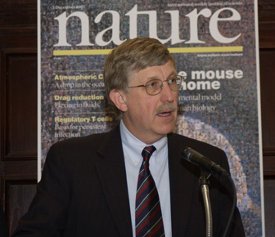 Francis Collins, the former Director of the Human Genome Project (HGP) and now the Director of the National Institutes of Health (NIH), has risen to national prominence in recent years. His scientific acumen combined with his rather public confession of Christian faith has garnered both excitement by Christians, as seen in these Christianity Today articles (here and here), and interest among unbelievers, as in this exchange with Richard Dawkins in Time.
But not everyone is excited about Collins’ recent appointment by President Obama to direct NIH. Sam Harris, the author of the atheistic diatribes against faith, The End of Faith and Letter to a Christian Nation, questions Collins’ fitness for NIH due to the geneticist’s Christian faith in this NY Times piece. While I don’t question Collins’ fitness for his present position, I do question how much he should be viewed as an ally of Bible-believing Christians. His foreword in a new book exposes his disdain for anyone who would take the creation account in Genesis 1-2 as an accurate description of the beginning of the world. Collins pens a four-page foreword for Karl Giberson’s Saving Darwin: How to Be a Christian and Believe in Evolution (Harper One, 2008). In this rather strained attempt to harmonize Christianity and Darwinism, Giberson stretches the limits of reason and logic in an attempt to reconcile the irreconcilable. His book is introduced by Collins’ similarly tortured attempt to elevate science way beyond its boundaries and to denigrate anyone who supports Intelligent Design (ID), young-earth creationism or virtually anything regarding the early chapters of Genesis.
Collins describes ID’s challenge to evolution’s ability to explain irreducibly complex structures in living organisms as pressing on “despite the lack of any meaningful support in the scientific community” (p. v). This statement is simply not true and masks not only the many scientists who question Darwinism’s explanation of irreducible complexity but also the almost universal pressure on scientists to toe the party line concerning Darwinism.
Poll Results
The Convergence of 2 Peter and Jude: How Do You Explain It?
From the website:
The Bible in 90 DaysTM is a non-denominational curriculum structured around a simple, straightforward mission for its participants: “To read, ATTENTIVELY, every word of the Bible in 90 days.”
 Does God allow doctrinal problems in the church so that Christians will study God’s Word carefully and defend it more accurately against unbiblical ideas? Maybe so. There does seem to be some evidence of this in church history. But whether this is true or not, it does seem that several serious doctrinal deviations have arisen in our generation—one after another—even within what has been considered generally conservative Christianity. From the fifties on, evangelicals debated among themselves the doctrine of the inerrancy of the original writings of Scripture. In response to those evangelicals who were arguing that Scripture was not inerrant in the scientific and historical sections of Scripture, the International Council on Biblical Inerrancy was formed in 1977. These biblical scholars planned a ten-year strategy of education, study, and publication. Over the course of ten years, they and others published several important and helpful books, along with the notable Chicago Statement on Biblical Inerrancy. The battle is not over, but much has been accomplished through careful biblical responses to those compromising the doctrine of Scripture.
Then around the turn of the century, a new approach to the doctrine of God was submitted by those known as Open Theists. Open Theists argue that God does not have detailed control of the universe and that He does not know for sure the future acts of free moral agents. In the words of Al Mohler writing in the end of the twentieth century: “My argument is that the integrity of evangelicalism as a theological movement, indeed the very coherence of evangelical theology is threatened by the rise of the various new ‘theisms’ of the evangelical revisionists.”1 The ideas of Open Theism have been answered by those in support of the classic doctrine of God,2 and the debate has seemingly quieted just in time for another major doctrinal deviation to be proposed.
Now we are hearing that the penal substitutionary view of the atonement should be replaced by some other theory. Seemingly the left side of the Emerging Church has been in the forefront of this grave development, though there is no unified agreement in what the correct theory is. In fact, some, in typically postmodern style, seem to be arguing that there really is no one model of the atonement that gets to the essence of Christ’s death on the cross. The value of the atonement might depend on each individual’s understanding.3
Discussion