(Cover image enhanced by Gemini)
Image
Read the series.
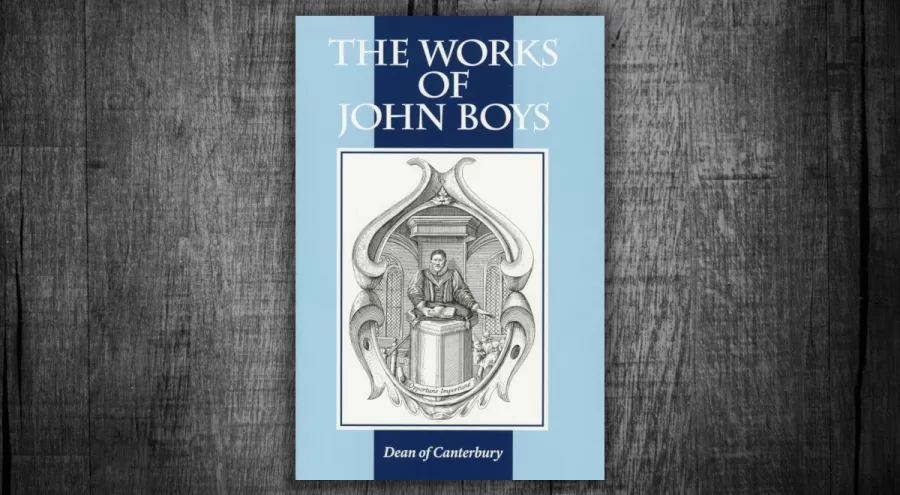
It is a bit of a stretch to call John Boys (1571-1625) a Puritan. He was an Anglican cleric who was Dean of Canterbury Cathedral and a translator of the Authorized (King James) Version of the Bible of 1611. He was certainly evangelical in his sympathies and was held in high esteem by his contemporaries.
This volume was reissued by Soli Deo Gloria in the late 1990’s and may be hard to get hold of today. The work is strongly Anglican in orientation, being the good doctor’s expositions of the various liturgical helps from The Book of Common Prayer etc. As such it may seem a little alien to many readers. The expositions of these rote devices can jar those moderns who like their Bible studies presented in a more prosaic way. I happen to be among that number, so I have to admit that getting comfortable with this volume wasn’t easy for me. But the book, which ranges over nearly 800 pages, deserves to be treated for what it is, not for what I might prefer it to be. I would advise the reader to have an older Book of Common Prayer on hand.
The expositions are often brief, say of the Lord’s Prayer and the Ten Commandments, but those of the Gospel reading for the day, or the Epistle reading for the day are generally fuller, covering several pages. I particularly like the way Boys breaks down the main structure of any given biblical text, and the way he organizes his applications in the same manner. For the most part this is very helpful and edifying. The author’s concern is to instruct and build up, and his effort requires some reciprocation from the reader. For instance, Boys inserts many historical lessons into his expositions of texts. He reminds me of John Trapp in that regard.
As for the expositions themselves, they are filled with instruction. In his too brief attention to the seventh commandment on adultery he rightly includes warnings about “ribald talk, wanton looks, and lascivious attire” (66). On prophecy he is sometimes surprisingly literal. For example, he correctly places Isaiah 24 before the second coming (91). The meditations are frequently theological to a fairly advanced degree. Consider this on the doctrine of Christ:
If Christ had been man only, he could not have done so much for us; if only God and not man, he would not have done so much for us; Christ did die, but all of Christ could not die, but if he could have suffered in all, his love surely was such, as that he would, for he saith, Isaiah v. 4, “What could I have done any more to my vineyard, that I have not done unto it?” (410-411)
I’ve rolled that around by brain a few times and it has done me good. Just think about how he introduces the genealogy of Matthew:
The climax of theology is the Scripture, the climax of Scripture is the gospel, the climax of the gospel is the book of genealogy, the climax of all things is Jesus Christ, the Son of David, the Son of Abraham. He is the first; he is the last; the Alpha of the law, the Omega of the gospel, the beginning of Genesis, the amen of the Apocalypse. (196)
What a way to open! The skippable first seventeen verses of Matthew’s Gospel are presented as a deep reflection of divine cause and effect.
Writing as an Anglican of the time it is unsurprising to come across many warnings about the dangers of Popery and the Roman Catholic doctrines. For today’s reader these can get wearisome, but the threat was real, and a faithful man of God would need to keep his people’s defenses up.
Of course, Boys’ zeal for the Church of England can spill over sometimes. These were more unadorned times. But his grouping of the Brownists, who were the independent proto-Baptists of the age, with “Carnal gospellers, Papists, and Atheists” is a bit over the top (300-305).
So, The Works of John Boys is a learned, pious devotional book, employing Scripture, history, polemic and theological reflection for the serious Christian. When we discard the trappings of the Anglican Church and concentrate upon the expositions themselves, this book has much to commend it. I suppose the most striking thing to me is that it approaches Christian truth from a different perspective than I am used to. It is deeply pious, but it is determinedly rigorous—Not at trying to be clever, just Christianity presented for the serious-minded. We could do with a little more of that in the contemporary Church.
Paul Henebury Bio
Paul Martin Henebury is a native of Manchester, England and a graduate of London Theological Seminary and Tyndale Theological Seminary (MDiv, PhD). He has been a Church-planter, pastor and a professor of Systematic Theology and Apologetics. He was also editor of the Conservative Theological Journal (later Journal of Dispensational Theology). He is now the President of Telos School of Theology.