Harold Camping hospitalized with stroke; "speech affected'
Body
“As of Friday, Camping’s neighbor told the Tribune that the 89-year-old preacher was doing OK. His speech, however, appears to be slurred.” Christian Post
As iron sharpens iron,
one person sharpens another. (Proverbs 27:17)
If the Bible is God’s Word, then why does it come to us as such an (apparently) random collection of diverse literature? In one place we find stories, in another we find legal codes, and in another, epic poems. Here we read correspondence and there we discover verses of song. Some documents contain didactic reasoning, but others give us apocalypses.
Would it not have been better if God had simply sent us an inspired and inerrant systematic theology? Or better still, He might have given us two lists: one of propositions about Himself and the other of commands for us to obey. Would not life and faith be simpler?
Nevertheless, we have been given the Bible. God is the one who gave it. God is the one who inspired it. God is the one who commands its use. Why is the Bible that we have better than a systematic theology (however perfect) or a list of propositions and obligations?
The fundamental reason is that no list of discursive propositions can possibly communicate the multi-faceted nature of God’s glory. God is infinite in His majesty and, consequently, infinitely variegated in His splendor. Part of the purpose of the Bible is to help us glimpse the many dimensions of God’s grandeur.
That would be difficult—perhaps impossible—to do with mere theological propositions. True, God could give us a proposition to the effect that His glory has many dimensions. We could read such a proposition and intellectually affirm it without ever beginning to glimpse the glory itself. God does not simply want us to know and affirm that He is glorious, He wishes us to behold His glory. He wishes to place Himself on display.
More than that, God wants us to know Him. That is not at all the same thing as knowing about Him. We can learn about Him from propositions. We can gather theological data, categorize it, and publish theologies. Nevertheless, however much data we amass, it will do us no good unless we know Him.
Poll Results
What Best Describes The Relationship of the Believer to the Law of Moses (recognizing apriori that salvation is not by the Law)?
 Republished with permission from Dr. Reluctant. In this series, Dr. Henebury responds to a collection of criticisms of dispensationalism entitled “95 Theses against Dispensationalism” written by a group called “The Nicene Council.” Read the series so far.
Despite the dispensationalists’ teaching that “Jesus will come in the air secretly to rapture His Church” (Tim LaHaye), their key proof-text for this “secret” coming, 1 Thess 4:16, makes the event as publicly verifiable as can be, declaring that he will come “with a shout, with the voice of the archangel, and with the trumpet of God.”
Response: By “secret” LaHaye, who is not to be thought of as an authority on the issue, meant something like “kept secret until revealed.” For a number of reasons, not least because anti-dispensationalists try to make capital out of it, this is not the best way to speak about the rapture—so most dispensationalists don’t!
But again it ought to be pointed out that the preterists who signed these 95 Theses don’t really have a problem with an “event as publicly verifiable as can be” being, in fact, totally secret. This is precisely how some of them interpret the Second Coming passage in Matthew 24:25-31 (see K. Gentry in The Great Tribulation: Past or Future?, 65-66. Gentry co-wrote this book with T. Ice). They think all this happened secretly and invisibly in AD 70.
 Reprinted with permission from As I See It. AISI is sent free to all who request it by writing to the editor at [email protected]
Earlier this year, the massive loss of life and utter devastation to property that afflicted northern Japan as a consequence of a massive earthquake and tsunami were appalling by their massiveness. In subsequent weeks and months, a series of property-destroying and death-dealing tornadoes repeatedly afflicted the heartland of America, most recently in Joplin, Missouri. While the death and destruction in Japan were much more extensive than all the storms collectively in America, the much closer proximity of these American storms to us in south central Kansas, particularly the tornado in Joplin (a city just three-plus hours away by car , and one we have driven through dozens of times), gives them a much greater immediacy. What did happen there could easily happen here.
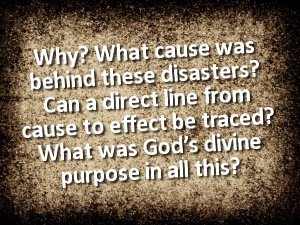
The prominence of such tragedies in recent news raises a serious question: Why? What cause was behind these disasters? Can a direct line from cause to effect be traced? What was God’s divine purpose in all this?
The first and natural (and usually wrong) impulse is to say, “It must have been deserved. Something these people did brought this on themselves.” That was the theory of Job’s friends in trying to reason through the cause of his multiplied calamities. That was the speculation of Jesus’ disciples, too, when they saw the man born blind in John 9. Surely his parents or he himself committed some specific sin (which in the case of the man himself assumes divine foreknowledge of a future heinous sin and a preemptive strike, of sorts, by God).
Read Part 1, Part 2, Part 3, Part 4, Part 5, Part 6, Part 7, and Part 8.
H. Richard Niebuhr has provided the paradigm for discussions of Christianity and culture. In his seminal volume, Christ and Culture, he articulated five “ideal types” that are now widely employed in this conversation: Christ against culture, the Christ of culture, Christ above culture, Christ and culture in paradox, and Christ the transformer of culture.
Critiquing these categories has become a cottage industry in the theological village. It seems that one way of gaining one’s theological spurs is to offer a new evaluation of Niebuhr. Naturally, the explanations and criticisms have varied in their usefulness.
One of the most frequently heard is that Niebuhr’s categories do not fit real-life individuals, and that several of Niebuhr’s examples seem strained. This criticism would be more telling if Niebuhr had meant to provide a taxonomy rather than a typology. Since ideal types are supposed to represent logical possibilities, however, it is not surprising that few “pure” examples of any type can be found.
A more responsible criticism is that Niebuhr’s typology is incomplete. One recent evaluation of Niebuhr’s work, a volume by Craig Carter (Rethinking Christ and Culture, Brazos, 2007), offers a sustained argument to this effect. Carter suggests that Niebuhr’s discussion assumes “Christendom,” i.e., a cultural situation that has been created by the sustained political and social enforcement of Christian domination. Since Christendom is now disintegrating, Carter presents a series of alternative types for Christians to employ in the future. Unfortunately, Carter’s discussion is skewed by his Anabaptist assumption that non-violence and non-involvement in the state are requirements for Christians.
 Ask most people to describe materialism and you’ll hear references to big screen TVs, computers, SUVs, big houses and overpaid CEOs. A few might mention “consumerism” and “greed.” Most would agree with the idea that materialism has been a major obstacle to relieving world poverty. Some would say it’s the cause of that poverty.
But what if materialism isn’t really what most people think? We could fall prey to materialism unawares or reject good ideas we have misidentified as materialism. In seeking to help the poor, we could waste our efforts opposing what really contributes little to the poverty problem.
So what is materialism? I’ll pursue a definition by countering four popular myths.
A widespread attitude, especially among Christians, is that materialism involves attaching value and importance to material things—and that these things are not truly important.
But wouldn’t that make God the first materialist?
 Read Part 1, Part 2, Part 3, and Parts 4 & 5.
We have briefly looked at three of the four spectacular things God will do just before the rapture of the church: (1) “the Lord Himself will descend from heaven with a shout;” (2) “the voice of an archangel [Michael]” will be heard; and (3) “the trumpet of God” will sound. Then—and what an event this will be—all “the dead in Christ will rise” (1 Thess. 4:16, NKJV).
Who are these people? They are people who have believed in Christ since the church began nearly 2,000 years ago in Jerusalem on the Day of Pentecost (Acts 1-2). They include men, women and children from many people groups from around the world, speaking many hundreds of languages and representing a vast spectrum of cultures.
Everyone who has died as a little child will also be resurrected, for the Lord Jesus made special provision for them. “Take heed that you do not despise one of these little ones, for I say to you that in heaven their angels always see the face of My Father who is in heaven. Let the little children come to Me, and do not forbid them; for of such is the kingdom of heaven” (Matt. 18:10; 19:14).
This truth was revealed a thousand years earlier to King David, for when his baby boy (by Bathsheba) died, he was comforted with this assurance: “I shall go to him” (2 Sam. 12:23). David also knew that a person’s life begins at conception (cf. Ps. 51:5). Millions of people who have been killed—aborted—before birth are now in God’s heaven.
Read Part 1, Part 2, Part 3, Part 4, Part 5, Part 6, and Part 7.
No work exerts more influence upon the way that contemporary Christians discuss culture than H. Richard Niebuhr’s book, Christ and Culture. Niebuhr’s categories have become standard for professing Christians from liberalism on the Left to fundamentalism on the Right. One might well disagree with Niebuhr’s typology, but no reputable discussion of Christianity and culture can ignore it.
Niebuhr himself developed his classifications over several decades. He intended the book to provide a typology that describes logical possibilities rather than a taxonomy that classifies observable phenomena. He found the notion of a typology (or “ideal types”) in sociologist Max Weber, from whom he also borrowed his original two classifications. Weber had posited that Christianity could be classified socially as either church or sect. This distinction had been repeated by Ernst Troeltsch, who had added a third type (mysticism). Niebuhr dropped Troeltsch’s third type and renamed Weber’s original two categories. What Weber and Troeltsch had called a church, Niebuhr called a denomination. What they had called a sect, he called a church.
This distinction was important for Niebuhr in an early work, The Social Sources of Denominationalism. As Niebuhr used the term, a church is relatively small, personal, inward looking, perfectionistic, and generally drawn from the lower social classes. In contrast, a denomination is part of the accepted social order and appeals to the intellectual and ruling classes. Denominations tend to work downwards through the social order while churches criticize the social order from outside. Importantly, Niebuhr observed that affluence and influence tend to transform churches into denominations. This observation suggested that church and denomination represented the two poles of a spectrum of possible positions in the relationship between Christianity and culture.
Niebuhr expanded this distinction in The Kingdom of God in America. Dealing specifically with American Christianity, he identified revivalism with church and liberalism and its social gospel with denomination. He noticed, however, that the Puritans fit neither of these categories neatly. Their approach to culture suggested the possibility of intervening steps between denomination and church.
Discussion