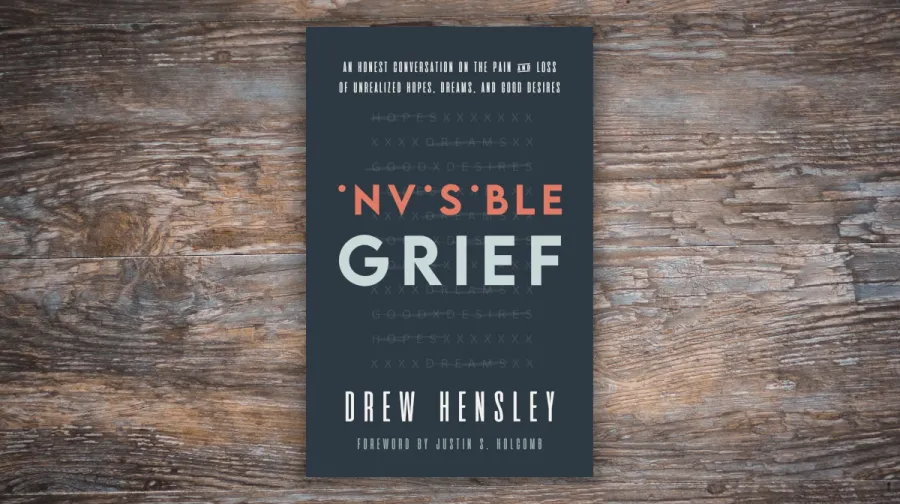
Pastor Drew Hensley and his wife Laura wanted to have children, but none came. They sought medical intervention, but nothing seemed to work. Their friends rejoiced as their families increased, but the Henleys wept as their home remained barren. In desperation, Drew turned to alcohol to numb the pain, and even contemplated suicide. He eventually reached out to a retired minister for help, and there, found comfort for his soul.
Rev. Hensley recounts this story in his new book, Invisible Grief, hoping to give aid to others who sorrow in similar adversities, whether it be involuntary infertility, unwanted singleness, or chronic illness. He understands that their pain comes from a good desire (children, marriage, or health) which has not yet been realized, and may never be. He recognizes that unlike some other forms of grief, their sorrow can last a lifetime (varying in seasons and intensity) and has no cherished memories attached to it (like a mourner of a deceased loved one) because the object of their desire never existed. Having tasted the bitter effects of wrong choices, Hensley counsels grieving readers to steer clear of destructive behaviors like deconstruction, “overeating, overspending, hyper-sexualization, pornography, [workaholism], or substance abuse” (19, 162-163). He also dismantles several lies that these mourners may face, including: 1) adversity does not happen to good Christians, 2) adversity is always a sign of punishment for personal sin, 3) time heals all wounds on earth, 4) invisible grief should be ignored because it is not supposedly as big of a deal as other griefs, and 5) God does not care about invisible grief. Hensley furthermore tells grievers not to find their primary identities in their temporal circumstances, but in their spiritual sonship in Christ. Although the grief can be long and hard, he explains that trials have blessings, such as a greater sympathy for others suffering from the same hardships and an appreciation for gifts which others take for granted. Hensley cautions mourners not to suffer in silence, as they are prone to misinterpret reality due to the fog of pain. Instead, he encourages them to find other Christians who can help bear their burdens.
The epilogue may be the best chapter in the entire book. Here, Hensley offers advice for Christians seeking to help those suffering from invisible grief. He encourages them 1) not to be quick to fix the pain, 2) not to say that they completely understand the pain if they have not experienced such themselves, and 3) not to make the pain the center of every conversation. He recommends, however, that Christians 1) minister to sufferers with their presence, 2) ask the Holy Spirit to guide them in their conversations, and 3) speak timely truths, not platitudes.
Hensley also could have added that Christians should be sensitive to invisible mourners about painful places, events, and announcements (which he experienced), not pressuring them to participate in indifferent matters (gender reveal parties, baby showers, church nurseries, Mother’s and Father’s Day celebrations, mother-daughter banquets, bridal showers, Valentine’s Day festivities, marriage conferences, formalized youth programs, athletic competitions, etc.) but exhorting them to be faithful to God’s Word.1 In accordance with his previous comments to grievers, Hensley likewise could have admonished churches to emphasize (in creed and practice) what all members have in common: union with their Lord and Savior (Gal. 3:28, Col. 3:11). Fatherhood and motherhood, while good, are not the highest callings. Conformity to Christ is. By God’s grace, such an emphasis can bring greater unity to congregations, regardless of people’s secondary callings or particular afflictions.2
Invisible Grief is not without its faults. The tone is that of informal hipster rather than a dignified pastor. The stories and sources cited are spiritually mixed, ranging from Charles Spurgeon and Matthew Henry on the sound end of things, to Hollywood movies, the Alpha Leadership Conference, Philip Yancey, and Brennan Manning on the unsound end. These things, however, are not surprising, considering that Hensley was a disciple and former pastor under Mark Driscoll at Mars Hill Church in Seattle, WA.3
The book also includes a couple of conflicting statements. As was mentioned, Hensley says that it is good for married couples to desire children, but he later absolves those who seek voluntary childlessness (96). He also denounces unbiblical means to escape trials, but he later permits binge television watching (141) and secular psychological therapy. He even appeals to the cult of victimhood to dismiss critics of the latter who, he says, largely speak “from a place of conception, not a place of lived experience” (68).
Because of these flaws, pastors and laymen must exercise great discernment concerning this book. Some may choose to eat the meat and spit out the bones. Others may choose not to read this book due to the potential damage which the errors may cause. For many, this may be a very prudent choice. But they should be careful not to ignore altogether the topic of unrealized good desires. Sadly, as Hensley notes: “The church has historically done a poor job at handling this” issue (95). When forced to confront it, people often do not know what to do or where to go since it was never (adequately) discussed within their communities. Invisible Grief tries to provide some tools which, if used wisely, may alleviate the situation.
Notes
1 “Resolution on Childlessness,” American Council of Christian Churches (October 21-23, 2025): https://accc4truth.org/2025/11/12/childlessness/. Hensley found playgrounds, baby announcements, and life milestones (birthdays, Mother’s and Father’s Days) particularly challenging (65, 66, 129).
2 Mary Van Weelden, “Motherhood Is Not a Woman’s ‘Highest Calling,’” (October 28, 2025): https://substack.com/home/post/p-177402227.
3 Hensley, along with eight other Mars Hill pastors, petitioned for Driscoll’s removal in 2014, but not for reasons pertaining to his charismaticism or cultural liberalism. Nicola Menzie, “9 Mars Hill Church Pastors ‘Lovingly’ Demand Mark Driscoll Step Down From Leadership, Quit All Ministry Work (Full Letter),” Christian Post (August 28, 2014): https://www.christianpost.com/news/9-mars-hill-church-pastors-lovingly-….