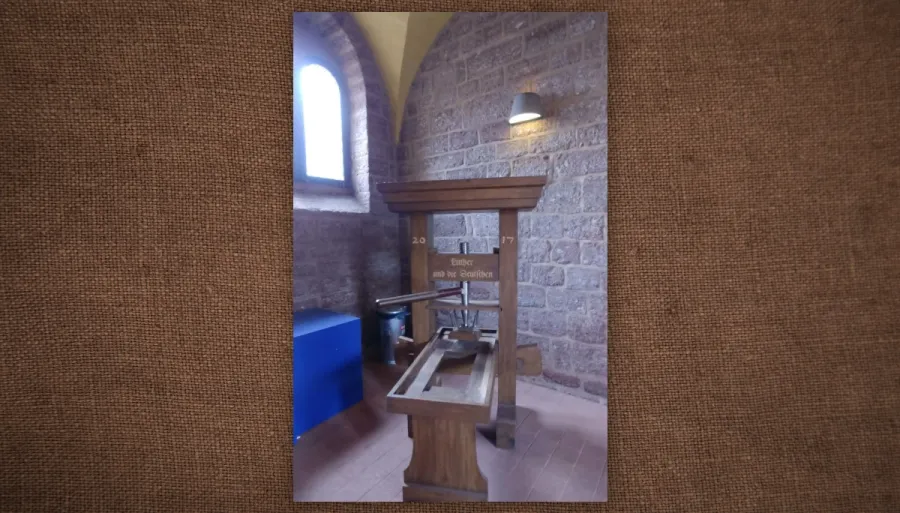
Replica of a printing press at the entrance to the Wartburg Castle, outside of Eisenach, Germany. Photo by Paul J. Scharf.
Image
Read the series.
I love studying the Reformation at this season of the year. I am invigorated by listening to lectures about it on sunny, summer walks, thinking about the coming fall, which points toward another Reformation Day.
Recently my mind was drawn back to the Wartburg Castle, and I thought of Luther spending nearly a year in hiding there from May of 1521 to March of 1522, following his victorious stand at the Diet of Worms. I wonder if, while he was enduring such a trial, he ever considered his stay to be a waste of precious time.
We know that Luther experienced health struggles during that year, and that he was frustrated enough by his circumstances to make an incognito trip to Wittenberg in December of 1521. Indeed, how incredibly discouraged he must have been on occasion! Here he was in the prime of life, at the pinnacle of his ministry, spending months hidden away in obscurity in that castle. The Reformation was less than four years in the making, and Luther had come off a banner year in 1520, which saw the publication of three of his most influential books: To the Christian Nobility of the German Nation, The Babylonian Captivity of the Church and The Freedom of a Christian Man.
That year had ended with Luther burning the papal bull, which levied 41 charges against him. He performed his act of defiance amidst a raucous celebration of students at Wittenberg’s Elster Gate on Dec. 10, 1520. This led to a second papal bull of excommunication and Luther’s courageous stand at Worms in April of 1521.
But then, for most of a year, there were no cheering crowds urging him on, no students to teach, no congregants to counsel, no lectures to present, no sermons to preach. Disguised as Junker Jörg, or Knight George, the bearded, long-haired Luther betrayed no connection to the movement he had launched, which was in the process of shaking the Catholic Church and the Holy Roman Empire to their cores.
How thankful we should all be that Luther did not pass his days at the castle in idle discomfort, or by succumbing to crippling depression. Instead, it would be an understatement to say that he kept himself occupied during his stay—or even that he used his time productively. It would be more accurate to state that his stay in the castle would forever affect the course of the western world.
Following the trip to Wittenberg in December, Luther completed his translation of the New Testament into German in just 11 weeks. By this magnificent feat, he initiated the modern era of Bible translation.
Of course, Luther wrote numerous additional books during his days in hiding. But it was his translation of the German New Testament that would have the greatest influence, to be certain.
In fact, far beyond anything that Luther could plan, his work would serve as a model for a future disciple of his. This man would seek to do for the English-speaking world what Luther had done for Germany—namely, simplify the nation’s language on a popular level and translate the New Testament into that dialect in such a way that even a plowboy could understand it.
That student, of course, was none other than one of the paramount spiritual heroes of the Western world, William Tyndale.
While this particular installment in this series does nothing to chronologically advance the narrative of all that happened 500 years ago, it does set the stage for what is to come. In future columns, I look forward to sharing more about Tyndale and the events that led up to the first publication of his New Testament in English, 500 years ago, in 1526.
In spite of all appearances during that year of waiting in the shadows, God was not finished with Luther, and Luther was not finished with the Reformation. To quote a popular line, things were not falling apart—they were merely falling into place.
If you enjoy holding a Bible that you can read, in your language, in your hands, then you must confess that Luther’s year in that mighty fortress was not wasted. Its impact could never have been comprehended at the time, and it accomplished results that will only be realized in eternity.
Therefore we do not lose heart. Even though our outward man is perishing, yet the inward man is being renewed day by day. For our light affliction, which is but for a moment, is working for us a far more exceeding and eternal weight of glory, while we do not look at the things which are seen, but at the things which are not seen. For the things which are seen are temporary, but the things which are not seen are eternal. (2 Cor. 4:16-18)
Dear friend, do you find yourself disheartened by your circumstances? Does it feel like life is slipping away? May the Lord help us to make the most of our—otherwise—wasted time.
NKJV - Source
Scripture taken from the New King James Version®. Copyright © 1982 by Thomas Nelson. Used by permission. All rights reserved.
Paul Scharf 2023 bio
Paul J. Scharf (M.A., M.Div., Faith Baptist Theological Seminary) is a church ministries representative for The Friends of Israel Gospel Ministry, based in Wisconsin and serving in the Midwest. For more information on his ministry, visit sermonaudio.com/pscharf or foi.org/scharf, or email [email protected].

Discussion
NewAnd a bit of beauty
Back when I was in college, my town was blessed with a regrettably short-lived antiquarian bookstore, and on one visit, I found two volumes from the Berlenburger Bibel--the Torah (1726) and books of history (1728). Imagine a skinny college kid (he was back then!) who knows he's one of maybe ten people in his hometown who understands the significance of those volumes being asked by a young lady "May I help you?" and responding "Yes....do you take Mastercard?".
The answer was yes, and I read from 2 Kings today from a 298 year old Bible. Thank you, Martin!
Aspiring to be a stick in the mud.
NewAwesome find!
Reminds me a bit of the parable of the pearl of great price. Berlenburger Bibel was probably not on the shopping list.
I’d definitely be reaching for the credit card, too!
Views expressed are always my own and not my employer's, my church's, my family's, my neighbors', or my pets'. The house plants have authorized me to speak for them, however, and they always agree with me.
NewAnd thinking aloud
The Torah portion celebrates 300 years this year. I'm wondering if I should have a birthday party for it....
Aspiring to be a stick in the mud.