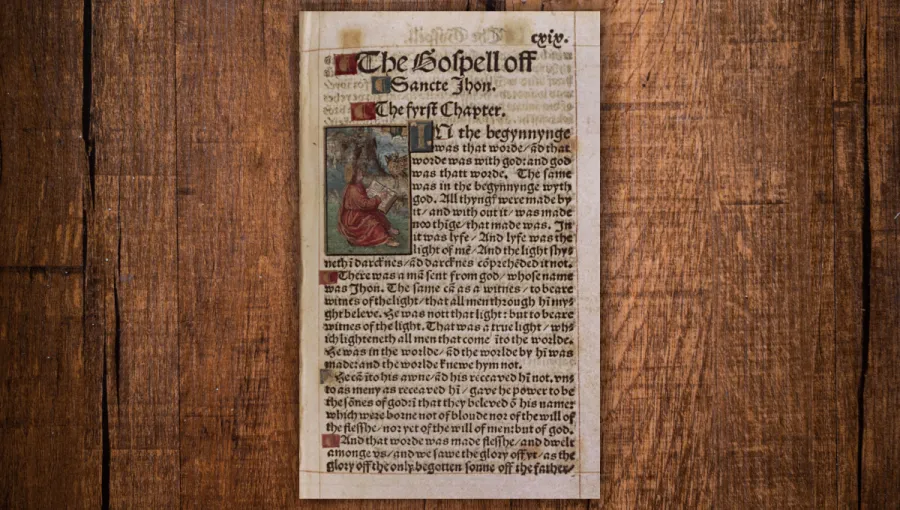
The first page of the Gospel of John: Tyndale New Testament (public domain)
Image
Read the series.
Of all the characters we meet on the pages of church history, surely one of the most beloved and intriguing is William Tyndale—the Father of the English Bible. This year marks the 500th anniversary of Tyndale’s groundbreaking translation and publication of the New Testament in English, and I believe that milestone is worthy of considerable attention.
Tyndale is esteemed as a hero almost universally in the Christian world, and with good reason. It would be very difficult to conceive that anyone who values the ability to hold an English Bible in their hands—and read it—could hold him in anything but the highest regard.
Since Tyndale spent more than a fourth of his life on the run, hiding from both church and state authorities who sought to execute him, there are many details about him that are shrouded in uncertainty. Yet the mystery that surrounds him only serves to make his character more compelling.
We will undertake a study of the details of Tyndale’s life beginning in the next installment. First, I would like to focus on three quotations that define Tyndale’s life and his very purpose on this Earth—two of which come from him, and one that was written about him.
The first likely ruined a wonderful dinner one evening at Little Sodbury Manor in Gloucestershire, the home of Sir John Walsh and his family, where Tyndale served as chaplain and tutor.1
By this time, Tyndale had become obsessed with the New Learning—the ideas of Reformation moving west from Wittenberg, Germany. He had established himself as a regular at the clandestine meetings of Little Germany, which were held at the White Horse Inn in Cambridge.
One evening as a dignitary of the Roman Catholic Church visited Little Sodbury Manor, the subject of Holy Scripture came to the fore.
That is when their guest made one of the most foolish and bombastic claims in all of history: “We were better without God’s law than the pope’s.”2
It was then that Tyndale delivered his famous rejoinder, the force of which still echoes down to us today:
I defy the Pope and all his laws. If God spare my life, ere many years pass, I will cause a boy that driveth the plow shall know more of the Scripture than thou dost.3
Fast forward several years to Oct. 6, 1536, to a barren scene outside of Brussels, Belgium, at the Castle of Vilvoorde, where Tyndale spent the final 18 months of his life imprisoned. This would be the place from which he would depart to glory—but not before he had uttered words far more powerful than the flames that exhausted his physical life.
He stated simply: “Lord! Open the King of England’s eyes.”4
We shall examine the significance of that perceptive statement in a future article.
But, finally, I would like to consider one last quotation—this one being about Tyndale, and coming from historian John Foxe’s momentous volume. He wrote this of Tyndale:
William Tyndale, the faithful minister and constant martyr of Christ, was born about the borders of Wales, and brought up from a child in the university of Oxford, where he grew up, and increased in the knowledge of tongues and other liberal arts, but more especially in the knowledge of the Scriptures, to which his mind was singularly addicted.5
Tyndale, lived and died—and surrendered his life—for the cause of translating the Bible into the English language. As Martin Luther had done for Germany, Tyndale also virtually created a unified language for his country in the process.
Though he never tasted the fruit of his labors in this life, he is owed a debt of gratitude that can only be repaid in glory.
But in addition to the legacy of his translation, there is also the weight of his example.
May the Lord help us to be enthralled by his testimony, and may we always be “singularly addicted,” as Tyndale was, to “every word that proceeds from the mouth of God” (Matt. 4:4).
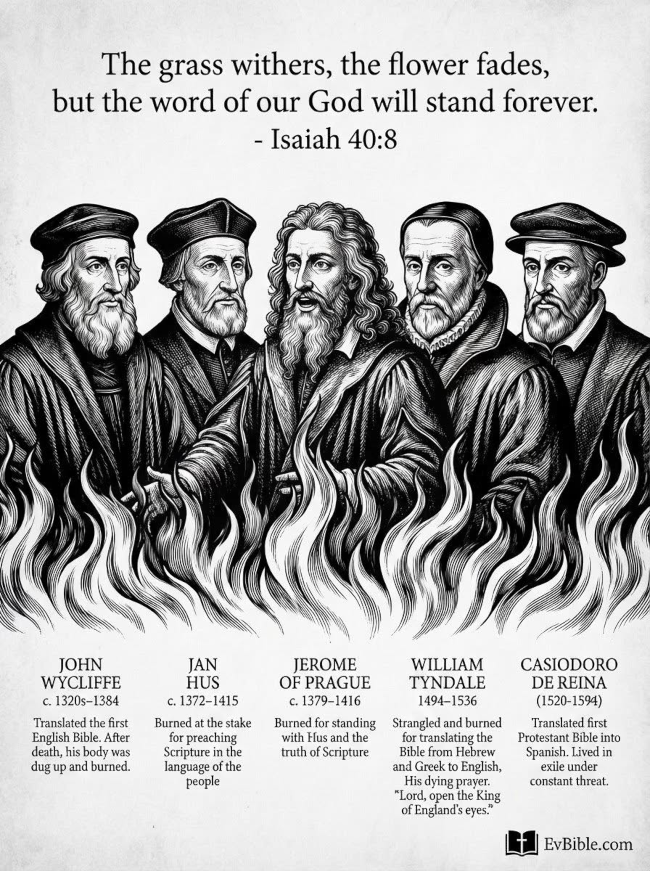
Image: EvangelicalBible.com
Notes
1 Lillback seems to place this event in 1522. Peter Lillback; “William Tyndale: The 500th Anniversary of His First English Translation of the New Testament.” Vol. 6, Issue 1, Our Common Confession; Westminster Theological Seminary; n.d.; https://wm.wts.edu/magazine-articles/william-tyndale-the-500th-annivers…; Internet; accessed 6 August 2026.
2 Peter J. Gurry; “The Life and Legacy of William Tyndale.” Text & Canon Institute; 3 May 2022; https://textandcanon.org/the-life-and-legacy-of-william-tyndale/; Internet; accessed 6 August 2026.
3 The first line of the quote is drawn from Gurry, “The Life and Legacy of William Tyndale.” The remainder is quoted from Tony Lane; “A Man for All People: Introducing William Tyndale.” Christian History Institute; n.d.; https://christianhistoryinstitute.org/magazine/article/a-man-for-all-pe…; Internet; accessed 16 June 2026. While Lane provides no attribution for his rendering of Tyndale’s life-defining quotation, I found that other credible sources have also relied on his version of it. It is believed that a form of the statement first appeared in John Foxe’s Book of Acts and Monuments of the Christian Church, published in English by John Day in London in 1563.
4 Gurry, “The Life and Legacy of William Tyndale.”
5 John Foxe, The Acts and Monuments (1563). Family edition ed. M. Hobart Seymour (1855). Formatted, corrected, modernized with American spelling by William H. Gross, 23 April 2012. Last updated 16 February 2026. https://www.onthewing.org/user/Foxe%20-%20Acts%20and%20Monuments%20-%20…; Internet; accessed 6 August 2026, p. 1,200.
NKJV - Source
Scripture taken from the New King James Version®. Copyright © 1982 by Thomas Nelson. Used by permission. All rights reserved.
Paul Scharf 2023 bio
Paul J. Scharf (M.A., M.Div., Faith Baptist Theological Seminary) is a church ministries representative for The Friends of Israel Gospel Ministry, based in Wisconsin and serving in the Midwest. For more information on his ministry, visit sermonaudio.com/pscharf or foi.org/scharf, or email [email protected].