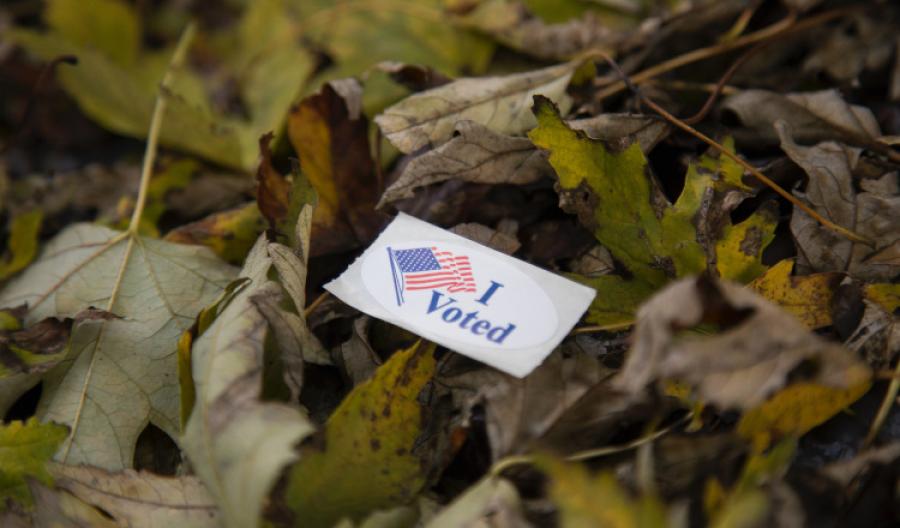
On the whole, I’ve written a lot less about the voting choices before us in this particular election cycle. From my point of view, it’s pretty much 2020 all over again, only with more clarity about the cultural and character factors.
More clarity? I’m sure many don’t see it that way. I’m not saying people are seeing more clearly. Subjectively, things seem more muddled than ever. Objectively, though, the character and positions of the candidates are even more clear than in 2020.
In this post, I’m reacting a bit to Kevin Schaal’s post over at P&D the other day, and many others like it (e.g., Jerry Newcombe’s similar list over at Christian Post). I don’t disagree with much in that post, but I would differ in emphasis.
First, I fully agree with this:
Some Christians do not live or vote by biblical values. And some Christians have not been taught how their faith should impact their voting choices.
Then we read, “These are the values that are at stake in this election.” The list that follows isn’t bad. I’m all for freedom of conscience, freedom of speech, sanctity of life, individual stewardship, biblical marriage, and just balances.
My own full list of values to vote for would include those things. There are some values at stake in this election, though, that are upstream of several of the above.
My own short, prioritized list of values to vote for would look more like this:
1. Vote for the gospel.
I’m not in favor of expansive and ambiguous uses of the term “the gospel.” The gospel is the good news that Jesus died for sinners and rose again. But this news has far-reaching implications. What do I mean by “vote for the gospel” here? Vote with the goal of helping churches and ministries retain or regain their understanding of what their focus should be in society: effectively adorning (Titus 2:10) and proclaiming the gospel.
The conflation of political tactics, policies, and candidates with Christian belief, practice, and mission is a serious problem.
I anticipate an objection: “We can’t vote for gospel clarity. It’s not on the candidates’ agendas.” I’m not sure it isn’t, indirectly, but let’s say that’s true. My recommendation, across the political spectrum, is to look at candidates’ stated agendas, remove everything they are not actually capable of achieving (because Congress would have to do it, or an amendment would be required, and every state would have to do it). Then look at what’s left and ask, “How much of this is just pandering?”
After that couple of filters, there might not be much agenda left!
Assuming something remains, it’s time to ask: If results are so important, what are some likely unintended results of the candidates’ agenda? What kind of backlash policies—or, more importantly, cultural shifts—might we see?
We really didn’t think overturning Roe would result in “abortion rights” becoming an issue that is not only actively supported by one party, but now passively supported by the other as well. But here we are.
Voting for results is a tricky thing, none of us being prophets.
But if we’re going to vote for results, surely increased clarity about what Christianity really is, and is not, should be a result we prioritize.
2. Vote for rule of law.
We live in a system of governance that, by design of its founders, has law at its center. When the colonies decided to part from the authority of England, they created a document with representative leaders as signers.
Later, they experimented with the Articles of Confederation and insisted on a ratification process. Why? Because of the conviction that the best way to govern a society is for the governed to create law that then has authority over those who made it.
Eventually, the Constitution was ratified in place of the Articles. Every office and branch of the U.S. government now derives its authority from that legal document. Lesser roles and requirements derive from the laws passed through the representative-legislators legal framework this Constitution authorizes.
In short, in a republic, the law is king, and all other rulers are its deputies.
If we’re going to vote for results, we should vote for candidates who seem likely to respect and nurture the rule of law.
3. Vote for truth in public discourse.
In the U.S., we have a long tradition of messy public discourse. For as long as I’ve been paying attention, that has included a fair amount of misrepresentation, exaggeration, and outright lying about political opponents.
And that’s not even including the candidates’ claims about themselves.
I’ve occasionally been accused of idealism, but I don’t expect “honesty in political rhetoric” to become a real thing.
That said, before 2021, did the U.S. ever have a sitting president try to hang on to power on the fantasy that the election had been stolen from him? I may have read that something similar has happened before in U.S. history, but at best, it’s been a very long time.
For Christians, does anything matter more than truth? We could make a case that several things are equally important. Of course, we’d insist that the God of all truth is more important than truth itself. It ultimately has little importance without its connection to Him.
That established, Christians, of all people, ought to treasure truth anywhere and everywhere it can be found. We ought to despise lies, useful or otherwise. We should loathe the kind of exaggeration, distortion, and sloppiness that ends up being little better than outright lying. We should be repulsed by the intellectual laziness that lumps dissimilar things together, overgeneralizes, and prefers increased vehemence over increased accuracy. That doesn’t promote truth either.
Surely we ought to be people who value truth more than tribe and who refuse to reflexively accept or reject claims based on what leader, pundit, or group they are coming from.
If we’re going to vote for results, we should prioritize whatever votes might help us, as a society, value truth more.
Final thoughts
I’d be first the admit that this short list of core values to vote for could be used to argue for whatever candidate one “likes.” That doesn’t make it objectively true that they are an equally good, or equally poor, fit for both candidates (or all the rest, down-ballot).
No, I’m not trying to tell people who to vote for (or “vote against,” if they look at it that way). But I do want to encourage us to have the gospel, the rule of law, and truth on our minds as we make these difficult choices. I want to encourage us also think in terms of our culture as a whole, not just the slice that is regulated by policy.
Important policy is at stake. Bigger things than policy are also at stake.

Discussion
NewIt is interesting to see how…
It is interesting to see how many the church views the importance of abortion in this election cycle. No doubt abortion is wrong. For years, the church drove the case home that we needed to vote in the right candidate in order to overturn Roe v. Wade. That has happened. Abortions are up, not nearly as bad as in the 1990's, but up over the past few years. States are codifying it into their constitutions. The Republican party has shifted its stance to be more open to the possibility of abortion, and is definitely at a stance that it should be up to the state to decide. Really at the Federal level it doesn't appear much can happen one way or the other regardless of which party is in power. The Republican party no longer supports a federal ban, and it is doubtful the Democratic party could pull off an abortion ban at the federal level, especially with the filibuster rules in place.
Abortion continues to be, from many Christian pulpits, the one defining aspect of which person to choose as President. Even to the point that it isn't where one stands, but which is the least worse for abortion, as Kevin pointed out.
Trump supports traditional marriage as a political platform, but does not attend church, and does not practice it in his personal life, having been married 3 times, and been convicted of sexual assualt. Kamala Harris supports traditional marriage, but advocates for other forms of marriage as a political platform. She is a baptist and been married once.
You have one candidate that has a platform that appears to support some of the initiatives of Christians, but could care less about living those practices and flaunts it. And you have another candidate that seems to live a life more alinged to the initiatives of the church, but has a platform that allows practices quite contrary to the church.
I don't have anything to say on who to vote for, just a really interesting state to be in.
NewWe lose
Regardless of who wins the election today, we lose.
NewI agree. We will have lost…
I agree. We will have lost something today, for sure.
NewI've read the end of the…
I've read the end of the book and we win. Regardless of who wins this election Jesus wins in the end. Let us never forget that.
I met a stranger last week and I wanted to talk about Christ and he wanted to talk about the election. He was convinced it was all over if Harris won. I told him my job was the same regardless of who won. Even if our country were taken over by communists, I would still have the same job- to serve the Lord Jesus Christ. As long as I serve Jesus, I will always be on the winning team.
Just as a side note, I met that stranger through another man I had just met. That other man wanted to talk about Christ more than the election and I never did hear who he planned to vote for. We did however have wonderful fellowship talking about Christ.
NewOn the bright side...
I don’t disagree, but…
Maybe it’s just the attitude of the town I live in, but here, no matter how disappointed I am with who is on the ballot, it always feels like it was a huge privilege to get to vote. It feels like voting itself is a kind of victory.
And that’s not just sentimental optimism.
In the history of civilization, it’s a rare opportunity, and being in a place where laws and court cases have worked diligently for more than two centuries to preserve and improve the voting process is even more rare.
Yes, there are always some irregularities, some errors, some offenders. But given how human the whole thing is, it’s amazing how high integrity the process remains. And many, many people work hard to keep it that way, across a wide spectrum of political perspectives.
I’m all for scrutiny and critical thinking. Paranoia is something else. The habit of encouraging franchised people to see themselves as disenfranchised victims is one of the worst things that has happened to conservatism in the last decade.
Views expressed are always my own and not my employer's, my church's, my family's, my neighbors', or my pets'. The house plants have authorized me to speak for them, however, and they always agree with me.
NewAgreed
Yes, I agree. I've traveled to Albania for two mission trips and spoke to the missionary who grew up under communism. Hearing about the secret police, the disappearances, and visiting a museum in Tirana that displayed how the regime spied, tortured, and killed political enemies of the state made me very thankful for living in the US.
NewGospel?
Obviously I believe the Gospel, but I do not vote for it.
In my view, proper government should provide common grace, not special grace.
NewYes, I agree. I've traveled…
I personally know people who have fled communism and now live in the USA. They refuse to vote democrat because it reminds them of what they left. It is one thing to hear someone like Trump who tends to be quite bombastic throw out the accusation of communism toward his opponent. It is another thing to hear it from people who lived under it.
Still, even if communism becomes the rule in our country, my job is still the same. Serve Jesus.
NewProjection?
I was surprised to see “Vote for the gospel“ as #1 (or at all). Its place in your thinking, perhaps along with projection, might explain part of your objection to Trump.
The distinction between common grace and special grace is helpful in understanding how a person can “save” a country (or have a role in that) while not offering spiritual salvation.
Now, I’m not sure Trump can save(secular meaning) our country. I’m not sure it is salvageable.
NewTrump vs Harris
I know of no charges against Trump since his current marriage. Do you? I’m not saying he has a lifetime of innocence, but you should probably change your accusation to past tense.
Harris’s sexual history and its role in the advancement of her otherwise dubious career is ignored?
NewDan, Civil charges were past…
Dan,
Civil charges were past tense, but I would say that having your third wife (present tense) is not part of a traditional marriage model as understood from a Biblical viewpoint. There are statements that Melania has left him for brief periods of time after an alleged affair (Kara Young), or knew of alleged affairs. Are they all true or are any true? not sure.
I wasn't laying out a whole history of each candidates sins or alleged premarital sex practices. I am not saying Harris is a saint or without fault. Just that her lifestyle is more inline with a traditional marriage lifestyle, than Trump, even though each of them have competing platforms as the champion of traditional marriage and alternative lifestyles.
NewVote for the rule of law
Well, yes, but what do you make of it when liberal prosecutors like Alvin Bragg and Fani Willis who come up with novel interpretations of the law applied only to opposition politicians? One of the objections to Bragg's prosecution, for reference, is that even when the prosecution had rested their case, they had not actually named the secondary crime Trump is alleged to have committed to enable the longer "look-back" for the misdemeanor charges that might plausibly have been filed....five or six years ago.
But a judge signed off on it, just like the administrative modifications of election law used in 2020. Is that good enough? If so, why did Christians raise a ruckus about Roe v. Wade?
Somehow, I'm reminded of Solzhenitsyn's 1979 Harvard address, where he noted that there must be a rule of law, but that was not sufficient for a functioning society.
Aspiring to be a stick in the mud.
NewBert, What does that have to…
Bert,
What does that have to do with the national election? Alvin Bragg is elected by citizens of Manhattan. I don't think any of us are residents of Manhattan and therefore have no ability to voice that through a vote today. Maybe someone lives in Fulton County on this board, but I don't think that Fanni Willis was up for election today in Fulton County.
NewRule of law
Look up "Matthew Colangelo", who left a senior DOJ post to work for Alvin Bragg. It's a serious downgrade in job title and status that really ought to be explained by....well...he's expecting a payoff, most likely coordinated from the White House and the DNC.
Long and short of it; when novel interpretations of the law are being levied against opposition politicians, injustice is being served.
Aspiring to be a stick in the mud.
NewLose ?
From a spiritual standpoint, as someone said, no. But I think we all know that T knows that in the end, Jesus wins.
A pastor friend of mine texted me this morning: “God is sooooo good!” Yes, He is, but the goodness of God transcends a political victory.
I think we should consider T’s statement on the basis of common grace. We are promised victory, in the end. But in the meantime there will be losses. Hus was burned, Bonhoeffer was hanged, Stalin came to power, etc. God is good, even in these losses.
In that temporal sense, was yesterday a win or a loss? Will this outcome increase or decrease common grace?
NewObviously I believe the…
I explained what I meant by that. Suggest reread. It is not about what government should provide. It’s about what we empower politics to do to Christian witness.
But is there any area of life that should not be gospel centered for the Christian? If not “gospel centered,” at least “gospel-sensitive”?
I’ve never been for trying to compartmentalize the Christian life as though there could be pieces that are secular. I was against that when I was a school teacher, against it when I was an office worker, against it when I was a pastor, and I’m still against it as an office worker again.
One of the things that has been so weird about the new-right populism is how it conflates religion and politics for unbelievers but over-separates faith and politics for evangelicals. It’s an interesting paradox. Under Trump’s influence, we have lots more God-talk by likely unregenerate people, and a decline in Christian ethics and gospel clarity by evangelicals.
Well said! Totally agree.
The answer to this is not obvious to me. Increase today, tomorrow, or next year? Common grace is really what God does, not what humans do, but the distinction may not be important in this context—because the good that humans do is a result of common grace. Will humans do more good because Trump won? There will almost certainly be cultural and political moderation on the left now. So that’s a good. But will there be trade-offs, absolutely.
The culture and the politics will almost certainly swing back the other way with gusto in 2028, for one thing.
But on the bright side, movements that rely heavily on grievance narratives and anti-elitism generally lose their steam after they gain power. (If you’re in the habit of blaming “The Man,” who do you blame after you successfully put your man in power?) So, maybe today is the beginning of the end of the Trump movement and new right. Time will tell.
Views expressed are always my own and not my employer's, my church's, my family's, my neighbors', or my pets'. The house plants have authorized me to speak for them, however, and they always agree with me.
NewIt looks like Christians did…
It looks like Christians did vote their values to an extent. The party that had ads promoting pornography, masturbation, abortion, drug use, and transgenderism, did not have a good night.
NewIt looks like Christians did…
And the party whose candidate was on stage five nights ago simulating masturbation and oral sex is now the president-elect. Not sure that electing this man speaks too highly of Christian values.
NewPrior to last night it was…
Prior to last night it was all about election fraud, stolen votes, illegal practices, lawsuits and teams ready to file lawsuits. This morning it was about fair elections. Was the election really fradulent as we were being told, or was it a cover? I would assume if it was fradulent we would still see a flurry of legal action and accusations this morning, because we want to be fair. And fair is fair. We shouldn't disenfranchise voters, regardless of who won.
Oh it will be a load of laughs over the next four years. Trump, Musk and RFK Jr. running things. I am buckling in for this ride.
NewBuckle up!
>>I am buckling in for this ride.<<
I would have buckled up either way. The difference would be whether I’m buckling up for something that could end up being disastrous (like a car race) or probably will (like a demolition derby). Personally, I like my chances better with the former.
Dave Barnhart
NewMy concern is that it will…
My concern is that it will be a bit of a demolition derby. They both had issues. It will be interesting to see him deport 10 Million people.
NewReread “vote gospel”
Ok. I reread. Not sure why that section was titled “vote for the Gospel.”
Do you mean, “Freedom of Speech and Religion”?
NewEl
A LOT of work was done to seek fair elections this time. I think we did better than last time.
Here’s a list of states that required No ID for voting:
Washington, Oregon, California, Nevada, New Mexico, Minnesota, Illinois, Pennsylvania, New York, Maryland, New Jersey, Massachusetts, Vermont, Maine.
It will be interesting to see how that list matches with the final states-won list.
NewBig Picture
The big picture won over the small picture. Trump as a person falls far short of being an ideal president. But so does Harris. Only one of these two could win. However, the principles and practices of each party are poles apart. God mercifully gave us the party that will slow down transgender males in women's sports (and locker rooms), progressive judges and DA's, unregulated abortions, cancel culture, pro-Hamas and other terrorist groups, high gasoline, grocery, and housing prices, etc. Big picture? It looks like a win for historic constitutionalism and traditional Americanism to me. The real need is for genuine Holy Spirit generated revival, but short of that, I'm glad to see the progressive left shorn from the levers of power.
G. N. Barkman
NewIndeed
>>A LOT of work was done to seek fair elections this time. I think we did better than last time.<<
No kidding. It’s amazing how much calmer things turn out when there are decisive results in a short time, with no lecturing about “red mirage” and similar, and no late night closings of the polls while sending observers home, or dumps of ballots >90% for one party days later. With the process as it took place last night, it is much more likely to generate no conspiracy theories (true or not) when nothing even looks like funny business.
Now, if we can just get to the place where election day becomes a federal holiday with all non-essential businesses closed so everyone can vote in person, with only people like military, first responders, and the disabled/shut-in allowed to absentee vote, where all voters are required to present ID, where voter rolls are actually allowed to be purged of non-citizens and the dead on a regular basis, we might really be able to have no drama or accusations of “insurrection” in the aftermath of the election.
I find it pretty sad when countries we might call “third world” have more secure elections than we do.
Dave Barnhart
NewOn the fairness issue
When I saw the popular vote counts--I think it's currently about 72 million to 67 million--I got curious and looked up the vote counts previously:
2008: 131 million total votes cast, enthusiasm for Obama
2012: 129 million total votes cast, Obama enthusiasm waning
2016: 137 million total votes cast, Trump/Clinton mania
2020: 154 million total votes cast
2024: ~141 million total votes cast
2020 was a clear anomaly, one that IMO is not easily explained by the joy of voting for a guy "campaigning" from his basement. Part can be explained by a huge prevalance of mail in ballots, but I have to wonder if another part of it is old fashioned, Richard Daley ballot box stuffing.
Yes, the judges signed off on the voting changes, but the numbers suggest that there's something very interesting, and very likely illegal, going on. Hard to prove, but statistically, this is very different from the ordinary trend.
Aspiring to be a stick in the mud.
NewMore on the popular vote
Just to expand a bit on what Bert just mentioned, how Joe Biden generated over 14 million more votes than elections before or after is a great mystery, especially considering the lack-luster campaign that he waged.
2012 -- D (65.9 million) R (60.9 million)
2016 -- D (65.8 million) R (62.9 million)
2020 -- D (81.3 million) R (74.2 million)
2024 -- D (67.2 million) R (72.1 million)
Stats from wikipedia
unsearchableriches.blogspot.com
NewStolen Election?
Hmmm. Perhaps Trump has some justification in refusing to concede that he lost in 2020? As the press keeps telling us, "there is no evidence of voter fraud", but there may be fraud that is impossible to prove because it was difficult if not impossible to trace. Just wondering. We know that several large minority precincts in PA kept GOP representatives from observing in 2020. They tried to do it again this year but were forced to allow entry. Why do they want to keep them out unless they plan to stuff the ballot box with fraudulent votes?
G. N. Barkman
NewStats from wikipedia
Exactly. Now throw in some additional context.
We are supposed to believe that Democrat voter turnout decreased by approximately 10-15 million, despite the foreboding "Threat to Democracy (TM)," the dastardly villain of 1/6 on the ballot.
Kamala actually also campaigned instead of hiding in her basement the entire time.
Meanwhile, "Threat" received roughly the same votes in 2024 as 2020, despite a different demographic mix.
Given those factors, one would think that her voter turnout should have remained in the ballpark, but she lost because of a precipitous drop - somewhere close to 20%.
I've remained mostly ambivalent towards the concept of large-scale voter fraud, but what we just saw is eye-opening.
I don't think quality of the candidate had anything to do with it. Biden and Harris were both terrible, albeit in different ways.
I'm curious how those who pooh-pooh the idea explain the difference. Any ideas?
NewKen S wrote: And the party…
Ken S wrote:
It saddens me that I even have to reply to something this disgusting. The context was that Trump was talking about the technical difficulties they were having with the microphones and how the microphones were also often at the wrong height. He ran his hand up and down the microphone stand to show that sometimes it was too high and sometimes it was too low and that it was annoying for him to have to lean up or down to get to the right place where the mic would pick it up. Those of us who do public speaking with a mic can understand such challenges. It takes a perverted mind to turn that into something else. Of course progressives have said for years that what Trump says is not what he means and that they have the secret code for his "dog whistles." When people claim to know another person's heart and claim that they have the right to tell you what a person meant when that is not what they said, that is injustice and even slander. We should never excuse anyone on SI promoting that sort of thing.
NewIts so interesting how y'all…
It's so interesting how y'all are so suspicious of fraud, such as ballot stuffing in communities that you know so little about socio-culturally. There was much more momentum back in 2020 to vote against Trump in cities with a history of racial tension between black communities and the police, especially with the George Floyd protests going on. I saw it in my city, as well as in Detroit. I met a black Episcopal pastor in 2020 who organized nearly 1/3 of the churches in the city limits of Detroit with voter registration. I also talked with several colleagues in cities such as Philadelphia, Chicago, and Milwaukee, and similar efforts were going on. Resorting to believing conspiracies that cannot be proven, especially by ignoring the George Floyd factor for why the numbers were so big in urban communities, is simply intellectual laziness combined with motivated reasoning.
What's the difference from 2020 to 2024? Why did Trump double the black vote in Pennsylvania and Wisconsin from 2020 to 2024? Why did Trump get nearly 25% of male black votes in the United States this time around (as well as 45% of the Hispanic Vote)? To start, The national GOP and the state GOPs around the nation woke up to the fact that they needed to develop a broader coalition of people voting Republican than only its traditional white conservative base, especially since college-educated whites from the suburbs were drifting left. Since both blacks and Hispanics happen to be more socially conservative due to their Christian faith and background, Republicans finally decided to intentionally reach into minority and multi-racial communities, which had never been done before on such a large scale. For example, Republicans came to my door 3 different times in the past 6 months. Having lived in the inner-city since 1992, this was the first time Republicans took the time to reach out into my neighborhood. In the previous 8 presidential elections, they chose to ignore my community. Also, inflation was a huge concern and unchecked immigration for the past 4 years had negatively affected working class blacks competing for trade-skill jobs. Kamala stating that she would do nothing different than Biden while the working class (including black folks) were feeling the negative affects of inflation.
Also, Obama scolding black men for possibly not voting for Kamala (insinuating that it was because she was a woman) backfired on the Democrats. It actually created more of a barrier because Obama was directly patronizing black men.
Even though Kamala is biracial and grew up middle class through middle school, she has lived a privileged elite life since 9th grade, and working-class blacks felt that she wasn't real. She had an awful record as a prosecutor in California including a time where she was largely responsible for over-criminalization and incarceration of black men, while doing everything she could to defend and protect corrupt prosecutors under her when they were witholding evidence from defense attorneys. As a result 600 drug cases were dismissed. Anyway, there wasn't much enthusiasm for Kamala in cities such as Detroit and Philly. Because of these reasons so many blacks who voted for Biden chose to stay home because they didn't like either candidate.
Trump bringing on JD Vance as his vice-president was pure genius and helped solidify newly built coalitions. Vance builds common ground with black folks better than any candidate among Republicans that I've seen in my life time (except for maybe Jack Kemp). His working class background raised by his grandma relates to working class blacks and I've seen on more than one occasion where he won over majority black audiences, especially black men.
NewDeleted double post
Deleted double post
NewJD Miller
JD, I saw the video of what he did. It was more than just running his hands up and down the mic. There were gestures with an open mouth as well. This is a man who was talking about the size of Arnold Palmer’s genitals a week earlier so it’s not like this is something beneath Trump’s character. It had nothing to do with me having a perverted mind, and I’m offended at your accusation.
EDIT: Since JD mentioned my post being slander, I went back and watch the video again. I will admit that it is possible JD is right and it was innocent. I'm not completely convinced, as I think it is totally within Trump's character to do that (re the Arnold Palmer quips). But I do admit that it just as easily might have been innocent as JD has said and I don't want to falsely accuse. I think that Trump is a master at doing or saying something outrageous and then claiming it is actually something else or is being misinterpreted. After a certain amount of that behavior you tend to lose the benefit of the doubt by observers. I wonder if members of SI would have shown the same benefit of the doubt that they show to Trump to Kamala Harris if she had done exactly the same thing.
I stand by what I said about it having nothing to do with me having a perverted mind, and it's offensive to be labeled as such. Many people have posted the video with the same assumption.
NewThe psychology is interesting
We could go on and on about the psychology of following candidates.
For instance, Trump and “misinformation.” Early on, he was mocked for suggesting that the Coronavirus came from the Wuhan lab. And he called it the China-virus. “Experts” at that time said, “No, it came from a bat in a market.”
Trump’s statements were used to paint him as a science-denier and a racist. It turned out he was right, but the belief that he’s a “racist” and “liar” persist anyway. After all, he “is” a liar.
As you said, he either does or doesn’t get the benefit of the doubt.
NewOn those 2020 numbers
Joel, the trouble with the argument of historic motivation is that the "bump" for Biden is much larger than the bump for Obama. The total number of votes cast in 2004 was about 123 million, which rose to 131 million in 2008 and then dropped to 129 million in 2012. So the increase for Biden is ~2x as big.
Statistically, that's immense, especially when I consider that the "draw" for Biden was nowhere near as big as it was for Obama, and moreover it's at a time where the (yes, court-approved) changes in voting procedures were indeed objected to on the grounds that it could lead to ballot box stuffing.
Maybe there's a more innocent explanation, but a lot of those eased voting restrictions were still in place in 2024. If mail in ballots and such greatly increased participation in 2020, the same thing should have been in place in 2024. But it wasn't.
Aspiring to be a stick in the mud.
NewOk. I reread. Not sure why…
No. I mean voting for candidates who are not actively contributing to gospel confusion.
These bits might help…
I could have said it better, I’m sure, but on the whole, I have seen lots of concern about this or that policy but Christians don’t seem to be taking seriously enough how the political environment confuses people regarding what Christian faith is really all about.
By the time we get to an actual vote, it’s a bit late to think about that, though, I admit. But most people are not actively supporting a candidate until election day, with their vote.
So what I’m trying to say on that subtopic is that there is a growing problem of conflating political agendas with Christian faith and Christian living. They are related, of course, but parties and candidates are not what our faith is about and better public policy is not really “saving” anyone.
But the Right these days is full of language that seemingly equates social/political policy with real Christianity… and Jesus is just branding. Personal faith in Christ and belief in the gospel are irrelevant in that whole mess.
About election fraud…
The media regarding 2020 have not been saying “no evidence fraud.” There is always fraud in every election, in the sense of some people trying to mess with the process, and a number who get caught. What they’ve been saying, entirely accurately, is that there is no evidence of the kind of large scale fraud that would be required to impact who won.
One project that the country really needs a non-partisan non-profit entity to take on is educating the public on how the process of collecting and securing votes actually works. There are layers and layers of protection in most states and counties, and interfering with that effectively on a large enough scale to swing a state (without eventually getting caught) would be extremely difficult in most states (probably all of them).
Trump culture…
Trump has brought a culture along with him in his rise to power. It includes placing a low value on truth, a highly selective regard for the rule of law, a lot of muddling of faith and politics, an emphasis on victimhood/grievance politics, and several other problems I could list.
I don’t know how conservativism recovers from all that, but it can’t hurt to have Christians start caring a lot more about these problems.
Views expressed are always my own and not my employer's, my church's, my family's, my neighbors', or my pets'. The house plants have authorized me to speak for them, however, and they always agree with me.
NewBut that doesn't explain the drop
To Aaron and Joel. I don't think either of you have explained the 20 million drop in total voters in 2024 compared to 2020. Joel, I thank you for explaining why many who voted for Biden in 2020 voted for Trump in 2024. That explains, in part, why Trump won, but doesn't explain the astonishing drop in vote totals. If it isn't ballot box stuffing of some sort, what actually explains it? I'd really like to know.
G. N. Barkman
NewYou are totally right. The…
You are totally right. The Deep State coordinated a concerted ballot stuffing exercise across 100,000 polling places. They executed this activity covering their tracks so well, that they eliminated any proof. In addition, they prevented anyone involved in this vast exercise to escape being caught and was able to prevent any of them from later confessing to their crime. It was a massive scale operation.
I personally believe it was carried out by the Pentaverate, a secret organization that is made up of five members, who run the world and meet triennially at a secret country mansion known as "The Meadows". It is made up of the the King, the Vatican, the Gettys, the Rothschilds, *and* Colonel Sanders.
NewOn 2024’s vote totals:
https://www.kgw.com/article/news/verify/elections-verify/unaccounted-2024-votes-20-million-18-million-fact-check/536-4a6cb71e-fb8d-4616-a848-f22c53ccf3b2
Be sure to read the final paragraph.
NewThanks, Larry!
Thanks, Larry!
NewLarry, good post. Why is it…
Larry, good post. Why is it some people view the discrepancy and automatically go to ballot stuffing, instead of understanding the data first and coming to a logical conclusion? This goes back to what I posted on another thread. There is a framework in an individuals mind and when they see something that aligns to that framework (i.e. there was rampant election fraud in 2020), than that is what they chalk it up to.
NewMuch appreciated
Thank you, Larry. That answers my question. (I'm thankful to know that there really is no mystery.) (Oh, and dgszweda, pardon me, but your sarcasm is showing.)
G. N. Barkman
New"Missing" votes
That article certainly helps explain the votes that were supposedly missing. However, I still want to point out that the fact it takes the U.S.A. so long to count votes after an election points to real problems in the system that need to be fixed. There’s no reason we shouldn’t know the results by the next day. The process of voting and counting needs some real work.
Looks like most of the votes to be counted are from California. If it took Google or Amazon that long to evaluate statistics for their businesses, they’d be behind the curve and laughed out of the room. Of course, votes are more important than that, so we can’t just leave out the votes beyond the lines of statistical importance, but even so, the states that aren’t getting this done need to look to other states that had their counts done quickly.
I’m sure part of it is lax laws that allow votes to arrive without verification or up to a week or so late, but those things shouldn’t be allowed anyway.
Dave Barnhart
NewWhat caused the Drop in the…
What caused the Drop in the Democratic party from 2020 to 2024? Besides what Larry Nelson has said, I have also explained why the needle moved towards Trump in black communities and why there was a significant drop in enthusiasm among Harris supporters, which led to them staying home from voting (just like with Hillary Clinton in 2016).
But let's also look at Dearborn, MI. In 2020, 30,718 votes were cast for Biden, while 13,239 were cast for Trump, with a total of 44,997 votes. In 2024, Harris got 7,813 votes, Trump got 13,209 votes, while the rest went to 3rd party candidates, including Stein (who advocated cutting all support to Israel), for a total of 28,226. Because of Gaza, a large number of Arab-Americans stayed home or voted 3rd party. American support of what they believed was a genocide drained any momentum for Harris in Dearborn but also for many far-left Generation Z and millennials who get their news from TikTok. I personally know several far-left progressives who sat this election out because it was their way of virtue signaling in standing against the "Genocide" in Gaza. Why wasn't Harris able to garner any momentum on liberal college campuses across the country when she was supposed to have such a huge advantage because of her radical pro-choice stance? It was Gaza. The same radical identity politics that was used to usher in such a huge vote in 2020 for Biden because of the George Floyd protests came back to haunt Harris and the Democratic party in 2024.
I know it's hard for you, Bert, to conceive that cities like mine cast many more votes for Biden than for Obama, but popularity isn’t the only driving force for change. Instead, what I saw in 2020 was Anger and Fear beyond anything I had ever seen in my lifetime. The voting drives in 2007 and 2008 were big but paled compared to what I saw in 2020. Registering to vote Democrat for Biden for the radical pro-mask/social distancers and many of the George Floyd protesters was the ultimate virtue signal.
NewLook it up, Joel
African-American voting rate actually went down from 2008 to 2020, from nearly 66% to about 62.4%. Like I said, they were less enthusiastic, at least nationwide, about Biden than they were about Obama, and it's worth noting that Trump took a larger share of both the African-American and Latino votes (21% of the latter) than previous Republicans in 2020.
As I'm parsing through, state by state, what I'm seeing is not really a racial or ethnic pattern, but a pattern where certain states--North Carolina, Pennsylvania, California, Arizona, Michigan--had 25-30% higher vote counts, while vote growth in other states was more in accord with population growth. It seems to correspond very well not with demographics, but rather with the ways votes were collected.
Aspiring to be a stick in the mud.
NewDave, Vote counting in the…
Dave,
Vote counting in the US is one of the fastest counting mechanisms in the developed world. Remember, most countries do not allow citizens to vote for the countries leader. At this point in time, I can't think of a developed country in which the citizens vote for the leader of their country, except for the US. Compared to places like the UK, we are exceptionally fast. We could be faster, but each county decides its own election processes and many counties have concerns with fraud and so they may be more manual than others. Remember the last election, everyone got in their head that the votes from machines were going to foreign countries, being modified and then sent back to the counties. That craziness almost amounted to everyone going back to paper ballots which would have gone back to taking days to count.
NewBert, Sorry I did not…
Bert, Sorry I did not clarify. I wasn't talking only black voters in my last paragraph. You are absolutely right that there were more black voters in 2008 than 2020. By the way, I live in an inner-city neighborhood that's become gentrified over the past 15 years with a majority of white progressive hipsters (but still multi-ethnic). These Progressives utilized their momentum of anger and fear, directed towards Trump, which personified the system which they deemed evil and racist,
NewStill unexplained.
>>I can’t think of a developed country in which the citizens vote for the leader of their country, except for the US. Compared to places like the UK, we are exceptionally fast.<<
This is still not enough of an explanation. According to the NBC election results site as of just now, here are the totals for California:
6.08 million Harris, 4.20 million Trump
Here’s Florida:
6.10 million Trump, 4.67 million Harris.
The Florida counts were 99% in the next day. California is currently at 65.7%, and even of the votes that are in, they have counted less than Florida. Of course, California has more people than Florida, but at 54 electoral votes vs 30, it’s not even double the population. So give them twice as long as Florida. However, it’s been 3 days since the election, not 2, so there’s still no good explanation for California (a supposedly highly-educated, high-tech state) to be this far behind. It’s going to be days longer before they get to 99%.
This represents either outdated processes, laziness, incompetence, or That Which Cannot Be Named. In any of those cases, reforms of the process are long overdue.
Dave Barnhart
NewDave, It is because the vast…
Dave,
It is because the vast majority of California voting is done with mail in ballots. They have to be counted in a more manual process. Signatures need to be validated. If they don't match, voters need to be contacted to make corrections. California also offers provisional ballots, which takes longer to verify. Places like Norway allow people to create their own ballot and mail it in. And yes it takes up to a week to count votes in those elections. There is no provision to mandate anything at the federal level and there is no requirement to name a winner on election night, because technical the citizen is not voting for the President. They are voting for electoral votes. It isn't until the electoral college votes that it is official and there is plenty of time for that. So there is no real provision or requirement to go fast or be like Florida or any other state. They are only required to have everything completed by January 6th.
NewLax election laws
You are correct that I left the category of lax election laws off my list, though I referred to it in an earlier post. Though I’m sure you disagree, I believe that absentee/mail balloting should not be universal but reserved for those cases that really need it. I still remember when I voted during college, I had to send in an application for a mail ballot (for the state of Maryland, no less), and I had to provide a reason that was considered good enough to qualify. Different times, but better in that respect, IMO.
It wasn’t all that long ago that both the left and right agreed that mail balloting allowed the most possibilities for fraud, and that was why its use was limited. Clearly, that’s no longer a consideration (for some).
Dave Barnhart