Confused about Catholicism, Part 3
(This series on evangelical confusion about Roman Catholicism originally appeared as one article in JMT, Fall, 2008. Read Part 1 and Part 2).

Areas of disagreement between Roman Catholics and evangelicals
(2) A different view of ultimate authority
Related somewhat to one’s understanding of church history is one’s viewpoint of ultimate authority as quotations above suggest. From the Catholic side there is the general sentiment that since Christ formed the church (a single church) it inherently carries His authority. Perhaps the general Catholic thought is summed up with these words: “They [Protestants] are not clear-headed enough to perceive that a proper notion of the Church is a necessary stage before we argue from the authority of Christ to any other theological doctrine whatever.”1 Adding some intensity, the same writer goes on to claim that “the Protestant had no conceivable right to base any arguments on the inspiration of the Bible, for the inspiration of the Bible was a doctrine which had been believed, before the Reformation, on the mere authority of the Church; it rested on exactly the same basis as the doctrine of Transubstantiation.”2 Karl Rahner, the famous Catholic theologian, says the same truth in a different way. He speaks of the two aspects of the faith of a Christian. Those two aspects are faith in Christ and faith in the church, not faith in God’s Word:
It makes no difference…whether he believes in the Church first and then in the rest of matters proposed for his belief because these come from the Church, or whether he first attains to belief in Christ and his word, and goes on from there to belief in the Church as founded by Christ…On the basis of faith in Christ the believer includes the Church too in his faith in such a way that it immediately becomes the direct medium and rule of faith as such.3
Discussion
Many Denominations: The Positive Side

“If the Bible is true, why are there so many denominations?” What Christian has not fielded this question? Yet there is an unspoken assumption behind this objection, namely, that having one denomination is somehow a good thing. I suggest that the opposite is true. Bigger is not always better.
“But didn’t the Head of the Church, Jesus Christ, teach that there should be just one denomination? Wouldn’t the church be more effective if we had one central voice?”
When the churches were one
Before we explore these valid concerns, let me prime your mind by asking a few questions of my own. When most of Christendom was part of one denomination, how ideal were things? Before 1054 AD (when the Eastern Orthodox Church split from the old Western Catholic Church), the overwhelming majority of Christendom considered itself Catholic and somewhat loyal to Rome. Both forms of Christianity had wandered far from the simplicity of Scripture centuries before the split. Were Christian laymen mighty in the Scriptures? Was the gospel of salvation by grace through faith spreading throughout the world?
Discussion
Global Day of Prayer Celebrates 10th Anniversary
Body
Discussion
ACCC Report on the World Council of Churches
Reprinted from the American Council of Christian Churches Special Report, Fall 2009. It appears here unedited.
Central Committee Meeting of the World Council of Churches
August 26 – September 2, 2009 • Ecumenical Center, Geneva, Switzerland
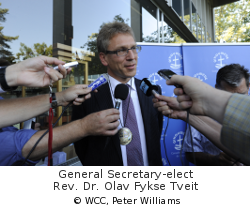
The process to elect a new General Secretary for the World Council of Churches (WCC) was marked by mystique, intrigue, secrecy, and guarded doors, with cell phones and iPods checked prior to an entrance into the William A. Visser’t Hooft Plenary Hall. Only the 140 members of the Central Committee were permitted inside.
Earlier the Search Committee shared with the media that the two candidates being presented were the Rev. Dr. Park Seong-won, a Presbyterian from Korea, and the Rev. Dr. Olav Fykse Tveit of the Church of Norway.
Several hours passed, and we later learned the method used in the restricted room. The first item on the agenda was for the Search Committee to give their report. This was followed by a speech from each of the two candidates. The actual voting was next. While the election was taking place, out in the lobby tables were being decorated, bottles of wine were chilled, and glasses made ready for the celebration toasts to begin. As soon as the doors were opened, the news spread rapidly that 48-year-old Dr. Tviet of Norway was chosen as the 7th General Secretary. One report indicated he had been selected by a majority vote of 80 to 60. At his first press conference, Tviet outlined his vision and goals. He began by pointing to a display on the wall near him and referring to the words that were there. They were from John 17:21, “…that they all may be one.” He stressed there had been a spirit of unity that dominated the election process and hoped it would continue.
Discussion
Pope May Make State Visit To UK
Body
Discussion
Russian Orthodox & Catholics Together?
Body
(Related- Russian Orthodox Church Elects Modernizer)
Discussion
Uncertain Future for "Evangelicals & Catholics Together"
Body
Related: …Colson Leading Southern Baptists Home to Rome
Discussion