The trouble that afternoon started with the hurt pride of two neighborhood middle school boys who had snuck into Coit Elementary School—back in an era before modern security precautions locked down a building. They had been around before as elementary students, but now they had moved on to middle school and had also joined the Clancy Boyz (associated with the Vice Lords).* They often hung out outside the gym doors of our after-school program, attempting to recruit more younger kids from the neighborhood. When they refused to leave the building, Harold, the school’s head custodian and a former Golden Gloves boxer, took matters into his own hands. He physically dragged them out and dropped them onto the pavement.
The head custodian’s humiliation sent the boys running, but they weren’t about to let it go. Within twenty minutes, they returned with reinforcements with seven older teen guys from the Clancy Boyz. Some of them were low-level drug dealers, armed not with guns or knives, but with improvised neighborhood weapons: socks weighted down with pool balls, claw hammers, and discarded lengths of lumber.
We all found out what was happening when one of my older students burst through the gymnasium doors, shouting that a gang fight was going on in the schoolyard. Fifteen or so of our after-school program students bolted outside to see what was happening, and I ran right behind them.
The schoolyard scene was chaos. Harold stood his ground, with his fists in a boxing stance. But he was badly bloodied, with deep cuts above his eyes where a piece of lumber had connected squarely with his head. By the time my wife Sherilyn, who had instantly called the police and ran out to join us, I had thrown myself physically into the circle, standing right between Harold and a ring of furious teenage boys. The oldest of them was attempting to lunge around me so he could strike Harold again with a broken piece of lumber.
“The police are on their way,” we shouted.
With the threat of the police coming, the circle abruptly broke away. They all scattered as fast as they had gathered, dissolving back into the neighborhood streets.
A Life Lived on the Edge
Encounters like that, and the ongoing, grueling work of helping rid our block of open-air drug dealing, formed the foundation of Urban Transformation Ministries in our early years of our ministry in the mid 1990’s (although we were technically under the auspices of Servant Center back then). While those years involved many crisis interventions, breaking up fights, and preventing immediate violence, they were also about what came next. As we formed friendships with neighborhood children as well as teen gang members and drug dealers, our mission was to disciple them into adulthood, anchor them in Christ, and offer real, tangible alternatives to street life through the church and as they became older: creating social capital linking them to business enterprise. We fought spiritual battles to redeem the very streets that tried to tear themselves apart.
The unpredictability of those years prompted a strange sort of practicality. We were living day to day, not knowing what the future held for us. After we bought our house on Livingston Avenue, there were terrifying nights—such as when Sherilyn was pregnant with Tiera our oldest—when we hit the floorboards because the gunfire sounded far too close. Or the multiple times we called the police after witnessing several assaults and batteries take place in the wee hours of the morning right across the street from us. When a door-to-door salesman came knocking offering a “buy-one, get-one-free” deal on cemetery plots during that chaotic season, Sherilyn insisted that we buy them. Because we lived day to day with such raw uncertainty of life in our inner-city ministry, we never truly knew how long we’d be around on this earth. Several years later, our extended family even bought several plots near ours, including a few extras.
Because of the risk-taking inherent to building relationships with neighborhood youth during those early years of the drug wars, I always assumed I would be the first one in our family to pass into the next life with Jesus. At times, I unhealthily lived on the edge of adrenaline, pushing through the daily chaos. It culminated ten years later at the tail end of the drug wars in 2005, when a young drug dealer pointed his laser-scoped gun at my forehead on a neighborhood street corner. It was I who was more prone to impulsive risk-taking and danger. That relentless exposure to trauma eventually left me in a fragile mental state, leading to a diagnosis of Post-Traumatic Stress Disorder from a professional counselor I began seeing shortly after my first mental breakdown.
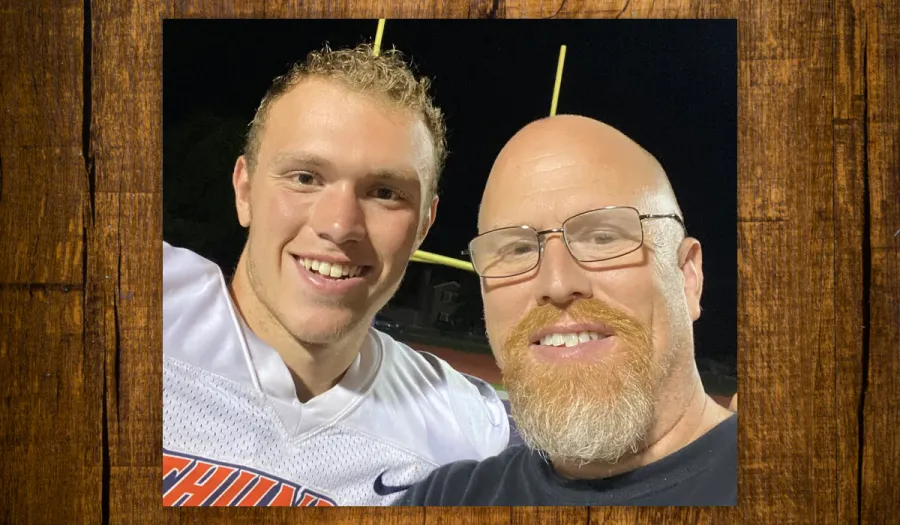
In his short, twenty-six years of life, Jalen always calculated his risks with remarkable maturity. For instance, we could see it clearly in all the years he played organized football. Playing positions where both boys and young men are most likely to receive severe concussions through punishing tackling, Jalen averaged over twenty carries a game as a running back in high school. Later, as a college linebacker for Wheaton College, he perfected precise angles combined with his closing speed that frequently allowed him to avoid the 300-pound offensive linemen assigned to block him, letting him slice through and tackle running backs cleanly. Yet Jalen was always careful on every play to keep his head up and execute “heads up football.” As a result, he never received a single concussion in his fifteen years playing tackle football.
He brought that same deep intentionality and calculated risk to every area of his life. At his employment with Bridge St. Ministries, as he mentored and discipled urban at-risk and high-potential youth, he possessed wisdom and discernment that took decades for me to obtain. He led primarily by being a listener. His intentional presence built deep relationships with his students and fellow staff, modeling the love and life of Jesus. Even in his dating life, Jalen was remarkably calculated, never pursuing anyone unless he genuinely saw a marriage future with her.
However, he made his ultimate calculated risk when another person’s life was on the line. He stepped directly into a life-or-death situation to give his life, attempting to save his football friend and teammate Phil, who was drowning in Lake Michigan, losing his life in the process.
The Unnatural Weight of Losing a Child
Yet accepting the agonizing reversal of burying your child before you die has by far been the most difficult part of our grief journey. Thinking about those extra plots our family bought years ago, knowing that one of them is now where Jalen’s body peacefully lies, breaks my heart in two. Early on in my grief, my mind constantly traveled to King David crying out for Absalom, feeling the fullness of wishing that God had taken me instead.
Sometimes these moments of grief give way to my raw anger, and I find myself questioning God. Why Jalen? He was one of the most godly young men I’ve ever known, someone who lived out his faith and impacted everyone who knew him through his intentional presence. How could God allow him to be taken from our family, all of his family and friends? The raw pain is especially agonizing when I see the hurt my daughters carry, particularly one of his younger adult sisters with special needs, who is deeply struggling in her own pain and grief. She frequently cries out at the top of her voice for her brother to come back to her. I shudder with anger in those raw moments.
The unnatural weight of loss also rippled through into our extended family, hitting Jalen’s grandparents, shaking them as well. I watched my own parents, who have lived full, Christ-filled lives of 89 and 90 years, weep and grieve over Jalen, asking aloud through their tears why God didn’t take them first and allow Jalen to live. How could a grandfather and grandmother watch their healthy twenty-six-year-old grandson be taken while they stood at the threshold of their nineties?
My older sister Linda, in her usual wise manner, offered them insightful comfort. She gently reminded my parents that God’s plan for their lives was different than His plan for Jalen. More than that, she strengthened their hearts with a beautiful promise. Because of their age and their trust and walk with the Lord, they would likely see Jalen in Heaven long before the rest of us in the family, stepping into a joyful, eternal reunion with him.
As I listened to her words, I felt a complicated, heavy emotion settle deep within me. If I’m being entirely honest, I’m deeply jealous of my parents. Sherilyn and I have frequently talked about the distressing, open expanse stretching out before us. We don’t know how we’ll survive the next twenty or thirty years, or a full lifetime, without Jalen. It feels as though we have survived a catastrophic spinal injury, or a massive heart attack, or the sudden loss of a limb. In every one of those cases, life somehow continues. But instead of facing a grueling physical and psychological battle to return to some sort of normal living with a catastrophic medical event, we are forced into a grueling, daily rehabilitation of our emotional and spiritual life, knowing with absolute certainty that we will never, ever be the same as we were before Jalen’s passing.
Longing for Heaven, Learning to Remain
Yet, in the depths of our crushing sorrow and discouragement, we are learning that only God’s presence can sustain us each day. In the darkest hours of grief, the words of Psalm 42 (NLT) have been a lifeline, keeping us from losing all hope:
As the deer longs for streams of water, so I long for you, O God. I thirst for God, the living God. When can I go and meet with him?
And Psalm 34:18:
The Lord is close to the brokenhearted; he rescues those whose spirits are crushed.
That raw, honest thirst for God, and his promise to be near us in those moments, has proven to be our solid rock, protecting our souls when the heaviness of grief is too much to bear. More than ever, God’s presence is everything to us, and like Moses in Exodus. 33, we can’t go anywhere or do anything without Him. In the midst of rare tears that God allowed me to cry (my anxiety/depression medication often flattens my emotions) in my grief, he gave me these words as the chorus of a worship song that I’ll eventually share publicly.
If Your presence will not go with me I cannot take another step
If Your goodness is withheld from me I will have nothing left
Be my shelter in the wilderness For you bless those who wait
Without Your presence, Lord Like a bruised reed I’ll break
Without Your presence, Lord Like a bruised reed I’ll break
As bruised reeds pursuing God’s presence, Sherilyn and I have also found comfort in the immovable promises of Heaven, where Jalen now resides. We have turned to Randy Alcorn’s classic book on Heaven to steady our hearts. It’s a profound reminder that while our ultimate, eternal hope is the New Earth (when God finally brings Heaven down onto earth after the judgment, wiping away every tear and making all things right), there is also a transcendent comfort found in the intermediate state right now. We fully realize the promise that if God calls us home before He comes, we will see Jalen face-to-face in His presence. Knowing Jalen is resting in Jesus’ immediate presence brings a resolute peace to our grief. We know he is in the presence of Christ, rejoicing without hindrance, resting, and worshiping continuously. He has taken his place among the cloud of witnesses who cheer us on, and with whom we will one day be reunited.
As the Apostle Paul wrote to the Philippians, I feel the deep tension that he felt.
For to me, to live is Christ and to die is gain. If I am to go on living in the body, this will mean fruitful labor for me. Yet what shall I choose? I do not know! I am torn between the two: I desire to depart and be with Christ, which is better by far; but it is more necessary for you that I remain in the body.
More than ever, I long for the day of complete restoration, when God cleanses the earth of evil and brings Heaven down to earth. And I long to embrace Jalen again—whether in the intermediate joy of His presence should my own race finish early, or in the physical glory of the New Earth. But for now, sustained by God’s faithful presence and God’s people in the church, I realize that it is more necessary for me to remain. I am here to stay with my life partner, Sherilyn, and continue to love her through this deep pain we share, to love our family and be fully present in their pain. I am to keep living out my faith in Jesus among my church family, and love and make disciples of Jesus among my co-workers and neighbors. And I will continue to process my grief through my writing and through my music on this fractured and groaning earth until my own time comes where I am united with God in his presence in glory.
* Gangs in the Belknap-Lookout/South Creston neighborhoods of NE Grand Rapids during the 1990s didn’t last long due to their folks nation (Gangster Disciples) and people nation (Vice Lords) affiliations. They were easy targets for the Grand Rapids Police Department due to their hierarchical structures, strict territory boundaries marked by the colors they wore and gang signs and graffiti that marked their territory. Many were handed down lengthy sentences in the Michigan Department of Corrections, which decimated these Chicago-affiliated gangs. In the year 2000, a new model emerged. The younger brothers, cousins, and neighborhood kids who grew up watching the Clancy Boyz and the Lafayette Boys operate turned to a different model. Instead of trying to rebuild a fractured gang, they leveraged their lifelong childhood ties (their social capital) to form North North. They realized that overt gang flags and stationary territory made them easy targets for GRPD raids. By replacing the old gang identity with a decentralized, technology-driven business model, North North successfully dominated the North Side drug trade for the next a decade until their massive 2009 federal indictment. This coincided with a dozen of North-North’s foot soldiers giving their lives to Christ through the ministry of Urban Transformation Ministries: one of which is now an urban missionary with Navigators and a few others are lay ministers mentoring and discipling youth throughout urban Grand Rapids.

Discussion
NewThanks
Thanks for sharing this, Joel.
Everyone grieves differently, but I believe nobody should do it alone.
I’m reminded of…
I sometimes read/hear 1 Thess 4:13 misunderstood as a duty to not grieve. We do not grieve as others who have no hope, but we still grieve—only as those who do have hope.
Views expressed are always my own and not my employer's, my church's, my family's, my neighbors', or my pets'. The house plants have authorized me to speak for them, however, and they always agree with me.
NewI am very sorry for your loss
I can't begin to imagine.
Is your wife handling this as well as you?