Theology Thursday - Is Evangelical Theology Changing? (Part 1)
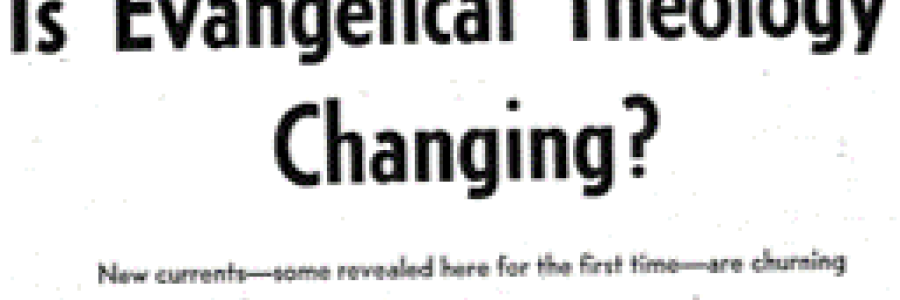
This article was published in the March 1956 issue of “Christian Life” magazine. It was seen by fundamentalists as a direct repudiation of the movement. One fundamentalist scholar wrote that the contributors were “crystallizing new evangelical discontent with fundamentalism.”1Still another observed that fundamentalists “viewed the leadership of new evangelicalism as a group of compromisers who were abandoning the fundamentals of the faith in order to be accepted by the larger theological world.”2

Here is the article:

During Billy Graham’s 1955 Scotland crusade a B.B.C. interviewer asked him to define the fundamentalist label he’d been plastered with. Billy objected, “I don’t call myself a fundamentalist,” he said. There was an aura of bigotry and narrowness associated with the term—which he certainly hoped was not true of himself.

“I’d prefer to call myself a ‘constructionist,’” Billy said, explaining he was seeking to rebuild the church.

Discussion

Review - The Church of the Fundamentalists

Amazon Affiliate Link

Larry Oats prefaces his new book, The Church of the Fundamentalists, by noting “While much has been written on the histories of the fundamentalist and evangelical movement, the theological basis of that division has frequently been overlooked. The purpose of this book is to examine how the ecclesiologies of mid-twentieth century fundamentalists and evangelicals affected their views of ecclesiastical separation and how those views led individuals to establish, abandon, or modify their views of ecclesiastical separation.” In other words, the controversies swirling around the fundamentalist issue center on the question, “What is the church supposed to be?”

The book contains four chapters with an introduction and conclusion in its 176 pages. The first chapter surveys “Varieties of Ecclesiologies,” really a survey of the “primary historical views of the nature of the church.” (25) This background is necessary in order to understand the theology driving the fundamentalist-vs.-evangelical answers to this central question.

Discussion

Biblical Fundamentalism, Part 2

From Think on These Things, Mar/Apr 2016. Essentially the same article also appears in Voice magazine. Read Part 1.

Discussion

Biblical Fundamentalism, Part 1

From Think on These Things, Mar/Apr 2016. Essentially the same article also appears in Voice magazine.

I am a Fundamentalist. There I said it. And yet, although I inherited a few guns I don’t know where the bullets are. I don’t hate anyone, not even my neighbor whose cat keeps my songbird population thinned out. Knowing my own weaknesses and sinfulness I refrain from being particularly judgmental of others. Some might call me a “Bible-thumper” but I have not actually thumped anyone with a Bible since junior high when I was trying to impress the girls (I learned many years later that punching girls did not impress them nearly as much as I originally thought).

I have some strong preferences and opinions about everything from politics to entertainment (just ask me), but I recognize that not everyone shares all my views and I am at peace with that. I believe in separation from sinful practices and compromising associations, but I do not hide out in a wilderness refuge in an effort to stay as far away from “sinners” as I can. And horror of horrors, I will tune into CNN as much as Fox News—which may cause me to lose my Fundamentalist membership card in the eyes of some.

Discussion