Read the series.
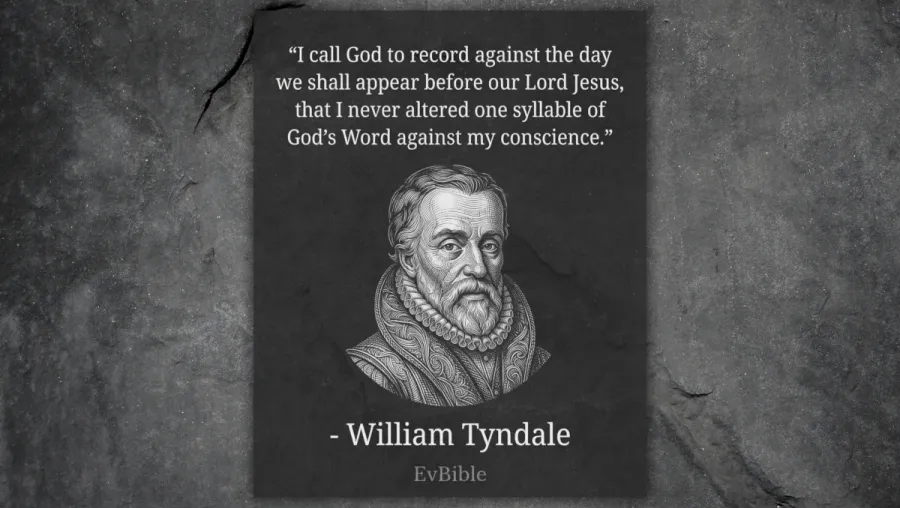
Following the model of Martin Luther and his German September New Testament of 1522, William Tyndale essentially enhanced and unified the English language in the process of translating and publishing his New Testament in 1525, 1526 and 1534. Together, Luther and Tyndale began the modern era of Bible translation—providing the Scriptures in the languages of these two major people groups.
And, as Michael Reeves states, “Tyndale’s New Testament was a gem of a translation. Accurate and beautifully written, it was a page-turner.”1 Truly the translation and transmission of God’s Holy Word was at the very heart of the Reformation.
So many words that are simply second nature to us as English Bible readers spring from Tyndale’s pen. He forever altered our spiritual and theological vocabulary. He also impacted the way that all English speakers interact on a daily basis, even if they are completely oblivious to the origin of their words.
Neil Rees writes:
Tyndale was a master of words and he coined many phrases which are part of our rich idiom today such as “it came to pass” (used frequently in Genesis), “the salt of the earth” (Matthew 5:13), “seek and ye shall find” (Matthew 7:7), and “the powers that be” (Romans 13:1). He also coined a number of theological terms which are still used today such as “atonement”, “scapegoat” and “Passover”.2
Furthermore, according to an article from Wycliffe Bible Translators:
Clarity and naturalness are indeed the outstanding hallmarks of Tyndale’s work. Yet there is so much more! This is the man who coined expressions that are still in everyday use, such as “my brother’s keeper”, “go the extra mile”, “the apple of his eye”, “filthy lucre” and “the still small voice”.3
These biblical words and phrases have simply rolled off the tongues of God’s people for centuries. We cannot imagine reading the Bible without them! But they have been given to us by way of the genius of William Tyndale. Here are some more of them:4
| Alpha and Omega blind lead the blind brokenhearted busybody cast the first stone castaway coat of many colors eat, drink, and be merry eye for eye fight the good faith fisherman full of days |
infidel Jehovah judge not no man can serve two masters mercy seat nurse pillar of salt rose-colored seventy times seven showbread signs of the times |
sin of the fathers sorcerer stiff-necked stranger in a strange land suffer fools gladly thirty pieces of silver two-edged sword undergird ungodly uproar viper |
David Daniell states succinctly, “… the list of such near-proverbial phrases is endless.”5
But Tyndale is to be credited not only for his creativity, but also for his courage. As Reeves explains:
Tyndale’s translation was highly dangerous. “Do penance” in the Vulgate was now “repent” in Tyndale’s version; “priest” was merely “senior”, “church” just “congregation”, “confess” now simply “acknowledge”, “charity” now “love”. It pulled the biblical carpet right out from under the claims of the church.6
At just the right time—for just the number of years required—God sent the English-speaking world a man named William Tyndale, and it would never be the same again. He joins the list of those in Hebrews 11 “of whom the world was not worthy” (v. 38).
Out of this life of hardship, trials, unspeakable tragedy and persecution—including imprisonment and martyrdom—came an unimaginable harvest of “fruit [that would] remain” (John 15:16).
Tyndale’s vast contribution to the history of the English Bible is typified by the words of King Solomon: “The words of the wise are like goads, and the words of scholars are like well-driven nails, given by one Shepherd” (Eccl. 12:11).
Notes
1 Michael Reeves, The Unquenchable Flame: Discovering the Heart of the Reformation (Nashville, TN: B&H Publishing, 2009), p. 123.
2 Neil Rees; “The Translation of William Tyndale.” Cambridge; 12 January 2026; https://www.cambridge.org/us/universitypress/bibles/the-translation-of-…; Internet; accessed 21 October 2026.
3 “William Tyndale: A Master Translator.” Wycliffe Bible Translators; n.d.; https://wycliffe.org.uk/blog/story/william-tyndale/; Internet; accessed 21 October 2026.
4 This list is partially drawn from “English Words/Phrases from Early Translations.” Houston Christian University; n.d.; https://hc.edu/museums/dunham-bible-museum/influence-in-history-and-cul…; Internet; accessed 21 October 2026.
5 David Daniell, William Tyndale: A Biography (New Haven, CT: Yale University Press, 1994), p. 142.
6 Reeves, p. 123.