Review of Brian Recker’s ‘Hell Bent: How the Fear of Hell Holds Christians Back from a Spirituality of Love’
Image
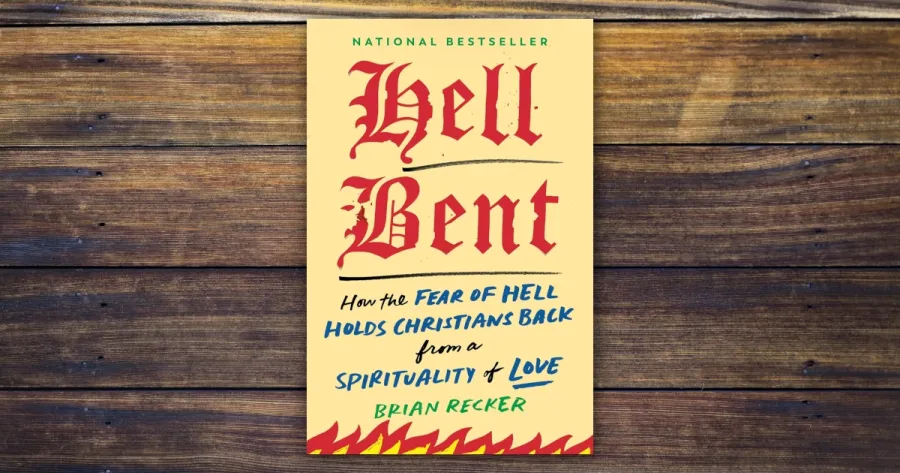
I have never read a book that I would categorize as a “Satan-breathed”; a book where the author defends the devil’s dogmas of “ye shall not surely die” and “ye shall be as gods” by using the words of Scripture. Now I have.
In Hell Bent: How the Fear of Hell Holds Christians Back from a Spirituality of Love, Bob Jones University (BJU) alumnus and former evangelical pastor Brian Recker characterizes the doctrine of Hell as “a black hole, sucking in and crushing every other priority under its weight” (13).
The book begins by recalling a phrase Chancellor Bob Jones, III often repeated in chapel while Recker was a student at BJU: “The most sobering reality in the world today is that people are dying and going to hell today.” “Dr. Bob played the hell card,” Recker asserts, “knowing exactly what feelings he would produce in us. A deep inner fear, with a thick layer of guilt” (8).
Countering Jones’ statement, Recker responds,
The most sobering reality in the world today isn’t a hell that waits for us when we die. It is the poor being neglected, the hungry going without food, the immigrants being refused at the border, and the incarcerated being ignored. It is a hell of our own making, right here and now. Jesus was not “hell bent” on saving souls for the afterlife but on bringing the wholeness and love of God into this world, on this side of eternity. (13)
Growing up in the home of a fundamental Baptist pastor, Recker remembers praying the sinner’s prayer over-and-over again. He makes light of the secret sins of his youth—specifically his cursing (35) and masturbation (36-38).
Recker claims, “The Bible never says we inherit sin … goodness is intrinsic to our nature” (39). He suggests “the doctrine of original sin was invented by Augustine of Hippo 400 years after Jesus lived” (44).
Those familiar with the totality of Scripture will readily notice Recker’s propensity to make false claims and to quote Biblical passages out of context. Some might say that growing up under old-school fundamental Baptist preachers made him adept at stringing verses together to prove a point!
He quotes Rachel Held Evans, “There are times when the most instructive question to bring to the text is not what does it say?, but what am I looking for?” (74) This accurately describes Recker’s hermeneutic. For instance, Recker postulates that if Revelation 14:11 was not in the Bible “the doctrine of hell would probably not exist” (82) and that the Apostle Paul never referenced Hell (81).
When Jesus mentions “Gehenna,” Recker alleges His motive was “to warn a corrupt establishment that if things didn’t radically change, they would find themselves in the rubble of their own dirty rotten system, a system that privileged the powerful, while excluding the poor and vulnerable” (91). He explains,
Hell is always on earth. The message of Gehenna is about the very real hells we create, and suffer in, right now, when we fail to live out God’s love and justice in the world. It’s about the hell of systemic racism and mass incarceration. The hell of endless wars and refugee crises. The hell of wealth hoarding amid desperate poverty. The hell of a planet dying while corporate powers block action on climate change. (97)
Recker views the Bible through the lens of Progressive Christianity—Social Gospel 2.0. Consider his view of salvation,
Salvation is not about choosing the right theological beliefs to avoid hell. It’s about recognizing the goodness and divinity in the despised “other” and joining in on the party God is throwing, where everybody is invited. Jesus never tells people they need to change their doctrine or convert to another religion in order to be saved from hell. Jesus doesn’t defend theology, he defends the humanity of the vulnerable and the marginal. Jesus doesn’t explain one correct statement of faith to his disciples; he meets real human needs, while calling out religious leaders for the hypocrisy of caring more about dogma than justice and mercy. (58)
“White supremacy, sexism, ableism, the patriarchy, queerphobia, climate-change denial, capitalism—these are some of the domination systems that rule the kingdoms of this world,” Recker declares. “These systems crucify people, especially people at the bottom of the hierarchy, just as these kinds of systems always have” (153). These screeds pop up throughout his book.
Echoing recent comments by Christian influencer Kirk Cameron, Recker proposes that “even the worst human being imaginable does not deserve a never-ending punishment for crimes committed in one finite life” (113).
The foundation for Recker’s Universalism lies in his views concerning the Cross and humanity. According to Recker, the doctrine of substitutionary atonement “was not fully taught until the year 1100 by a theologian named Anselm of Canterbury” (164). He alleges that “Jesus died a political death because Jesus preached a political message … [and was] killed as a political agitator fighting for a better world” (167).
Recker absolutely butchers Galatians 2:20,
When Paul says Christ lives in him, he does not mean that his identity is lost in Jesus’s identity. Christ is not Jesus’s last name; Christ means “the anointed.” Christ is the divine that inhabits material existence. Christ lives in us, because we bear the image of God; we are “partakers of the divine nature” (2 Peter 1:4). (190)
He continues,
I was told that the secret to joy was JOY: Jesus first, Others second, and Yourself last. I don’t believe that’s what dying and rising with Christ is about. We put our false selves to death so that our true selves can come to life. “Christ in you” is not a separate person from you. It is the best and truest part of yourself. (191)
Recker asserts that “broad, inclusive universalism was central to the message of Jesus” (198). In fact, “To God, no one is impure. Everyone is clean. … God accepts everyone” (206). Being born again to Recker,
is recognizing that you are already forgiven, you are already accepted, and you couldn’t be any more accepted than you already are. You are already a part of God, and God has always been a part of you. Once, you were blind to this, but now you can see it. (217)
Recker quotes poet Mary Oliver, “You do not have to be good. … You only have to let the soft animal of your body love what it loves” (223).
As I kept reading, I wondered, “Will this book ever end?” I do not typically feel that way about books that I choose to review. Recker’s manipulations of the Scriptural texts and continual rants against traditional American values grow tiresome after 100 pages or so.
Unlike most books I review, I do not recommend this book. Recker freely uses bad language. He would certainly not knowingly offend a marginalized group, but he does not extend that same courtesy to Evangelicals and Fundamentalists.
That being said, I fear the self-love, no-Hell Universalism that Recker lays out in his book is growing in popularity. For this reason, ministers of the Gospel need to familiarize themselves with the reasoning that leads their congregants and family members to grasp at Universalism’s false hope.
The saddest part of this book is found in the Acknowledgments. Recker writes, “Thank you to my brother Daniel and sister Rachel, who found their own ways out of a spirituality of hell—I hope our friendship continues to deepen on this side of deconstruction” (233).
How does a fundamental Baptist pastor lose all three of his children? That would make a worthy topic for a future SI article.
C. D. Cauthorne Bio
C. D. Cauthorne Jr. earned his BA and MA at Bob Jones University during the 1990s. He and his wife Heather serve at Calvary Baptist Church near Clintwood, Virginia, where C. D. is pastor.


It sort of sounds to me like the book is a rant about ‘things I hate about fundamentalism.’ But I wonder if he’s aware that fundamentalists did not invent the traditional doctrine of Hell. It’s not like someone dreamed it up in the 20th century. It’s easy to trace as far back as the Reformation. Prior that, if you strip away concepts like limbo and purgatory, essentially the same view is in the Roman Catholic church (though maybe limbo and purgatory are later developments anyway). Going back before RCC is fully RCC, you can probably trace it to the 4th century or earlier.
Just a hunch on that last bit.
Point is, this understanding of eternal punishment has been around for many centuries.
But judging from excerpted quotes here, Recker does not seem to value historical theology. And seems to feel free to make any claim he likes just by stating it emphatically. Or maybe cherry picking a few verses.
(Yeah, as C.D. noted, maybe he learned that from ‘evangelists’ he grew up hearing, ironically.)
Views expressed are always my own and not my employer's, my church's, my family's, my neighbors', or my pets'. The house plants have authorized me to speak for them, however, and they always agree with me.

Having read portions of the Book of Mormon and John Shelby Spong's works, I think I've got you beat on reading books that are spawned of Hell. But that said, well described, and his, um, "theology" would seem to be a warning against "prooftext theology" too common in our circles.
Aspiring to be a stick in the mud.

Recker’s manipulations of the Scriptural texts and continual rants against traditional American values grow tiresome after 100 pages or so.
Unlike most books I review, I do not recommend this book. Recker freely uses bad language. He would certainly not knowingly offend a marginalized group, but he does not extend that same courtesy to Evangelicals and Fundamentalists.
Ranting against traditional Christian values and Bible believing Christians seems to be the trend among more progressive Christians.

https://www.linkedin.com/in/brian-recker-9ab07019/
He went from pastor to part time bartender
Featured Resource


Discussion