Can We Celebrate Independence without Celebrating Revolution?
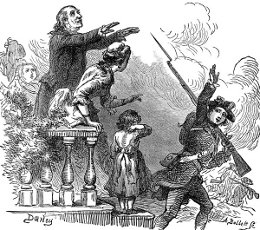 Something doesn’t add up. We refer to July 4 as Independence Day. We refer to the war that followed as the Revolutionary War. But if we viewed ourselves as independent of British rule on July 4, how could we have engaged in revolution after July 4? Revolution normally precedes independence. Either the day or the war is a misnomer.
For Christians the incongruity raises deeper questions. Given the response to government that Scripture requires, shouldn’t we oppose the whole idea of revolution, regardless of the circumstances? And if we’re opposed to revolution, can we rejoice in independence?
The Bible and revolution
Genesis 9 is understood by many to represent God’s re-founding of the institution of human government. The NT emphasizes submission to that institution as our Christian duty.
And He said to them, “Whose image and inscription is this?” They said to Him, “Caesar’s.” 17 And Jesus answered and said to them, “Render to Caesar the things that are Caesar’s, and to God the things that are God’s.” And they marveled at Him. (Mark 12:16–17)
Remind them to be subject to rulers and authorities, to obey, to be ready for every good work… (Titus 3:1)
Therefore submit yourselves to every ordinance of man for the Lord’s sake, whether to the king as supreme, 14 or to governors, as to those who are sent by him for the punishment of evildoers and for the praise of those who do good. 15 For this is the will of God, that by doing good you may put to silence the ignorance of foolish men. (1 Peter 2:13–15)
In addition to these, Romans 13:1-7 represents “the governing authorities” (exousias huperechousais) as “from God” and “appointed by God,” and asserts that resisting them is resisting “the ordinance of God.”
It’s hard to imagine how prohibiting the overthrow of governments could be put in stronger terms.
Celebrating independence
Believers must be anti-revolution, just as they are anti-disobedience. But must we be anti-independence? Is there a way Americans can be opposed to revolution yet rejoice in American independence? I believe at least two ways to do this exist.
1. Deny the revolution.
The idea that what occurred in the late 1700s here was not really a revolution has been around for a while. A professor of mine at BJU (back in the 80s) was adamant that no revolution occurred. He had written a book on the subject. (Copies appear to be available still at Amazon).
Though parts of his argument were unclear to me at the time, the gist seemed to be that a British document (perhaps one of the “Intolerable Acts”?) had already effectively ousted the colonies from the empire and that the 1776 Declaration was little more than an acknowledgment of that fact. In this version of events, the war that followed was one of defense, not of revolution—and, though various acts of rebellion did occur, our independence is not the result of a war of rebellion.
More recently, I’ve encountered a different revolution-denial argument (though it is, perhaps, compatible with the previous one). This view reasons that no revolution occurred because the “governing authorities” (to use Paul’s Romans 13 term) were not actually King George and Parliament, but law itself—and the laws of England in particular.
Thomas Paine wrote that “in America the law is king” (Common Sense). Certainly this way of thinking was strong in the “revolutionary” era and echoes some of the thought of Samuel Rutherford (1644: Lex, Rex) and, later, John Locke and Charles (etc.) Montesquieu. (Some trace the idea of “rule of law” or “law as king” back to the Roman Republic, then further to Aristotle. The case could be made that the spirit of it dates to the days of Moses.)
Accordingly, some have argued that Britain violated the terms of its own agreements with the colonies, and some of its own laws in the process, and that, therefore, the contractual relationship between the crown and the colonies was nullified.
In this version of events, no revolution occurred. The colonists who fought in resistance of Britain were fighting in support of law—and the law was the real king. The wording of the Declaration of Independence would seem to support the idea that, right or wrong, the colonists were thinking in these terms.
Perhaps we’ve done them all a disservice by naming the war “revolutionary,” though it seems probable that the likes of Patrick Henry wouldn’t object to the term. (Perhaps the writings of the patriots of that era are full of calls to “revolution.” If I ever knew that, I’ve forgotten. I’m sure a historian will straighten me out.)
2. Separate the result from the process.
If you have no stomach for revolution-denial, you can still rejoice in American independence. Sometimes people do the wrong thing and God graciously overrules their conduct to produce a wonderful result (to Him be praise!). Perhaps we American Christians can proudly sing our “revolutionary” national anthem and salute our flag through teary eyes on the conviction that “God meant it for good” (Gen. 50:20), even though we’re uncertain that armed resistance was the right thing to do—or even if we strongly believe both the Declaration and the War were unchristian acts.
One thing is certain. Our duty and opportunity as believers is to give thanks for everything (1 Thess. 5:18, Eph. 5:20). Regardless of our view of revolution in general, or the “American Revolution” in particular, God has greatly blessed us, and the independence we now enjoy is a major part of that blessing.
Aaron Blumer Bio
Aaron Blumer, SharperIron’s second publisher, is a Michigan native and graduate of Bob Jones University (Greenville, SC) and Central Baptist Theological Seminary (Plymouth, MN). He and his family live in a small town in western Wisconsin, not far from where he pastored Grace Baptist Church for thirteen years. He is employed in customer service for UnitedHealth Group and teaches high school rhetoric (and sometimes logic and government) at Baldwin Christian School.


[JT Hoekstra] Don’t smoke, don’t drink, don’t…er…revolt? Yes, that’s what we need, more rules for the Christian Faith. A free grace institution is marriage, and God’s will and common sense throughout history has been that you are free to protect your own home and family. “If the Son of Man hath set you free you are free indeed!” In a constitutional democracy you render unto Caesar what is Caesar’s by VOTING.We need whatever rules God has given us. So the question is not “do we need more” but “What does Scripture teach?” It’s not like we could go through the ten commandments and stop at #6 because we think we have “enough rules.” It’s not for us to judge.
As for the Jesus quote there.. not relevant at all to what we’re talking about. There are different kinds of freedom. The political kind has no relationship at all to the spiritual and moral kind, which has to do with the ability to reject sin and serve Christ.
On rendering to Caesar by voting… I’m not aware of anybody who would disagree with that.
[JT H]Nobody is denying that. The debate is not about what God knows or even what He has planned. For my part, I have no hesitation at all with saying that God planned the American “revolution.” But what is planned and what is right for individuals to choose… these are not the same (see Gen.50 and the last couple paragraphs of the essay)
God says he knows when a sparrow gets grounded - He does not know when tyranny exists?
As for Barton…. don’t know anything about him or his ideas.
[Steve Newman] we could go back to Scripture and see Israel fight against enemies in “revolutionary” ways. I would think the people of Jericho would agree (at least the few that lived through it)! Furthermore, they were doing so at God’s direction. Granted, we are not a theocracy, but we could definitely say that Americans came to this country for freedom….The distinction “we are not a theocracy” deflates the argument here because it leaves the main question unanswered: we know God told (“theocracy”) Israel to take Canaan. Did he tell the colonists to “take” the colonies from Britain? Of course, we know they had no direct revelation on the matter, so the question becomes “Does Scripture commend the revolution?” That’s what the essay is about and what the debate is about.
[Steve Newman] Didn’t the founders see the British monarchy as having abdicated its responsibility and therefore illegitimate?I think that’s generally not in dispute. The question is whether or not they were right about the “therefore” part.
Views expressed are always my own and not my employer's, my church's, my family's, my neighbors', or my pets'. The house plants have authorized me to speak for them, however, and they always agree with me.

I am concerned that the author is overstating the biblical case and simplifying the historical problem created by human fallness, finitude, fallibility, freedom. The Bible requires that we submit to the governing authorities, but it doesn’t tell us which authorities are legitimate or the process of legitimacy or what actions and abuses lead to illegitimacy. And the Bible clearly teaches that at some point, the governing authorities must be disobeyed and therefore become illegitimate (Acts 5:29) to the degree that they make it impossible to obey God. How far and potentially violent that disobedience goes is going to be dependent on the circumstance.
For instance how does the citizen of Taiwan know which government is legitimate? Two governments claim his allegiance. Was the Christian in Russia required to support the Reds or the Whites during their civil war? A Christian in the Roman Empire was required to support which one of the competing Roman emperors? The Christian is required to make the wisest decision he can, given his vocation and the current circumstances.
When we look back into history and consider our forefathers, we must be careful to judge their actions in the best possible light (Matt. 7:2). As far as I can tell, it was possible to participate as a godly Christian on either side of the American Civil War or the American War for Independence. Whether or not someone was sinning would depend on the individual actor’s motives and his or her understanding of the events and the legal cases being argued by the lower magistrates.
Second, the Bible gives an example of a revolution of the lower magistrates against the established government of Athaliah in 2 Kings 11. You might argue that Bible gave legitimacy to the line of David, but neither the Torah nor a prophet confirmed that Joash was the legitimate heir in the biblical account. The lower magistrates (the military and tribal leaders 2 Chron. 23:2) trusted the testimony of Jehoiada that Joash was in the line of David and overthrew the settled government of Athaliah (2 Kings 11:4
[swalker] I am concerned that the author is overstating the biblical case and simplifying the historical problem created by human fallness, finitude, fallibility, freedom. The Bible requires that we submit to the governing authorities, but it doesn’t tell us which authorities are legitimate or the process of legitimacy or what actions and abuses lead to illegitimacy. And the Bible clearly teaches that at some point, the governing authorities must be disobeyed and therefore become illegitimate (Acts 5:29) to the degree that they make it impossible to obey God. How far and potentially violent that disobedience goes is going to be dependent on the circumstance.I’ve already conceded that these choices can be complex sometimes. In most “revolution” scenarios, they are not all that complicated. There is usually a long-standing government that is being resisted and usually that resistance is not due direct incompatibility between the commands of the regime and the commands of Scripture.
Even when it is, how do we get from “obey God rather than man” to “overthrow your government”?
I’m open to the idea that this can sometimes be justified. I just haven’t seen a persuasive case at this point.
When we look back into history and consider our forefathers, we must be careful to judge their actions in the best possible light (Matt. 7:2). As far as I can tell, it was possible to participate as a godly Christian on either side of the American Civil War or the American War for Independence. Whether or not someone was sinning would depend on the individual actor’s motives and his or her understanding of the events and the legal cases being argued by the lower magistrates.Where do Rom.13 or 1 Peter 2 say “submit to the authorities unless you have really good motives”?
As for “best possible light,” I’m for that but “possible” requires accounting for the facts. The record is pretty clear that the motives were complex but none of them involved “George is ordering us to disobey God.”
So the case has to be made some other way.
[swalker] Second, the Bible gives an example of a revolution of the lower magistrates against the established government of Athaliah in 2 Kings 11. You might argue that Bible gave legitimacy to the line of David, but neither the Torah nor a prophet confirmed that Joash was the legitimate heir in the biblical account. The lower magistrates (the military and tribal leaders 2 Chron. 23:2) trusted the testimony of Jehoiada that Joash was in the line of David and overthrew the settled government of Athaliah (2 Kings 11:4This is an interesting case. But it also doesn’t serve well as a defense of the American “Revolution” or revolution in general, for two reasons.
First, the “example” here is a historical record and these kinds of examples are not, in themselves, arguments for or against what happened.
Second, in this case, though, the kings of Israel and Judah were bound by a covenant. In a slightly different sense than we usually use the phrase, the Law was king. So whenever people with power had an opportunity to choose between backing a covenant-breaking idolatrous king and covenant-honoring worshiper of Yaweh, the choice is pretty clear.
Any way we interpret 2 Kings 11 is going to be leagues away from the colonial scenario in the US.
Had there been a coup in England and the rival monarch was one more inclined to be generous with colonial liberty, it would be far easier to make the case that the colonists could legitimately back the new king rather than the old one (assuming he’d still be alive). But this is very different act from the masses of the people taking up arms to replace their government with self-government.
I think the stronger argument I’ve heard in the thread is that for the ordinary guy, his “powers that be” changed without his participation as the local “powers” decided to throw off the higher “powers.” Since the local powers were constituted legally, what you have in the colonial struggle is one of “powers that be” vs. “powers that be” within the same government…. until one set of “powers that be” decides to go rogue.
So as a citizen, where your allegiance belongs at that point is a little murky, arguably.
But as a legislator who had to make a decision to rebel… I still have a hard time with that. It’s very hard to see how that is anything but “resisting,” which Rom.13 and 1 Pet.2 forbid.
It’s just as hard to see how it is “obeying God rather than men.”
Views expressed are always my own and not my employer's, my church's, my family's, my neighbors', or my pets'. The house plants have authorized me to speak for them, however, and they always agree with me.
First, the people did not covenant with Joash until after the revolution was over (2 Kings:11:17). And positionally Christians are in as much a covenant with God as were the Jews (1 Cor. 11:25) of the Old Testament.
Second, in the historical sections of the Bible, we observe believers attempting to obey God’s fundamental law—love God with all your being and love your neighbor as yourself. Godly motive—defined here as loving God and neighbor—decides whether or not one is obeying more specific commands of God. Certainly, those who preach the gospel from envy and rivalry are not obeying God, only those who do so out of love (Phil. 1:15-17) even though they are “obeying” the great commission.
As far as I am able to tell from 2 Kings 11, God’s law was not violated in a revolution against a settled government. This leads to the possibility of repeating this pattern in history in a godly manner. The contours of this revolution were that lower the magistrates, or the lower political rulers, lead the citizens in what the queen understood was treason (2 Kings 11:14). We have no evidence in the text that the queen was requiring the people to disobey direct commands from God. And the Bible does not contain an exhaustive list of what makes a government legit nor does it say how many years a government must settled.
The point of the citation of Acts 5:29 was not merely the issue of direct commands from ruling authorities, but that all human authority has limits. And so Abigail loves Nabal as herself, by disobeying him and providing food for David. Jonathan loves his father and his king and David, by refusing to reveal to Saul the whereabouts of David. And our Lord loved his neighbor and the temple authorities by beating the money changers in the temple with a whip. And one would assume that the godly Israelites loved Athaliah (Lev. 19:18) by revolting against her, unless one would like to argue that fulfilling God’s law requires that you violate God’s law (Matt. 22:36-40) or that Jesus did not love the money changes as he beat them.
The American Revolution follows the pattern of Jehodiah’s revolution in that it included the lower magistrates and was based on the legitimacy of authority. In the American War of Independence, the lower magistrates (colonial authorities) revolted against what they understood were the illegitimate commands of a superior authority. They then presented a public argument for the revolution. The Christian caught up those events, must do his best to love God and to love his neighbor with the information that he has and the wisdom God has given him, and good and godly men will come to different conclusions.
[swalker] The American Revolution follows the pattern of Jehodiah’s revolution in that it included the lower magistrates and was based on the legitimacy of authority.No, the American Revolution was akin to Jehosheba’s revolt, not the defense of an established monarchy, i.e. Joash. To call Jehodiah’s defense of the monarchy a revolution is to miss the point of the story.

Bob T. has done an excellent job making the case that the events of 1776 and following were a war for Independence not a war of Revolution.
I would like to inject a related topic which needs to be examined by those who are genuinely interested in this discussion.
And I would point you to “The Doctrine of Interposition”
Daniel Webster’s 1828 dictionary defines interposition as the following:
1. “A being, placing or coming between; intervention; as the interposition of the Baltic sea between Germany and Sweden. The interposition of the moon between the earth and the sun occasions a solar eclipse.
2. Intervenient agency; as the interposition of the magistrate in quieting sedition. How many evidences have we of divine interposition in favor of good men!
3. Mediation; agency between parties. By the interposition of a common friend, the parties have been reconciled.”
Most sources I’ve read attribute the “Doctrine of Interposition” to Calvin, although I can’t back that up here.
I would like to point you to a blog post by Dr. John Eidsmoe author of “Christianity and the Constitution”
I think he presents the topic clearly and succinctly here,
The Doctrine of Interposition
Further study on the Biblical principle of interposition might be helpful in understanding the Founders thoughts on their position in relation to the King of England.
[swalker] First, the people did not covenant with Joash until after the revolution was over (2 Kings:11:17). And positionally Christians are in as much a covenant with God as were the Jews (1 Cor. 11:25) of the Old Testament.The covenant I was referring to was the Mosaic. The kings of Israel, as well as the entire nation, were sworn to its terms. The consequence is that people with power to do so had a responsibility to replace a covenant non-compliant king with a covenant-compliant one.
Again, very different from throwing off a legitimate power.
The covenant Christians are sharers in today is not one that includes a government (yet), so it’s really not relevant to the case.
[sw]History records both obedience and disobedience. Mostly the latter. But this is also moot as far as my argument goes, since I’m arguing that it was obedient for people in the court to oust an idolatrous ruler.
Second, in the historical sections of the Bible, we observe believers attempting to obey God’s fundamental law—love God with all your being and love your neighbor as yourself. …
[sw] The point of the citation of Acts 5:29 was not merely the issue of direct commands from ruling authorities, but that all human authority has limits.It’s true that all authority has limits. The limits in the text, however, are defined. We must obey God when man’s commands contradict His. That’s simply all that is there. It’s not possible to expand that text into “Resist the powers that be whenever you perceive a tension between their aims and God’s.”
Furthermore, as Brenda’s article illustrates to a degree the regime in Rome was quite corrupt and was certainly exercising a great deal more authority over people than ours today or Britain was in 1776. Yet, Paul says “submit,” not “show those guys they’ve exceeded the limits of their authority!”
Of course, in America, where we are governed by laws, lawful protest, lobbying, etc. is not “resisting” in the Romans 13 sense.
But taking up arms and destroying property, etc., as we did in the 1770s… hard to see how this is not resistance per Rom.13.
[sw] And so Abigail loves Nabal as herself, by disobeying him and providing food for David. Jonathan loves his father and his king and David, by refusing to reveal to Saul the whereabouts of David. And our Lord loved his neighbor and the temple authorities by beating the money changers in the temple with a whip. And one would assume that the godly Israelites loved Athaliah (Lev. 19:18) by revolting against her, unless one would like to argue that fulfilling God’s law requires that you violate God’s law (Matt. 22:36-40) or that Jesus did not love the money changes as he beat them.We are not really told that all of these acts were exactly the right thing to do. It’s not apparent that Abigail loves Nabal. She dishonors him in very frank terms in the passage. But she is clearly out to save lives and keep David from doing something drastic. Her intentions are commendable and the results were certainly positive (and her eval. of Nabal’s character appears to have been entirely accurate.)
Christ’s motive in the temple, to read the contexts, was zeal for the purity of the place of worship… not that His motive has anything to do with what’s in dispute here… Godly Israelites would not have loved Athaliah.
But we’re really deep into nonrelevant points here.
There is no OT sequence of events that teaches believers may overthrow their government because they believe they’re overtaxed. None of these passages speak to that issue at all.
Views expressed are always my own and not my employer's, my church's, my family's, my neighbors', or my pets'. The house plants have authorized me to speak for them, however, and they always agree with me.


Dave Barnhart

[dcbii] How would the end of Acts 16 fit into this discussion? When the magistrates (those with authority) sent the jailer to Paul to tell him to go, Paul refused and sent word to the magistrates to come and fetch him, because they had acted against law. It would seem to me that from this passage, he considered the law king even under Rome. When magistrates went against the law, he refused obedience to the magistrates, even though they could have been considered “higher powers.”Another view of Paul’s demand for the magistrates in Acts 16 is that Paul wanted to hinder future mistreatment of Christians in Philippi (and perhaps Macedonia in general) under Roman law. He and Silas has been mistreated since Roman law afforded them protection; Paul wanted future Christians to be protected from such abuse - and would use the law to do so. This consideration comes from observing Paul’s varying relationship to Roman law in Acts. Sometimes he appeals to the law immediately, sometimes not, and sometimes never. In Galatia he allowed for severe mistreatment to himself and makes no recourse to Roman law - apparently as an object lesson for the disciples (Acts 14:19-22).
The idea that the laws of men are higher than men is a little difficult to maintain logically. Is that which is made greater than its creator? It can tend toward an idolatrous patriotism, and eventual frustration. Those who make laws eventually change them to suit their agendas. Our Savior responds to the High Priest’s power to compel testimony (Mat. 26:63-64). He submitted to unjust law and unjust men to serve the higher law of love to God. He is our blessed exemplar of a good conscience before God (1 Pet. 2:13-25).
[dcbii] How would the end of Acts 16 fit into this discussion? When the magistrates (those with authority) sent the jailer to Paul to tell him to go, Paul refused and sent word to the magistrates to come and fetch him, because they had acted against law. It would seem to me that from this passage, he considered the law king even under Rome. When magistrates went against the law, he refused obedience to the magistrates, even though they could have been considered “higher powers.”Applied to our situation in 1776, this is the best argument I have heard over the years for the legitimacy of our Declaration of Independence, and another big reason I have not been dogmatic about my own position. While Paul seems merely to be lodging a complaint, you have correctly identified an abiding principle contained in this passage. Whether this abiding principle warrants armed rebellion on the part of Christians is debatable.
But stipulating for the sake of argument that it does, I’m still not convinced that the English government had so deviated from the law as to make armed rebellion a reasonable remedy. Rather, it seems that this complaint was a pretext for throwing off the yoke of English rule. John Wesley makes a good case for the legitimacy of the crown’s actions and the illegitimacy of the colonists’. It’s something I would like to study more, and study properly. I’ve come to distrust the histories taught on this by folks in our camp (c.f. earlier references to BJU).
[dcbii] How would the end of Acts 16 fit into this discussion? When the magistrates (those with authority) sent the jailer to Paul to tell him to go, Paul refused and sent word to the magistrates to come and fetch him, because they had acted against law. It would seem to me that from this passage, he considered the law king even under Rome. When magistrates went against the law, he refused obedience to the magistrates, even though they could have been considered “higher powers.”Yes, I do think we have to allow for the possibility of “illegal orders.” In this case, the locals are disobeying law of the empire and Paul cites the higher law as a reason to resist the local. This is sort of the reverse of the colonial situation where local law is being used (created) to trump the law of the empire. But the possibility that the crown itself was acting against its own laws has to be factored in.
Add to that the idea that the crown was acting against natural law and it had, in various acts, affirmed the legitimacy of that law in the past (“the rights of Englishmen” and all that. Wesley seems to have misunderstood the concept there because he understands English law as providing “the rights of Englishmen” as though these rights were afforded by the crown to its subjects, but I think a great many by that time understood the rights to be natural and that British law had mere acknowledged that these rights exist.)
From a contract law perspective, what sort of written and unwritten guarantees had the crown made?
But there is a danger here. If we view ourselves/citizens as judges of what laws are illegal (in violation of other laws or of our founding documents), there is a danger of thinking we’re authorized to pick and choose what laws we will obey. “Well I feel like being required to wear a seatbelt or buy health insurance is unconstitiutional.” This can easily become nothing more than “resisting” dressed up in righteous terms.
But there have been, and will be, laws that are truly illegal. So it’s difficult to establish a really clear boundary there.
It’s probably important to note though, that in these situations, it’s not about “obeying God rather than man,” but about “obeying man rather than man.” Law is hierarchical where you have constitutions, so lower law can be in violation of higher law. In a manner of speaking you can say that choosing to obey higher law is obeying God rather than man, but I think this tends to obscure the issue. We’re dealing mainly with problems in human law.
For example: suppose a state law passed requiring churches to pay taxes on the offerings they collect. It’s pretty hard to find Bible that says we can’t do that. So “God, rather than man” would be an issue-confusing argument for setting aside that law. Rather, my response would be that “this is an illegal law” and our obligation is to obey the constitutional law.
Views expressed are always my own and not my employer's, my church's, my family's, my neighbors', or my pets'. The house plants have authorized me to speak for them, however, and they always agree with me.

but I think a great many by that time understood the rights of an Englishman to be natural and that British law had mere acknowledged that these rights exist.)Italics=text added for clarification by me
I view the situation on a continuum starting with the Baron’s Revolt which produced the Magna Carta, though the English Civil War and the Glorious Revolution. If one has a problem with the AmRev, then one can not support the prevailing side of the three conflicts I listed above. The last two would have brought a French style monarchy and a return to Rome if the kings in question had prevailed.
Hoping to shed more light than heat..
… and they do not seem to understand how unconservative the idea of violent or illegal revolution is. Radical is the opposite of conservative.
Views expressed are always my own and not my employer's, my church's, my family's, my neighbors', or my pets'. The house plants have authorized me to speak for them, however, and they always agree with me.
[Aaron Blumer] Sometimes I hear talk from “conservatives” that scares me more than a little.Aaron,
… and they do not seem to understand how unconservative the idea of violent or illegal revolution is. Radical is the opposite of conservative.
If I were a pastor in the American Revolution, I’m not positive what I would do. However we’re not at all in the same context as that time today. Those “conservatives” who talk about armed rebellion as if it’s a welcome thing indeed are dangerous. Perhaps we need to do some clear thinking about the differences between this time and that time would help these radicals not be so radical. Those who talk in Revolutionary War jargon often make a straight line to the “tyranny” of today. When in fact, we elected these people.
I’ve lived in the DC area for 6 years. It has changed my perspective on government (for better and worse). One thing I’ve been struck with is that there are Christians in almost every aspect of government, politics, lobbying, military, intelligence, ect. And they all have different points of view. This has frequently encouraged me.
Thankfully, I just moved outside “The Beltway,” but I can still see the wall that separates the beltway from me out my back window. ;-)
I do agree that the situations of American revolution vs. today are dissimilar on multiple levels. I’m not sure that these distinctions can penetrate the thinking of those who are of a revolutionary turn of mind. But the case of the American Rev. really only interests me as test case for understanding how Rom.13/1Peter2 relate to revolution in general.
I’m not sure why Christians in government all having different points of view would be encouraging. I mean, you have a whole lot of public policy that is functional and has to do with managing the machinery, and there is seldom a clear biblical principle involved in that part of things. Then you have the ideological level where our convictions about right and wrong are informing the rest of our political efforts. It’s disturbing to me that Christians are not more united on moral (and some practical) questions Scripture speaks to fairly clearly.
Then again… we have thousands of Christian denominations because Christians are similarly unable to discern basic theology from Scripture.
It’s just human nature I guess.
Views expressed are always my own and not my employer's, my church's, my family's, my neighbors', or my pets'. The house plants have authorized me to speak for them, however, and they always agree with me.
And to defend the MOST freedom and liberty the world has EVER known, the blood shed FOR those freedoms that are being hurriedly carried away by a despotic, lying and arbitrary regime who by a stroke of pen spends egregious amounts of YOUR money for political purposes, has started and escalated SIX “kinetic” WAR actions with more, more, more bloodshed and NO apparent benefit for (y)our home defense…a call to action by a new Black Robe Regiment is imperative, nay, desperately needed.. at this time to calm the populous, to call your neighborhoods back to a Christ who WILL rule at some future day with a rod of steel. How many fiats will you let this regime dictator sign? How many regulations will be LAW without even a vote by congress? How many legit churches will be taxed and over run by the irs before there is a call to more action than raising your scripture meekly and bowing your head and allowing handcuffs to be placed on your wrists and be led away before you find it is too late to do anything to protect your families and…this greatest nation?.
[url] http://www.sfgate.com/cgi-bin/article.cgi?file=/c/a/2011/07/15/MNL61KAH…
It’s now the law to teach LGBT history.
Will you submit, or will you revolt?
If you submit, are you being disobedient to Scripture?
Acts 5:29
“Then Peter and the other apostles answered and said, We ought to obey God rather than men.”
But to briefly restate: nobody is suggesting here that we should obey man when man is commanding contrary to Scripture. The case of the holocaust and the case of teaching LGBT propaganda are clearly not in the same category as “George is taking too much money in taxes.”
Further more, resisting a particular law (or several) is not the same thing as overthrowing your legally established authority.
So, the essay raises the question. I’m not really trying to answer it firmly here. But cases of genocide and teaching corrupt morality do not prove revolution is a good idea.
Views expressed are always my own and not my employer's, my church's, my family's, my neighbors', or my pets'. The house plants have authorized me to speak for them, however, and they always agree with me.
Featured Resource


Discussion