Obama and the Next Frontier of Human Rights
On January 20 of this year, Barack Obama was sworn in as the 44th President of the United States of America. This momentous occasion did not mark the death of racism in our land. It did, however, betoken a crucial stage in the sluggish uprooting of racism’s influence upon this nation. It is no small matter that the majority of voting Americans in the election resolved to appoint an African-American to the highest office in the land—arguably to the most powerful governmental post on the planet. This marks a groundbreaking advance toward an America in which one’s abilities and opportunities are wholly disentangled from levels of melanin in one’s skin—toward an America in which citizens of every class and ethnicity share equal status as creatures made in the image of God.
Just days before Obama’s November 4 victory at the polls, I made a rather timely visit to two museums. Each of these museums preserves on display the viewpoint of onetime purveyors of a societal vision that hinged on the perceived inferiority of a specific class of people. The Gettysburg Museum in Pennsylvania and the Holocaust Museum in Washington D.C. each immortalizes the convictions of sincere intellectuals who sought to elevate one segment of society by oppressing another.
Alexander H. Stevens, Vice President of the Confederate States of America, declared that the “cornerstone” of the Confederacy “rests upon the great truth that the Negro is not equal to the white man; that slavery, subordination to the superior race, is his natural and moral condition.” In the hallowed halls of the U.S. Senate on March 4, 1858, Senator James Henry Hammond of South Carolina proclaimed: “Our slaves are black, of another and inferior race.”
Countering such sentiments, Abraham Lincoln declared in a debate at Galesburg, Illinois (October 7, 1858): “I confess myself as belonging to that class in the country who contemplate slavery as a moral, social and political evil …” In a letter to Albert Hodges, Lincoln wrote: “If slavery is not wrong, nothing is wrong.”
Consider this carefully: These two radically distinct ideologies were vehemently defended and publicly debated by sincere Americans. Mercifully, the viewpoint that eventually prevailed insisted that oppressing one class of people to protect the status of another was not only evil, but degrading to the protected class—a thesis Booker T. Washington ably championed in his autobiography, Up from Slavery. The presidency of Barak Obama rides on the wings of this achievement.
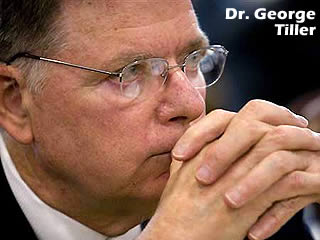 On Sunday morning, May 31, 2009, around 10 a.m., Dr. George Tiller, perhaps the most notorious practitioner of late-term abortions in America, was killed in the lobby of a Lutheran church in east Wichita by a lone gunman who fired a single shot into Tiller’s head. Tiller quickly passed into eternity on the floor of the church lobby. He had survived a previous assassination attempt outside his east Wichita abortuary some fifteen years earlier. (Photo credit: L.A. Times)
Discussion