Revelation 6
Image
This is a series of short expositions of Revelation 4-22 from a futurist perspective. Follow along with a timeline here.
In Revelation 6, the apostle John shows us the first six divine seal-judgments in rapid succession. He handles them in barely a few sentences each. While these first six judgments are terrible, the Lord seems to save his powder for the seventh and final act of vengeance—an event which runs from Revelation 8-18.
It’s impossible to know how long these judgments last. But, (a) if we suppose Jesus essentially ends the great tribulation by way of these judgments upon the kingdom of evil, and (b) we take the sinister half the great tribulation to be ≈ 3.5 years (42 months), then (c) it’s likely these judgments occur at the very end of this 3.5-year period. Perhaps they will take a few short months. The horror-stricken, “how could this even be happening?” reactions of unbelievers when Babylon falls, in Revelation 18, suggest a very short period of intense, violent, overwhelming divine judgment ending with the antichrist’s defeat.
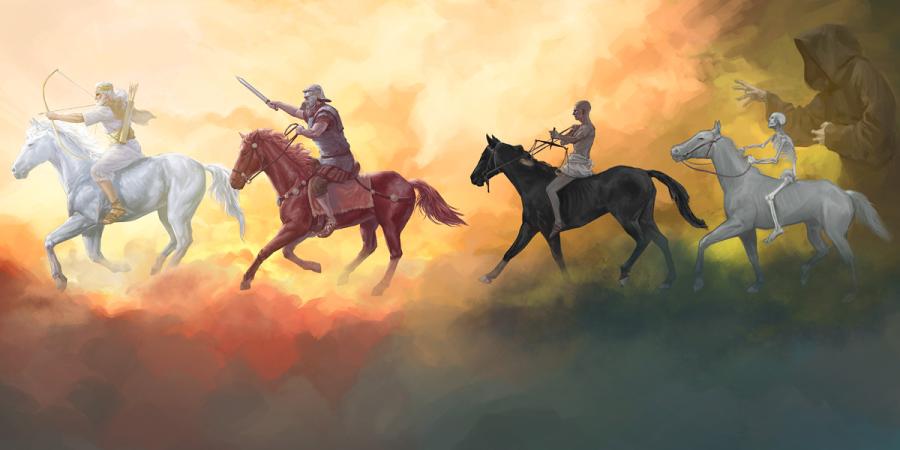
Sinister horsemen are the agents of the first four judgments. Each rider is astride a horse of a different color, and so of course bible teachers speculate about what these colors mean. John doesn’t say. But, the rider’s actions seem to naturally correspond to the color of their horses, so little speculation is necessary. It’s certainly not worth an argument. The judgments the riders bring seem to be successive, like a series of disasters striking one after the other in short order.
John sees Jesus, the lamb slain for the sins of his people, crack open the first seal. A seraph (“one of the four living creatures”) then spoke with a voice like the sound of thunder and commanded: “Come!” (Rev 6:1). The first rider (seal/judgment 1) enters the stage. Because this is a vision, and not strict reality, the horseman appears as if out of nowhere. The NASB 2020 translation reads: “I looked, and behold, a white horse …” (Rev 6:2). This is quite correct, but the effect is bland. “Behold” is an interjection, almost an exclamation. The sense is that John looks and suddenly—“Whoa! Oh, my goodness!!”—the horseman clomps onto the stage without warning.
This rider has a white horse, a bow, and a crown, “and he went out conquering and to conquer” (Rev 6:2). This rider gives off clear authority (“crown”) and military victor (“bow … conquer”) vibes. The white color of his horse suggests “purity” and “holiness.” Many good bible teachers believe this is Jesus. But, this is probably wrong.
- Jesus is in heaven, cracking open the scroll. Why would he teleport here into his own vision, playing two different parts? While prophecy can stretch reality into some elastic shapes, this may be too much.
- Remember that Jesus directs these divine judgments which comprise Revelation 6-18 against the antichrist and his kingdom of darkness. They are not a chronicle of the antichrist’s reign of terror—they are Christ’s judgment against the antichrist. So, this first rider is bad news which Jesus unleashes against the unbelieving world.
- The only way this first rider can be Jesus is if he is sallying forth to conquer his foes—sort of a shock and awe first strike against the antichrist. But, Jesus doesn’t return until in Revelation 19, which is directly after all judgments are complete.
So, who is this first rider?
- It seems to me that the antichrist’s reign cannot be a happy one, even for his followers. Later in this book, the apostle John tells us that during the great tribulation the antichrist’s creature compels obedience upon threat of death (Rev 13:15-17).
- So, it’s logical to believe that untold millions will “go with the flow” due to fear and intimidation and thus pay homage to the antichrist and his empire of evil.
- Therefore, I take the rider on the white horse to represent a military dictator (likely the antichrist himself) who commands obedience by threats of torture and murder as his rule (“conquest”) reaches a fever pitch towards the end of the great tribulation.
- In that event, by way of this first rider Jesus allows the antichrist to ramp up his vindictive and oppressive reign. Our rider doesn’t possess the crown by right—it’s given to him. The object would be to tell the unbelievers who continue to flock to this supremely evil man: “You don’t want Jesus as your savior? Well, this is the alternative. Is this what you want?”
- This scenario makes even more sense if we place the murder of Jesus’ two witnesses in Jerusalem (Rev 11:1-13) as the “all right, that’s it!!” moment which triggers Jesus’ divine wrath.
A seraph summons a second horseman (seal/judgment 2), who gallops off “to take peace from the earth, and that people would kill one another, and a large sword was given to him” (Rev 6:3-4). This rider is atop a red horse. Again, he does not own the sword—it’s given to him by a divine loan. The horse’s significance is clear; red equals war and bloodshed.
Who will make war and who will die? Those who assume Revelation 6-18 is the dark tale of the antichrist’s reign of evil assume this is his doing. But, as we’ve seen, this is divine judgment against the antichrist. If we don’t keep that framework in mind, we misread the situation. So, in this case, we should imagine the antichrist’s fascist dictatorship spiraling deeper into a more hardline stance, turning on its own people—imprisoning, torturing, murdering its citizens.
Christians often see themselves as playing the victims in the antichrist’s schemes. Here, that isn’t necessarily the case—Jesus would hardly bring purposeful destruction against his own people. Instead, we likely have most unbelievers caught in the middle—not interested in Jesus and his gospel, yet facing death and torture if they don’t go “all in” with the antichrist’s program. The kingdom of darkness doesn’t appreciate fence straddlers. So, as Jesus allows the antichrist’s program to ramp into overdrive, there is no place to hide—peace is taken away and people kill one another as the wicked noose tightens.
We discuss the next four seal-judgments in the next article.
Tyler Robbins 2016 v2
Tyler Robbins is a bi-vocational pastor at Sleater Kinney Road Baptist Church, in Olympia WA. He also works in State government. He blogs as the Eccentric Fundamentalist.


While these first six judgments are terrible, the Lord seems to save his powder for the seventh and final act of vengeance—an event which runs from Revelation 8-18.
Doesn't this characterization devalue the imagery of the text, which uses the imagery of seals and scrolls? Seals are used to keep a scroll closed. Seals are not on the same level of significance as the contents of the scroll itself.
Perhaps this is a small thing, but I am concerned that treating the events of Rev 8-18 as though they are simply an enhanced continuation of the events of Rev 6 not only fails to honor the imagery employed in the text, but may also lead to a devaluing of the significance of this consequential transitional event in the eschatological sequence, as we complete the seals and the events of Rev 7 and then transition into dealing with the contents of the scroll itself. In the analysis above, words like vengeance and judgment are applied to the events of Rev 6, despite not being found in the text, and I suspect that this is a consequence of minimizing the categorical significance of the transition. (Or perhaps this is a fall-out of superimposing the framework onto the text.) Granted, it is stated above that the latter events contain more explosive "powder"; but nonetheless, I suggest that the eschatological model being developed herein, which treats Rev 6-18 as being "about the time at the end of this seven-year 'great tribulation' when Jesus pours out the seven seals of judgment" (per the 6/2/26 article) would benefit by better recognizing the significance of the transition.
Note that Jesus is also careful in the Olivet Discourse to distinguish those events that are preliminaries ("the beginning of the birth pains" - Matt 24:8) from the main event, when the time of tribulation begins for the Jews (24:9).
Dan
atrustworthygospel.com


What’s clear to me in Matt 24, Revelation, and also lots of OT judgment sequences, is that they unfold in stages in order to express God’s mercy and calls to repentance. So the judgments build through the narrative.
As for seals vs. the contents of the scroll, it’s not clear to me that there is any difference. The seals seem to me to be noted as a dramatic way of revealing the contents of the scroll. Some see the scroll itself has having seven parts. Others see the scroll as unrolling in seven phases, so I guess with seals inside? I don’t know how that would work. But there is also the view that it’s a single scroll with seven adjacent seals and the ‘seventh seal’ judgment is really the scroll opening.
I don’t think the text mentions the scroll again after the seal sequence though. But I could be quite wrong about that. I’m going on memory at the moment.
Regardless of how we imagine the unstated details, what’s clear is a building of judgment slowly. And somewhere in there we have the ministry of the 144,000. So this fits the gradual rolling out of judgment + prophetic calls to repentance we see in the Prophets and in Matt 24, etc.
Edit: I just reread a chunk of the passage. To me, the seals feel like sneak previews of what’s coming, sort of like with each seal breaking a little bit of the judgment in the scroll leaks out. Then when the 7th is broken in ch.8, you get the contents of the scroll itself over the following chapters. This is just an impression from a quick reread. It’s been a good while since I studied these passages. So I don’t know off hand what the main/leading and alternative views are on the details. But at the moment it seems quite possible that the trumpets and bowls are the scroll’s contents—in the metaphor of the vision.
Views expressed are always my own and not my employer's, my church's, my family's, my neighbors', or my pets'. The house plants have authorized me to speak for them, however, and they always agree with me.

I believe the majority of judgments are in the seventh seal = seven trumpet judgments, and the seventh trumpet judgment itself contains seven individual judgments. So, only in that respect do I mean the Lord “kept his powder dry” for the last seal = most of the divine wrath comes then. That period, I believe, is found in Rev 8-18. There is an outline of Revelation (as best as I understand it right now!) linked at the top of the article that explains my view of the book’s flow. Hopefully I remembered to link the latest version—I’ve fixed some typos and clarified language from prior versions.
Tyler is a pastor in Olympia, WA and works in State government.

....got me thinking a bit about this. I must confess that my take on Revelation, as well as Daniel and Matthew 24 (etc..), is that I'm torn as I try and read it as literally as possible, but then the obvious symbolism in Revelation (etc.) makes that problematic.
I'm growing, though, as I'm not seeing the Four Horsemen as Stuhldrayer, Layden, Miller, Crowley following the "Seven Mules" to two losses to the Nebraska Cornhuskers.
Aspiring to be a stick in the mud.
I’m trying to be reasonable about the literalism. Will there literally be four horses? I doubt it. The vision simply explains, by way of each horseman, that a specific divine judgment has come. Likewise, I don’t believe the antichrist has multiple heads (Rev 13)! That is just imagery which, among other things, = “weird and scary,” with a tie-in to Daniel 7. Etc., etc.
Tyler is a pastor in Olympia, WA and works in State government.

Discussion