Revelation 6—the rest of it
Image
This is a series of short expositions of Revelation 4-22 from a futurist perspective. Follow along with a timeline here.
We continue our discussion of Revelation 6 from last time with the third horseman, who corresponds to the third “seal” on the scroll Jesus opens throughout most of this book (Rev 6-16).
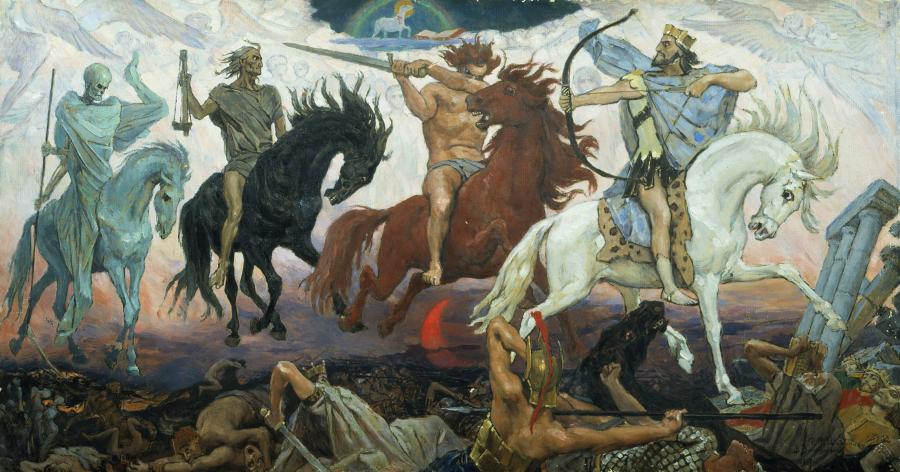
The third horseman (seal/judgment 3) enters from stage right. He rides a black horse, holding aloft a pair of scales. A voice booms from the midst of the seraphim, and this can only be God speaking (cp. Rev 4:2-3, 5-6). He says: “A quart of wheat for a denarius, and three quarts of barley for a denarius; and do not damage the oil and the wine” (Rev 6:6).
What does this mean?
-
A “denarius” is the equivalent of a day’s wage, while the “quart of wheat” and (alternatively, and less expensively) the “three quarts of barley” are food measurements that would last a typical family one day. These are not precise measurements, but rough approximations.
-
The command to not damage the oil and the wine is equivalent to “don’t waste these precious staples of your diet! Guard them carefully!”
-
Some believe it refers to a disconnect in society; the poor barely survive while the rich lounge about drinking wine with vats of olive oil secure in the basement. But Jesus is not bringing a class judgment upon the kingdom of evil—it’s a worldwide sentence against unbelief in general.
-
So, it seems best to interpret God’s admonition to the unbelieving world to mean: “be careful with the olive oil and wine you have on hand!”
The idea, then, is that our third horseman heralds a season of economic disaster and subsistence living. Consider the disasters of the “managed economy” of Soviet Russia in the 1930s, and communist China’s so-called “Great Leap Forward” in the late 1950s. Both resulted in famine, a collapsed economy, and the deaths of tens of millions of citizens. These are the consequences of the antichrist’s kingdom—repression and terror and a crashed financial system. Through it all, the Lord implicitly asks the world: “Why don’t you come to me, instead? My yoke is easy, and my burden is light.” In contrast, our rider’s black horse signifies despair, bleakness, and the darkness of long cold, hungry nights.
The fourth horseman (seal/judgment 4) now gallops to the fore at the seraph’s command. He rides an “ashen” (NASB 2020), or “pale” (ESV), or “pale green” (NLT), or “sickly pale” (NEB, REB) horse. The color is uncertain; the word means something with a green-ish yellow tinge. Context must decide the color. Because this rider bears the name “Death” and carries the realm of the dead (“Hades”) along with him, it seems best to see the horse being a sickly green—like that of a rotting corpse.
“Authority was given to them over a fourth of the earth, to kill with sword, and famine, and plague, and by the wild animals of the earth” (Rev 6:8). The focus is less about warfare and more widespread death; a world turned upside down. This will be a remarkably unsettled and unstable time; sort of a breakdown of order and civil norms (such as they are). Famine, plague, wild animals, and warfare (“the sword”)—each will take their pound of flesh. The focus is on the mass death that will result.
The fifth seal (judgment 5) is not really a judgment at all, but a plea from martyred believers for divine vengeance. They have “been killed because of the word of God,” and because they have been witnesses for Jesus and his gospel (Rev 6:9). It’s likely that they died during the great tribulation, which the Lord is now ending with these judgments from on high. “And they cried out with a loud voice, saying, ‘How long, O Lord, holy and true, will You refrain from judging and avenging our blood on those who live on the earth?’” (Rev 6:10).
This plea is why Jesus is unleashing this hellish wrath upon the empire of evil. Crime demands punishment and, by the time Jesus breaks open the first seal, the antichrist’s fascist war against God had reached its zenith: “And if those days had not been cut short, no life would have been saved; but for the sake of the elect those days will be cut short” (Mt 24:22).
The martyrs want justice. Vengeance. Divine retribution. Didn’t Jesus teach us to pray, “‘Your kingdom come. Your will be done, on earth as it is in heaven” (Mt 6:10)? Well, where is this kingdom and the righteous justice that comes with it? The first five seal judgments have thrown the world into chaos and surely rocked the antichrist’s kingdom, and now the martyrs are (in effect) pleading: “Finish him!”
John provides the Lord’s answer—the antichrist will be put down … but not quite yet:
And a white robe was given to each of them; and they were told that they were to rest for a little while longer, until the number of their fellow servants and their brothers and sisters who were to be killed even as they had been, was completed also (Rev 6:11).
This suggests that more Christians will die at the antichrist’s hand even as Jesus strikes him with these judgments, and others to come. Like a wounded beast, the antichrist will lash out and strike whoever is convenient at hand—especially Christians, the people who represent to one true God he hates most of all.
Jesus now opens the sixth seal, which foregoes the horses in favor of shocking, terrifying phenomena—earthquake, a blackened sun, a moon turning blood red, stars falling from the heavens in large numbers (Rev 6:12-13). This is a supernatural, “next-level” scale of sudden and violent destruction—one that has no possible natural explanation: “The sky was split apart like a scroll when it is rolled up, and every mountain and island was removed from its place” (Rev 6:14).
What will unbelievers do when this happens? What will they think? Will they choose Jesus, even in the face of torture and death at the hands of the evil empire? They will not; they would rather die. The rulers, the elites, the military commanders, the wealthy, the strong—every slave and free person will hide in caves and beg for death rather than submit to Jesus and his grace: “and they said to the mountains and the rocks, ‘Fall on us and hide us from the sight of Him who sits on the throne, and from the wrath of the Lamb; for the great day of Their wrath has come, and who is able to stand?’” (Rev 6:16-17).
Jesus told us that unbelievers, in effect, judge themselves by their reaction to the gospel. “And this is the judgment, that the Light has come into the world, and people loved the darkness rather than the Light; for their deeds were evil” (Jn 3:19).
The saddest thing in the world is that, even at the height of antichrist’s evil kingdom, even when he compels obedience upon threat of murder, even after the Lord’s two witnesses have preached so faithfully and passionately for 3.5 years (Rev 11:1-13), even after such a series of crushing hammer blows of divine wrath that surely must strike fear into every person’s breast … people would rather die than turn to Jesus for rescue. They can turn, if they want—much later in this cycle of divine judgment an angel explicitly makes a salvation offer to the unbelieving world (Rev 14:6-7).
They just don’t want it. More, and worse, judgments are coming.
Tyler Robbins 2016 v2
Tyler Robbins is a bi-vocational pastor at Sleater Kinney Road Baptist Church, in Olympia WA. He also works in State government. He blogs as the Eccentric Fundamentalist.

Discussion