Life Beyond the Algorithm: Timeless Meaning in an Age of Artificial Intelligence
The Crisis of Meaning and the Logic of Under the Sun
The Appearance of Novelty and the Reality of Recurrence
The contemporary cultural moment is often described in apocalyptic terms. Artificial intelligence, particularly in its rapidly advancing generative and decision‑making forms, is said to confront humanity with questions so unprecedented that inherited philosophical and theological frameworks can no longer address them adequately. Human beings are told that they now face a rupture in intellectual history: intelligence need no longer be embodied, creativity need no longer be human, and agency need no longer be personal. From this perspective, AI does not merely alter what we do; it destabilizes who we are. Meaning itself, it is claimed, is now in question in ways fundamentally unlike any previous era.
Yet this rhetoric of novelty obscures more than it reveals. Historically, periods of technological acceleration almost always produce the illusion of metaphysical transformation. The tools change rapidly, but the underlying philosophical assumptions change very little. What is newly visible in moments of upheaval is not a new problem, but an old problem under intensified conditions. Artificial intelligence does not generate the crisis of meaning; it precipitates the collapse of meaning structures that were already insufficient.
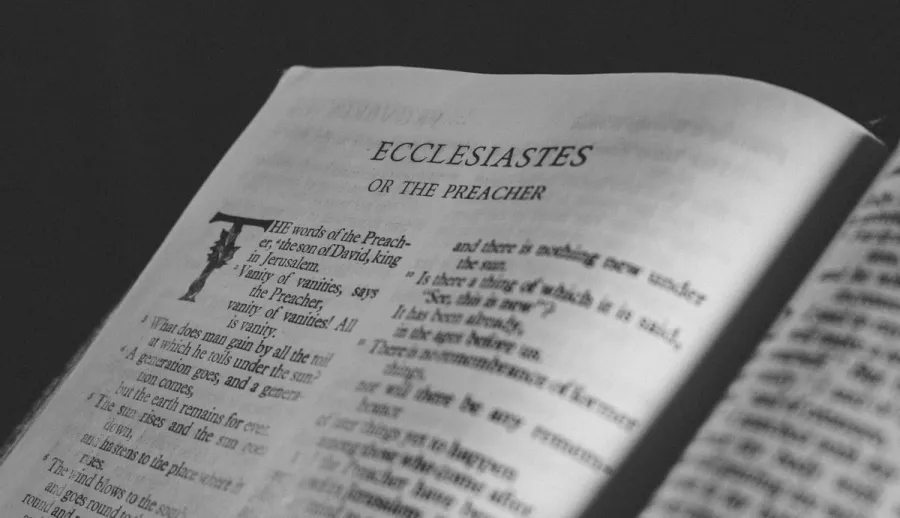
This is precisely the dynamic Solomon exposes in his profound tour de force that is the Book of Ecclesiastes. Long before computational systems or machine cognition, Solomon confronted the question that underlies every modern anxiety: Can human life sustain meaning when evaluated entirely within the bounds of the created order? Solomonic wisdom in the Book of Ecclesiastes is not a reaction to a particular cultural development. It is an analysis of what inevitably happens whenever meaning is sought apart from God. Its relevance to the age of artificial intelligence is therefore not incidental but deliberate. AI is simply the latest context in which the same perennial experiment is being run again.
Under the Sun as a Deliberate Philosophical Constraint
The phrase under the sun (tahat hassemes)1 serves as the conceptual backbone of Ecclesiastes. Its recurrence is neither poetic habit nor rhetorical flourish. It marks the precise boundary of Solomon’s investigation. Everything he evaluates—wisdom, pleasure, labor, injustice, progress, mortality—is considered strictly within that inherently limited scope. Solomon avoids appeal to special revelation or explicit theological claims throughout much of the book, not because such resources are unavailable, but because in so doing he demonstrates their necessity by exhausting every epistemological alternative.
This methodological key is essential to understanding both the severity and coherence of Ecclesiastes. Solomon is not arguing that life is meaningless. He is arguing that life becomes meaningless when meaning is pursued under the sun, that is, when human existence is interpreted as a closed system of natural causes, temporal cycles, and finite horizons. In this sense, Ecclesiastes is a thorough philosophical experiment rather than an expression of despair or cynicism.
The modern equivalents of under the sun reasoning are not difficult to identify. Naturalism, materialism, and secular humanism all share the same basic commitment, that reality is self‑contained, and whatever meaning exists must arise from within the system itself.2 Artificial intelligence inherits and intensifies this commitment. AI does not introduce new metaphysical assumptions—it operates at the furthest reaches of existing ones. It embodies confidence in immanent explanation, autonomous intelligence, and self‑generating significance. Solomon’s insistence on evaluating life under the sun anticipates the exact conditions under which AI now appears disruptive. This apparent disruption does not arise because machines are unprecedentedly powerful, but because meaning has already been severed from any transcendent reference beyond the system.
Hebel: The Ontological Diagnosis
The evaluative term that Solomon’s diagnoses is hebel.3 Translated traditionally as “vanity,” the word’s semantic range includes breath, vapor, mist—something that appears solid momentarily, but dissipates upon contact. The metaphor is deliberately chosen. Hebel does not imply moral worthlessness or meaninglessness in a trivial sense. Rather, it denotes ontological insubstantiality. It is something that does not endure. When Solomon declares, “Vanity of vanities, all is vanity,”4 he is not making a psychological confession, but rather a metaphysical judgment. He is identifying what human projects become when they are engaged and evaluated without reference to that which transcends temporality. Wisdom, pleasure, achievement, and power may have instrumental value, but they lack durability. They cannot resist erosion by time, death, or forgetfulness. They are the inevitable victims of the 2nd Law of Thermodynamics.5
This diagnosis is especially important for understanding why artificial intelligence feels destabilizing in the present moment. AI systems promise efficiency, optimization, prediction, and control, yet none of these addresses the problem hebel names. On the contrary, by accelerating production and compressing time, AI intensifies the very transience Solomon identifies. The faster one can produce, the faster one can discard. The more efficiently systems operate, the more quickly outcomes lose significance. Artificial intelligence is therefore not a solution to hebel; it is a catalyst that makes hebel more visible. It exposes the emptiness of projects undertaken in a context that is already incapable of sustaining meaning.
Yithron and the Search for Enduring Gain
In contrast to hebel is the concept of yithron,6 often translated profit or advantage. Solomon repeatedly asks whether any human endeavor produces lasting surplus—something that remains after time has done its work. The question is not whether activities are enjoyable or useful in the short term, but whether they generate enduring gain. Solomon’s answer, consistently, is that they do not. Knowledge increases awareness, but not permanence. Pleasure fades. Labor passes to others. Power is temporary. Even memory proves unreliable. Under the sun, there is no yithron. Every gain is provisional, every advantage short‑lived.
This question of surplus is particularly relevant in an age obsessed with productivity and optimization.7 Artificial intelligence promises unprecedented gains in efficiency, output, and capacity. Yet, Solomon’s analysis reveals the limitation of such promises: surplus without God is an illusion. Increased capacity does not equal enduring significance. The faster the cycle of production, the more rapidly meaning erodes. Solomon shows that the problem is not that human beings cannot produce enough value, the problem is that value cannot remain value when untethered from the ontological Source that transcends the system in which all value-pursuit occurs.
The Worldview Pursuit of Under the Sun Meaning
Wisdom Tested from Within the System
Having established the worldview boundary of life under the sun, Solomon proceeds to test its most respected candidate for meaning: wisdom itself.8 Unlike the pursuit of pleasure, which may appear philosophically unserious, wisdom presents itself as the highest human good. It is the pursuit most often assumed to justify human exceptionalism and dignity. If any under‑the‑sun project should succeed in producing meaning, it is the cultivation of wisdom.
Solomon’s method here is critical. He does not dismiss wisdom as worthless. On the contrary, he explicitly affirms that wisdom excels folly, just as light excels darkness.9 Wisdom enables discernment, restraint, prudence, and effectiveness. It solves real problems and mitigates real harms. Yet Solomon’s evaluation does not stop at instrumental superiority. His question is not whether wisdom works, but whether wisdom lasts.10
The result is as unsettling as it is precise. Wisdom may excel folly, but wisdom does not escape the conditions that render life under the sun futile. The wise and the fool share the same destiny: death. Both are forgotten. Neither can secure remembrance or permanence.11 Thus, Solomon poses the devastating rhetorical question: “Why then have I been extremely wise?” Wisdom, when evaluated solely within the materialistic system, ultimately fails to deliver yithron.
This conclusion anticipates the eventual exhaustion of intellectual elitism in every form. Intelligence, knowledge, and rational mastery cannot sustain meaning when the horizon remains bounded by time and mortality. Artificial intelligence intensifies this point rather than refuting it. AI systems now perform functions once thought uniquely human, such as calculation, pattern recognition, prediction, and even creative synthesis. If wisdom serves as the foundation of human value, then the possibility of non‑human wisdom destabilizes that foundation entirely. Solomon recognized this problem in principle long before its technological iteration. His resolution here is not at all to deny the value of wisdom, but to deny its ultimacy.
The Pleasure Experiment and the Illusion of Fulfillment
If wisdom cannot ground meaning, perhaps experience can. Human beings frequently retreat into pleasure when intellectual pursuits fail to satisfy. Solomon recognizes this impulse and subjects it to rigorous examination. Ecclesiastes 2 records an experiment of extraordinary scope: pleasure pursued without moral compromise, economic limitation, or social restraint. Wine, laughter, art, architecture, sensuality, entertainment, and aesthetic delight all come under scrutiny. Solomon’s evaluation here is striking in its restraint. He does not moralize pleasure or condemn enjoyment, instead, he asks a narrower and more devastating question: What does pleasure accomplish?12 Does it satisfy the soul? Does it provide permanence? Does it deliver meaning that endures reflection? The verdict is consistent: pleasure proves to be fleeting, unstable, and ultimately trivial. Laughter is madness. Joy accomplishes nothing lasting. Even when pleasure accompanies labor, it dissipates under scrutiny. The heart may rejoice in the moment, but reflection exposes the emptiness beneath the delight. Pleasure fails not because it is evil, but because it is inadequate.13
This critique speaks directly into contemporary cultural conditions shaped by technology. AI has supercharged entertainment, personalization, and immediate gratification. Algorithmic systems optimize experience, curate pleasure, and eliminate friction. Yet these very efficiencies reveal the insufficiency Solomon identifies. Pleasure designed, predicted, and delivered at scale loses its claim to significance. Hedonic saturation accelerates boredom. Experience optimized without God becomes anesthetic rather than meaningful. Solomon’s insight is thus remarkably relevant: enjoyment cannot function as a substitute for purpose. Pleasure can accompany meaning, but cannot generate it. When elevated to ultimate status, experience simply collapses into distraction.
Labor, Achievement, and the Futility of Accumulation
Solomon’s inquiry then turns from experience to productivity.14 This resonates particularly in an era of unprecedented technological advancement. Work has often been treated as the primary source of meaning in materialistic societies. One’s labor, accomplishment, and contribution are assumed to justify existence. Solomon tests this assumption with the authority of Divine revelation, and employing the greatest scope of autonomy and privilege. Once again, the conclusion is unambiguous. Labor produces, but it does not endure. What Solomon builds will be inherited by another who may lack wisdom or restraint. Accumulation fails to secure legacy. Achievement dissolves with time. Even the noblest of work cannot preserve meaning under the sun.
This critique dismantles the modern mythology of progress. Progress assumes that accumulation equals significance, that advancement produces value simply by virtue of expansion. Yet Solomon exposes the internal contradiction of this assumption: progress operates within time, but time erodes what progress produces. Without a Divine reference point, progress becomes a circular process that generates traces without meaning.
Artificial intelligence intensifies this dynamic dramatically. Automation accelerates productivity while simultaneously detaching human presence from production. As machines optimize labor, individual contribution becomes increasingly marginalized. This generates a crisis not because work has suddenly lost meaning, but because work was never capable of bearing the full weight of meaning in the first place. Solomon’s analysis shows that labor requires a significance from beyond the system to become meaningful. Without that reference, work becomes another manifestation of hebel.
The Injustice Problem and Moral Fragility
In Ecclesiastes, Solomon does not shy away from social and moral reflection. Solomon observes oppression, injustice, and the inversion of moral categories.15 Under the sun, righteousness does not guarantee reward, and wickedness does not secure punishment. The world appears morally disordered—and even upside down—with power rather than virtue determining outcomes.16
This observation introduces a crucial dimension of Solomon’s critique of materialistic worldviews: the absence of true moral meaning within the system. If justice is not guaranteed, if moral action does not reliably correspond to moral outcomes, then ethical investment becomes increasingly difficult to sustain. The human impulse toward justice collides with a world that offers no assurance of moral coherence. Here Solomon does not argue against morality, but rather he exposes the inadequacy of morality grounded in naturalistic frameworks. Without judgment, ethics collapses into preference, strategy, or sentiment. Moral outrage under the sun has no ultimate resolution.
Modern discussions of AI ethics exemplify this fragility with remarkable clarity. Algorithmic decision‑making distributes power while diffusing responsibility. Systems affect lives at scale, yet accountability remains elusive. Ethical guidelines proliferate, but their authority is procedural rather than ontological. Solomon observed precisely this situation: moral concern without moral resolution, ethics without eschatology—a worldview bridge to nowhere.
Cycles, Time, and the Illusion of Novelty
Solomon reminds us of the unrelenting passage of time. Generations come and go. Natural processes repeat. “There is nothing new under the sun.”17 This is often misunderstood as cultural pessimism or resistance to novelty. In fact, Solomon’s claim is ontological rather than technological. He does not deny innovation—he denies ontological novelty. The cycles Solomon describes, including birth and death, planting and harvesting, building and tearing down, are the inescapable rhythms of a closed system. Change occurs, but meaning does not accumulate. Time moves, but significance does not deepen. Novelty exists at the level of context, not at the level of meaning.
This insight is crucial for interpreting the current fascination with artificial intelligence. AI appears to introduce unprecedented change, yet its effects remain confined to the same ontological cycle Solomon describes. Intelligence changes form, labor changes medium, creativity changes expression, but the fundamental question remains unresolved: What endures? Without transcendence, novelty multiplies without delivering significance.
Solomon’s analysis thus dismantles the rhetoric of inevitability surrounding technological progress. Change does not equal meaning. Complexity does not equal purpose. The system remains closed.
Solomonic wisdom at this point helps us understand why under the sun theories—experiential (as in Hume), economic (as in Marx), existential (as in Nietzsche), nor expansive (as in Plato)—can never address the problem of meaning. While there may be points they correspond to truth, their proud under the sun tethering precludes even the possibility of considering a beyond the sun metaphysic, and thus obfuscates the transcendent Creator whose fingerprints can readily be seen under the sun by all who will consider Him.18
Philosophical Parallels: Ecclesiastes and the Humanistic Canon
The resonance between Ecclesiastes and the trajectory of human philosophy and worldview is one of the central themes developed in Life Beyond the Sun.19 Solomon anticipates the conclusions that later thinkers will reach through more elaborate conceptual machinery. Hume’s skepticism,20 Kant’s epistemic limits,21 Nietzsche’s nihilism,22 and the postmodern rejection of metanarratives23 all rehearse Solomon’s under‑the‑sun verdict in different forms.
What distinguishes Ecclesiastes is not its despair, but its efficiency. Where philosophy often multiplies complexity before arriving at collapse, Solomon arrives at collapse through disciplined observation. He exposes these system’s limitations without illusion.
Artificial intelligence does not escape this philosophical trajectory nor Solomon’s scrutiny. It operationalizes much of what modern philosophy theorized. Empiricism becomes data science. Utilitarianism becomes optimization algorithms. Structuralism becomes computational architecture. Postmodern recombination becomes generative models. In every case, the same problem persists: the system produces functions, not meaning. Solomon’s wisdom helps us recognize that the failure is not technical but metaphysical. The system cannot supply what it does not contain.
(Next: The Recovery of Meaning: Beyond the Sun)
Notes
1 Ecclesiastes 1:3,9,14ff.
2 Hans Jonas, The Imperative of Responsibility: In Search of an Ethics for the Technological Age (Chicago: University of Chicago Press, 1984), 1-6.
3 E.g., in Ecclesiastes 1:2.
4 Ecclesiastes 1:2.
5 Ecclesiastes 1:4.
6 E.g., in Ecclesiastes 1:3ff.
7 Josef Pieper, Leisure: The Basis of Culture, trans. Alexander Dru (Ignatius Press, 2009), 19-42.
8 Ecclesiastes 1:3-17.
9 Ecclesiastes 2:13.
10 Ecclesiastes 1:17.
11 Ecclesiastes 2:16.
12 Ecclesiastes 2:2.
13 Ecclesiastes 2:11.
14 Ecclesiastes 2:18-23.
15 E.g., Ecclesiastes 3:16.
16 Pascal similarly addresses this kind of inversion in Blaise Pascal, Pensées, trans. A. J. Krailsheimer (London: Penguin, 1995), §136–147.
17 Ecclesiastes 1:9.
18 Psalm 34:8.
19 Christopher Cone, Life Beyond the Sun: Worldview and Philosophy Through the Lens of Ecclesiastes (Exegetica, 2016).
20 Cone, Life Beyond the Sun, 7-10.
21 Cone, Life Beyond the Sun, 155-160.
22 Cone, Life Beyond the Sun, 25-28.
23 Cone, Life Beyond the Sun, 332-345.