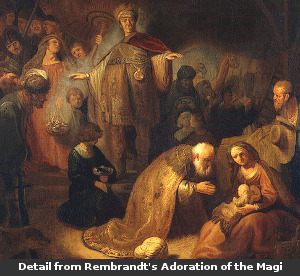
Previously (Part 1) we looked at a few myths surrounding the visit of the Magi to the child Jesus in Bethlehem. We questioned the ideas about the sources of their knowledge of the star and the “King of the Jews” as lying in astronomical phenomena or in astrological “signs.” What is an alternative explanation for their knowledge?
It is possible that the oracles of Balaam served as the source for their expectation of a Jewish king. Of the four oracles delivered by that fascinating man from beyond the Euphrates River (Num. 22:5), the last is most expressive: “I see him, but not now; I behold him, but not near: a star shall come out of Jacob, and a scepter shall rise out of Israel” (Num. 24:17). It is possible that the Magi from Persia had preserved the words of their “ancestor” Balaam and remembered his ancient prophecy when a “Star” did appear out of Jacob. Mention of the scepter also echoes an earlier Messianic reference in Gen 49:10.
An even stronger source for the Magi’s scriptural knowledge comes from the Book of Daniel. In the LXX Greek translation (Dan. 2:2,10), one of the words translated “wise men” is the same as the Greek word used in Matthew 2 (μάγοι/magoi). These Magi in ancient Babylon served as a religious caste in the state religion. One of their functions was to interpret dreams—a role in which they failed miserably in Daniel 2:1-13. Note Daniel 2:13—“So the decree went out, and the wise men (Magi) were about to be killed; and they sought Daniel and his companions, to kill them.” Therefore, Daniel and his three friends were associated with the Magi due to their God-given ability (Dan. 1:20-21). When Daniel accurately interpreted Nebuchadnezzar’s dream (Dan. 2:17-45), he was rewarded with an even higher position among them: “Then the king gave Daniel high honors and many great gifts, and made him ruler over the whole province of Babylon and chief prefect over all the wise men (including the Magi) of Babylon” (Dan. 2:48).
Consider also the amazing prophecy of the “seventy weeks” in Daniel 9:24-27. Verse 26 states that “Messiah (shall) be cut off” after a total period of 69 “sevens” (483 years). Therefore, Daniel’s book provides a timetable for the coming of the Messiah. This timetable from their leader must have been kept through the years by the Magi even after Babylon was conquered by the Persians.
There must have been a growing expectancy among the Magi as the years passed by. These Magi must have been watchful since the prophecy was originally given through one of “their own” many years before. Remember that a large Jewish community continued to exist in Babylon and Persia down through the centuries. They would have cherished Daniel’s prophecies and kept alive their hope.
Some have also suggested that one of the functions of the Magi was in the role of king-makers. It was they who went through the ritual of crowning new kings in Babylon and Persia. This would also shed light on their desire to encounter the “King of the Jews” and to “worship him” (Matt. 2:2).
What exactly was that “star” that led them?
In addition to the OT background for the Magi above, what help can be found in the OT for the correct interpretation of the star? The supernatural character of this brightness is implied by being described as “his star” (Matt. 2:2). I suggest that this unique shining was the glory of God described so often in the OT as the visible manifestation of God’s presence (e.g., Ex.16:10; 24:16-17, 33:22; 40:34). Or it may have been a glorious angel!
The incarnation of the Son was a manifestation of God’s glory (“the glory of the Lord shone around them” Lk. 2:9; “the Word became flesh and dwelt among us, and we have seen his glory” Jn. 1:14). When we recognize this, it is easy to see how the choice of the word “star” was so appropriate to describe just such a supernatural and visible token seen only by a select number (the shepherds and the Magi). No wonder that “when they saw the star, they rejoiced exceedingly with great joy” (Matt. 2:10).
A variation of this view is that the star was an angel, a view advocated in the patristic comments on this passage, and a view I develop in an academic article on this passage in the Tyndale Bulletin. Stars are often symbolic of angels elsewhere in Scripture (Job 38:7; Isa. 14:12; Rev. 1:20; 9:1,2; 12:4). That an angel also served to guide people in the OT can be seen in the following passages that use language quite similar to Matthew’s (Exo. 14:19; 23:20, 23; 32:34). There is, therefore, a wonderful point of contact with the Lukan Nativity because glorious angelic guidance was for both shepherds there (Luke 2:9-14) and the Magi here (Matt. 2).
This glory was the glory which the aged Simeon recognized as he held that baby in his arms (Lk. 2:32). This was that glory that shone through the earthly tabernacle of Jesus’ body on the mountain of transfiguration (2 Pet. 1:17, John 1:14), and it is that glory with which He shall come in great power (Matt. 25:31). Jewish people refer to the glory of God as the Shekinah—a later Hebrew word whose root idea is the concept of “dwelling.” The supernatural Shekinah inspired the Magi and directed their steps to the young Messiah.
As we have seen from a close reading of Matthew 2, there is indeed a “mythology of the Magi” that embodies questionable ideas about these men. There is also, however, some marvelous theology for us to see in their visit to Jerusalem and Bethlehem so long ago. We just need to look at the passage through the lens of the Hebrew Scriptures to see their real significance.
I close by asking why we do not believe we must have scientific evidence to prove Scripture, and yet we feel like we should find scientific evidence like a comet or planet conjunction to “prove” incidents like this “star”? This was a miracle, my friend. Why do we think we have to explain it by science?

Discussion
NewMiracle?
The near perfect Jupiter/Venus conjunction in Leo was six arcseconds from concentricity. When Venus is sufficiently elongated from the Sun, and the sky is crystal clear, Venus can barely be seen with the naked eye in broad daylight. This amazing conjunction was much brighter than Venus alone, it was certainly visible in broad daylight in a clear sky.
We don’t need science to prove scripture, but when science and scripture come into alignment it’s a blessing.
Newlooking through a diamond with poor eyesight
For myself, I have to say that without a willingness to conjecture, nothing at all could be learned in the first place, much less learned of the depth of God’s care.
We often disagree with each other over what conjectures we each find profitable to our appreciation of God’s care. But, I cannot proclaim a superiority of all of mine together, lest I too often shoot myself in the foot and others in the head.
I have observed arrogance in myself as much as in others, though I feel more offended by that of others. So, the best I can do is wonder at what I see of God’s care, and hope I do not either over- or under-value too much of it.
The next word you read is true (and now it's the seventh-to-last word).
New...by science? Here's a better question
Why does Matthew bother to use the word ‘star’ at all? If ‘his star’ is merely an angel, or merely God’s own direct glory, then why ‘star’ at all? Is ‘star’ here merely a reference of its resemblance to a star; Or, even to a sense by the eye-witnesses that it looked to them no different than a star?
But, if it looked no different to them than a star, then why would God have insisted on making it so appear? And, in that case, does God wish to make us wonder about actual stars in general? Or, instead, does God wish to make us suppose that actual stars, which He made, can never serve Him nor do His bidding? Or, maybe I’ve missed some third or fourth possibility?
I suppose that a near-passing comet can appear across the sky to be moving across and then arcing down to a sheer vertical ‘tail’; and, even, this comet at that point appearing to intersect one or more other actual stars. If a comet flies by close enough in space, I imagine that it’s exact vertical alignment with the ground, and perhaps including a vertical ‘tail’, can readily be triangulated.
I’m no ballistics/rocket/meteorology expert, but I suppose that to insist that a comet worthy of being ‘his star’ must pass by so close as to burn a village may be an insistence which is ignorant of some of the most basic measurement and navigation tools involving heavenly bodies. Must these ‘wise men’, despite that title, have been ignorant even of basic celestial navigation?
The next word you read is true (and now it's the seventh-to-last word).
NewSeen only by the magi?
Though signs are given, only those who mark the times, and in purity of heart, recognize the signs. This even is why the Pharisees did not recognize Jesus as Messiah; who were bent on their own finger-pointing traditions, which made them so much more righteous in their own eyes compared to some illegitimate son who seemed to them to be unable to name or otherwise identify his own father despite his claim to being known of his father and vice versa.
The next word you read is true (and now it's the seventh-to-last word).