Reflections on Republocrat: Beck, Limbaugh, O'Reilly & Fox
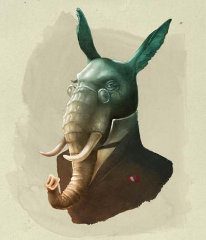
Chapter 3 of Carl Trueman’s Republocrat focuses on American conservative Christians’ view of the media—with Fox news as the focus.
Though the chapter (The Not So Fantastic Mr. Fox) seemed shorter, it’s length is actually the just-shy-of-twenty-pages standard for chapters in this book. Perhaps the illusion of shortness is due to my skimming several pages when it became clear they held nothing of interest (the part arguing against the virtuousness of Fox Broadcasting Company and Mr. Murdoch; since I never thought they were especially virtuous, and don’t know anyone who does, I didn’t care).
But Trueman does make some solid points in the chapter. We’ll consider those before I return to the problems.
Bias
Fox News is indeed biased, as the chapter asserts—depending on how you define bias. Trueman observes, “I like to argue in class that in the writing of history, no one can be neutral” (p. 42). From there, he distinguishes (though doesn’t really differentiate) between bias and objectivity. But he is undoubtedly right that there’s never been a human being who looks at events and ideas with some kind of tabula rasa.
Full disclosure: since our family doesn’t value cable or satellite programming enough to pay the monthly fee, my exposure to Fox News has usually been in small bits in auto-repair shop lobbies, video clips on the Internet and the odd occasion where the cable channel takes over local broadcast news for a period.
Nonetheless, to be human is to be biased, and since Fox News aims to avoid a particular bias, it undoubtedly replaces it—intentionally or otherwise—with another. As Trueman puts it,
I also have no problem with outrageous overstatement to make a point, no doubt being guilty of it myself on various occasions. The problem is neither of these things; rather, it is the failure to notice that these two things are actually happening. To refer to Fox News as “the unbiased one” is to make the mistake of thinking that all one gets on Fox are “the facts.” (p. 43)
Sloppiness
Trueman writes:
But my great fear is that Christian frustration with the liberal media has led to an overreaction that has generated a culture where alternative opinions are never, or rarely, considered, and where the most inarticulate and insubstantial arguments are swallowed whole. (p. 42)
He’s got a point there—more than one.
My weekly routine involves a fair amount of driving, so when I’m not listening to audio books, I’m sampling talk radio, usually of the conservative variety. What I hear there is indeed the “preaching to the choir” brand of reasoning. It’s human nature. If you’re speaking to an audience of fans, they hold you to a lower standard of proof than they do their ideological opponents. You get lazy sometimes.
These guys could try harder. I often hear Limbaugh, Beck, Hannity, et. al., make arguments so badly that even I—who am definitely on the conservative side of the great divide—get pretty disgusted and frustrated. Unfairly-construed sound bytes and inaccurate, sweeping generalities are routine, not to mention—in the case of Limbaugh—more than a little crass language, cursing, and sleazy innuendo. It’s sometimes enough to get me turning the dial to—gasp—NPR! (At least there, the bad arguments are uttered in well-modulated voices in a calm, even tone, and using a loftier vocabulary. That seems to fool a lot of people into thinking they’re hearing smarter radio.)
Trueman’s complaints focus on Beck and O’reilly, both of whom were with Fox when the book was written. The chapter quotes Beck and faults him for identifying “Marxism with the welfare state,” for characterizing the welfare state as “designed to stop anyone from getting a ‘boo-boo,’” and for asserting that welfare-state nations have only been able to sustain their approach “through the barrel of a gun.” (p. 45).
Trueman targets Beck’s paranoia as well, and describes his fans as “presumably already on board with the somewhat scary Beckian view of the world where ‘they’ are apparently always out there, trying their best to ‘get us.’” (p. 46)
Similarly, the author faults O’Reilly for inaccurate use of the term “socialist” to mean that “the government has all the power. You have none. Can you say Fidel Castro?” (quoting O’Reilly there, p. 46-47). Trueman objects:
I am not a socialist and never have been, but my grandparents were, and for the record, neither of them believed that the government had the right to control or seize private property in the kind of unconditional way implied by O’Reilly. (p. 47)
What Trueman has right here is that conservative pundits often use terms a bit carelessly and link things together without adequately noting important differences.
Ickiness
Trueman is certainly right that Rupert Murdoch is “scarcely a paragon of Christian virtue,” (p. 51), and that Fox TV puts out its share of sleazy entertainment. The Simpsons are his case in point. From what I’ve seen, that show is nothing compared to American Dad and Family Guy—and those are just the “cartoons.” The chapter devotes five pages to making this point (50-55).
Weaknesses
As trenchant as Trueman’s analysis is in places, the lack of attention to underlying political philosophy evident in ch. 2—and even more in ch. 1—is again evident here. First, a few smaller issues.
Maybe the distinction doesn’t exist in the UK, but here in America there’s a difference between news and commentary. Beck, Limbaugh, Hannity and O’Reilly are in the latter category and are usually pretty clear about that. Rush used to regularly characterize what he does as entertainment. Beck still uses the tagline “the fusion of entertainment and enlightenment.” In short, they don’t claim to be unbaised. The exception, perhaps is O’Reilly, who claims the “no spin zone” line. But even he is clear that what he does is mainly “opinion.”
Furthermore, as I’ll explain later, Beck, Limbaugh, et. al., are far better informed (if not always more articulate) than, say, Olbermann, Stewart, and Colbert. There is no true equivalence between the entertainment-commentariat of the Right and that of the Left.
As for the news arm of Fox News, just about every time I see it, two people who passionately disagree are trying to talk or yell over each other. Doesn’t look to me like a place where viewers are never exposed to alternative views.
Context
What Trueman seems to miss in the chapter is the historical-ideological context for what guys like Beck, Limbaugh, et. al. are yelling (often literally) about. Two very different sets of views about human nature, human society and the role of government began to battle for dominance in the 18th century. Weighed on the scale of biblical principles these two sets of views are not even close to equal.
Furthermore, it is nontrivial that when our country was founded, the thought that dominated was not the set of beliefs from which any flavor of socialism is a descendent. To say it another way, the USA was established by people who consciously rejected the ideas that are foundational to the Left and the kinds of socialism that eventually grew on that tree.
The consequence is that, for all their regrettable shallowness and sloppiness, the media voices of the Right are far closer to the truth than they may seem, and the subject matter is far less neutral than it may seem. What Limbaugh, Beck, et. al. understand is that movement toward the Left is movement away from who we are as a nation and movement toward socialism travel down a completely different highway than the one we set out on in 1789.
If Trueman were to take the historical-ideological factor into account, he’d be less critical of the voices on the Right and also less eager to advocate something like a 50-50 exposure to the thought of the Left. There really isn’t much virtue in revisiting settled questions.
Aaron Blumer Bio
Aaron Blumer, SharperIron’s second publisher, is a Michigan native and graduate of Bob Jones University (Greenville, SC) and Central Baptist Theological Seminary (Plymouth, MN). He and his family live in a small town in western Wisconsin, not far from where he pastored Grace Baptist Church for thirteen years. He is employed in customer service for UnitedHealth Group and teaches high school rhetoric (and sometimes logic and government) at Baldwin Christian School.


Yes, bias is unavoidable… and we need it. If we tried to get machines to interpret history or the news and deliver it to us “objectively,” the machine would deliver random bits of info—unless we gave it criteria for estimating relevance, value, narratives to fit the facts into, etc. So we’d have to bias the machine.
On the other hand—I don’t know the techinical hermeneutical terms for this (and hermeneutical niceties quickly become nothing more than annoying, in my opinion)—it’s possible to exercise the imagination to look at things from a bit of a distance, look at them from multiple points of view. So something like simulated objectivity is possible to a degree and a good thing to some degree.
But as I alluded to at the end of the post, we all have our settled non-negotiables. I’m not about to start seriously considering the idea that human beings may actually have unlimited potential and ability to change for the better and that traditional social norms are what’s holding us back on our march toward greatness, and that the way forward is to engineer society through constant innovation.
Then you have the boatload of notions that descend from those.
I’m not interested in looking at things from that point of view except for the purpose of better understanding how to oppose it.
Views expressed are always my own and not my employer's, my church's, my family's, my neighbors', or my pets'. The house plants have authorized me to speak for them, however, and they always agree with me.


It helps to note that there are different ‘kinds’ of conservatives. There are economic conservatives, social conservatives, paleo-conservatives, crunchy conservatives, and religious conservatives, and probably more that I can’t think of right now. These are constantly confused, but without putting someone’s ideology into the proper context, it’s a mess. IMO it’s why the ‘Christian right’ gets blamed for everything, because they are the first group that comes to mind when someone says ‘conservative’.
It also accounts for the “You say you’re a Christian and you voted for ____?” Well, I wasn’t voting for a pastor or deacon, but for someone with the knowledge and experience to make good choices fiscally, diplomatically, etc…

Furthermore, it is nontrivial that when our country was founded, the thought that dominated was not the set of beliefs from which any flavor of socialism is a descendent. To say it another way, the USA was established by people who consciously rejected the ideas that are foundational to the Left and the kinds of socialism that eventually grew on that tree.
It may be not be factually or historically trivial, but perhaps it is practically trivial. The constitution not only doesn’t rules out socialism but positively ensures—by protecting the free exchange of ideas, by instituting representative government, and by allowing for constitutional amendment—that socialism is “in play” as an option for national direction. Thus to head that direction is no real betrayal of our heritage even if it is a bad idea.

In the original post, Aaron said: “There really isn’t much virtue in revisiting settled questions.” Then in a comment he said: “I’m not interested in looking at things from that point of view except for the purpose of better understanding how to oppose it.”
You are proving Trueman’s point. I don’t understand an unwillingness to consider other points of views on the numerous governmental complexities that come in our societal structure.
Do you really think behind every comment or position that a liberal commentator may have is a big evil agenda about the supreme goodness and potential of fallen man?
Yes some things can be settled, but can’t other people have a point sometimes on some things?
It seems that in principle you wouldn’t have a problem with a complaint I raised earlier. I was spending the night in a Christian family member’s home recently and turned the channel to an interesting documentary on CNN. I was told: “We only watch Fox News in this house.”
That kind of closed mindedness is not laudable, in my book. It stunts one’s perspective. Maybe conservative ideology is the best there is. But it shouldn’t be afraid of exposure to competing ideologies. Other viewpoints should be caught and heard so we can understand where people are and how others think - not just for ammunition to nail them in our next debate.
Your loyalty to conservatism seems so big that one would have to guess the Bible teaches the pillars of conservatism. When in fact, it doesn’t. Christians have served Christ in feudalistic societies, imperial cultures, and stalinist regimes. Christians need to be careful wherever they are to avoid turning the governmental or political climate into a Christianized entity. We are in the world but not of the world. No political system is expressly taught in Scripture, and so every Christian must apply Scripture where they are as best they can.
Assuming the conversation is over and that real Christians should agree with you, and your political persuasion, is not the most effective strategy in persuading others and it muddles the water when it comes to defining the Christian faith for the world.
Striving for the unity of the faith, for the glory of God ~ Eph. 4:3, 13; Rom. 15:5-7 I blog at Fundamentally Reformed. Follow me on Twitter.

Yes, Fox news overall is biased. But there is certainly a difference between their hard news division and their opinion programs like O’Reilly, Hannity, etc.
Fox does hire many liberal opinion people, but they generally get talked over. Sometimes they are permitted to anchor key slots, however, and can say their piece.
On the hard news side, the top Fox news anchor Shep Smith is not conservative socially or politically. I can’t really tell where Bret Baier stands politically, but his excellent news hour is conservative in the same way the big networks are liberal…choice of stories, who tends to get the last word in political stories, and the (always respectful) panel discussions are usually weighted slightly in the conservative direction.
On the talk-radio side, I prefer Denis Prager… more thoughtful, cleaner, calmer, and more respectful to those who disagree. Actually, I think he’s something of a model for how conservatives should talk to the other side. He listens, and asks good questions. “I prefer clarity to agreement,” he says. And I think he does.
[Bob] You are proving Trueman’s point. I don’t understand an unwillingness to consider other points of views on the numerous governmental complexities that come in our societal structure.
First, Trueman’s point on this is not that tuning out happens but that tuning out is bad. My lack of openness proves that this happens… but nobody is disputing that. The question is, what’s wrong with not being open?
While I was reading the chapter, I couldn’t help but think of all the things Trueman himself doesn’t listen to with an open mind—his observations about the Trinity and the Elephant Room come to mind. He is not interested in the other side’s view on the Trinity. But in the same chapter is very closed minded about lots of things. For example, the idea that news can be unbaised. It’s in his settled questions category.
If there was a group of people arguing that Aaron doesn’t exist, this too would be in my settled questions category. So… we don’t need to have Holy Writ to justify tabling questions that are no longer of interest.
But I need to clarify what it is I am not interested in hearing:
- Ideas rooted in an unbiblical view of human nature, society and the role of government. If these ideas depend on premises I know to be false, why should I be open to them?
- Tired old arguments I’ve heard a zillion times before. In some cases, the lack of interest is just do “been there; done that.”
- Information framed in ways full of both of the above. If I can get the same info from somewhere else, I don’t see any virtue in getting it wrapped in confusion and cliche.
As for “numerous governmental complexities,” it’s not really these that are in my settled questions file. Lots of things are debatable multiple ways from both visions of human nature and society/gov. And because humans are not logically consistent, we can reason from premise A to conclusion B only to later realize that we should have reasoned from the same premise to conclusion C.
So to me, lots of things are debatable. Which foreign crises justify our military involvement? How to solve the growing health care cost problem? Is a gold standard a good idea vs. fiat currency? Should the government provide tax-payer funded education at all, and if so, how to make such a system actually work? Can we cut military spending in ways that make us more efficient but not more weak? The list goes on and on.
But when you start with different assumptions, you approach these questions quite differently, even if you do arrive at some of the same conclusions as “the other side.” So I’m not usually interested in how people with different assumptions process the questions—but sometimes they get to useful solutions despite faulty assumptions.
About socialism
This post is already long… It’ll have to suffice for now to say that even though the founders organized the nation in such a way that allows for the possibility that we might vote in favor of socialism, they designed the gov’t to resist the view of man and society that socialism depends on.
It’s like using an aircraft as a submarine. You can use the ability of the craft to fly to a lake and land it on it. But as it sinks, you have to do a whole lot of frantic rebuilding to turn it into a vehicle suitable for underwater travel. The analogy is a bit extreme… a better one might be trying to use a motorcycle as a snowmobile. Not as impossible, but still involves big changes and ending up with something that the cycle was never intended to be. (If you want a snow vehicle it makes more sense to trade the bike in and start over with the right sort of machine)
Views expressed are always my own and not my employer's, my church's, my family's, my neighbors', or my pets'. The house plants have authorized me to speak for them, however, and they always agree with me.
one would have to guess the Bible teaches the pillars of conservatism. When in fact, it doesn’t. Christians have served Christ in feudalistic societies, imperial cultures, and stalinist regimes.
Actually it does—depending on how you define conservatism.
The fact that Christians “have served” in societies structured in lots of ways doesn’t say one way or the other whether those societies were structured in biblical ways.
But as it turns out, the conservative view of human nature, society and government is called “conservative” because it aims to hold on to long standing understandings of people and society… understandings that go back into feudalist and imperial times.
Views expressed are always my own and not my employer's, my church's, my family's, my neighbors', or my pets'. The house plants have authorized me to speak for them, however, and they always agree with me.
Best comment on here.
I enjoy political commentary when it is framed as commentary. Truth in advertising, if you will. What I am unbelievable sick and tired of is ‘news’ outlets that are not about NEWS.
Five Ways the Mainstream Media Tipped the Scales in Obama’s Favor is a good illustration of this phenomena.
It’s fine that people will, consciously or unconsciously, present facts in ways that support their argument. But we’ve become so tolerant of “everyone’s opinion matters as much as anyone else’s opinion” that the ability of the average person to understand a reasonable and logical argument is now about equal to that of a parsnip. What’s worse is, people no longer care. They’ve got their cable, their smokes, and their booze. Why bother with all that thinking?
I’ve been trying not to think about political philosophy at all today … and even less about “politics,” but thoughts come unbidden.
One thing the once upon a time conservative movement in the US is going to have to do is face the fact that it has failed to be persuasive. Then, facing that, it’s going to have to ask why and what the answer implies for the future.
Conservative talk radio (and presumably TV—I just hardly ever see any of that) is going to have to face the fact that as a tool for stirring up it’s own, it’s done pretty well, but as a tool for persuading the uninformed, undecided and unsupportive, it has not accomplished anything. Since Leftist political assumptions dominate mass media, entertainment, education and labor (MEEL)—conservatives will need something capable of reaching the audiences who are in the grip of those influences.
Suggestion: think long term. Forget about 2014 or even 2016 and aim for 2020 at the soonest. Develop a plan for truly persuading the American electorate of key conservative principles (start by persuading “conservatives”! Many don’t really have a clue!). Find a way to end the ideological dominance of the Left in MEEL. This will never be accomplished by preaching to the choir (or by “equipping” the choir with arguments too thin to persuade anyone not already in it).
Views expressed are always my own and not my employer's, my church's, my family's, my neighbors', or my pets'. The house plants have authorized me to speak for them, however, and they always agree with me.

Aaron,
I think you hit on one of the issues. People don’t channel surf on the radio; you have to be looking for conservative talk radio to find it. A truly conservative voice on TV would be a start toward reaching a new audience.
I really think the issue is moral, not political. We have been coasting (downhill) on the momentum of a more Judeo-Christian past. That steam is just about spent. I don’t really see anything making a difference short of revival or catastrophe.
Why is it that my voice always seems to be loudest when I am saying the dumbest things?
Re: Socialism— the country has been retooling for socialism for the last 60 years. I would characterize the transition as fairly smooth and proceeding apace. A ‘crash landing’ is potentially coming, but will be in the eye of the beholder. Socalists will see it as an appropriate adjustment.
Re: Glenn Beck— His tagline might better declare “the fusion of entertainment and heresy.” Today, with my own ears, I heard him say “we have a constitution, one that is divinely inspired.” I have also heard him expressly apply the scriptural promise of the gates of hell not prevailing to the conservative movement (not today, although he did again reference that phrase, but in a different context). At what point do we declare him a wolf preying on sheep?
We’re all agreed that human nature and the fundamental nature of human societies are not going to change by any merely-human means. There’s no truly Great Society until that society consists of people who have been transformed from the outside, graciously, into great people—by a power not their own.
But looking at history, we can find periods in which multiple societies ebbed and flowed, some reaching very low points morally and ethically, only to eventually return to better ways of thinking and behaving… until the pendulum swung again. The fact that the swings for the better are always temporary doesn’t mean they aren’t worth striving for. (There are economic cycles also, but is anyone arguing that because prosperous times are temporary, we should try to make non-prosperous times permanent? Doesn’t make sense.)
So, providentially, societies have—at various times—embraced better values and truer views of how to manage and mitigate (never really solve) social problems. I think a society has probably never been turned around “on purpose” though.
(But as a sliver of evidence that this is not categorically impossible, notice how the abortion debate is now mostly about the rape exception? That’s because the debate is no longer about whether there is anything in the womb worth caring about. Opponents of abortion have managed to influence attitudes significantly in this area.)
Views expressed are always my own and not my employer's, my church's, my family's, my neighbors', or my pets'. The house plants have authorized me to speak for them, however, and they always agree with me.
[DavidO]Re: Socialism— the country has been retooling for socialism for the last 60 years. I would characterize the transition as fairly smooth and proceeding apace. A ‘crash landing’ is potentially coming, but will be in the eye of the beholder. Socalists will see it as an appropriate adjustment.
Re: Glenn Beck— His tagline might better declare “the fusion of entertainment and heresy.” Today, with my own ears, I heard him say “we have a constitution, one that is divinely inspired.” I have also heard him expressly apply the scriptural promise of the gates of hell not prevailing to the conservative movement (not today, although he did again reference that phrase, but in a different context). At what point do we declare him a wolf preying on sheep?
Can’t disagree with much there. Beck is too poorly informed to be “safe” for listeners who are also poorly informed. He does not know what “divinely inspired” means.
On socialism, it’s true that European-style socialism has been established in countries that were anything-but, way back when. In England, for example, it happened slowly enough that they are mostly socialist yet still manage to have a monarchy. So the airplane can be made to cruise the depths… though it looks pretty goofy with big ol’ wings still attached.
Whether it can be done slowly enough in the US to still resemble how we began, I don’t know. The bigger question is whether it ought to be done, and you already know how I feel about that.
Views expressed are always my own and not my employer's, my church's, my family's, my neighbors', or my pets'. The house plants have authorized me to speak for them, however, and they always agree with me.
Featured Resource

Discussion