The Best Cure for KJVOism: A Real 1611 KJV
82 replies [Last post]
Douglas K. Kutilek
Douglas K. Kutilek's picture
Offline
User
Joined: Wed, Jun 17 2009
Posts: 25

Reprinted with permission from As I See It. AISI is sent free to all who request it by writing to the editor at dkutilek@juno.com

It has been widely publicized that the year 2011 is the 400th anniversary of the original publication of the “Authorized” or King James Version of the Bible in English. Historically, this translation has been the most widely used, at least since it overtook the previous champion, the Geneva Bible of 1560 (chiefly, at least initially, as a result of the legal suppression of the printing of the Geneva Bible by the British monarchy, in favor of the KJV).

Note, however, that the great majority of the editions and copies of the KJV printed and read in the past 400 years have been revisions rather than reprints of the original form of the KJV, with literally tens of thousands of revisions in spelling, punctuation and the use of italics, plus many hundreds of revisions in the precise wording of the text. Later editions also included the switch from “black letter” (“Gothic”) type to Roman, the widespread omission of the Apocrypha in the 18th and later centuries, along with the omission of an extended calendar and charts of biblical genealogies. Most unfortunately, later editions omit the extremely important and informative introductory essay, “The Translators to the Readers,” which was included in the original edition. In short, most KJV users, particularly those who claim to be “King James Version 1611 Only” in their beliefs, have never actually seen or used a real 1611 King James Version in the original form in which it was issued from the press in 1611.

Past facsimiles

In the past facsimile reprints of the 1611 KJV have been produced from time to time. In 1833, “The Holy Bible, an exact reprint page for page of the Authorized Version published in the year 1611” was printed at the University Press, Oxford. It featured Roman type.1 In 1911, the University Press at Oxford issued two 1611 reprints—the first a facsimile (in black letter) in reduced size of the original 1611 KJV, the other an exact reprint page-for-page but in Roman type, both with introductory essays by A. W. Pollard.2 I have owned a copy of the 1911 Roman type reprint for almost 35 years.

This 1911 Roman type reprint was reissued in the 1970s (or early 1980s) by Thomas Nelson of Nashville, about the time they issued their New King James Version (and for a time Nelson sold the two volumes together in a slipcase). This reprint omitted the Pollard essay (and perhaps other features—I gave my copy to one of my sons a few years ago and cannot check it directly). Later—probably in the 1990s—Hendrickson Publishing also reprinted the 1911 Roman type edition (in precisely the form Nelson had). These two recent reprints are easy to find via the Internet.

Besides these, over the years various publishers have produced several full-sized facsimile reprints of the 1611 KJV. My brother has a copy of one made in the 1950s, for which he paid $350, used, a decade ago. Such full-sized facsimiles are rarely seen and are generally rather pricey (in the hundreds or even many hundreds of dollars).

An affordable new facsimile

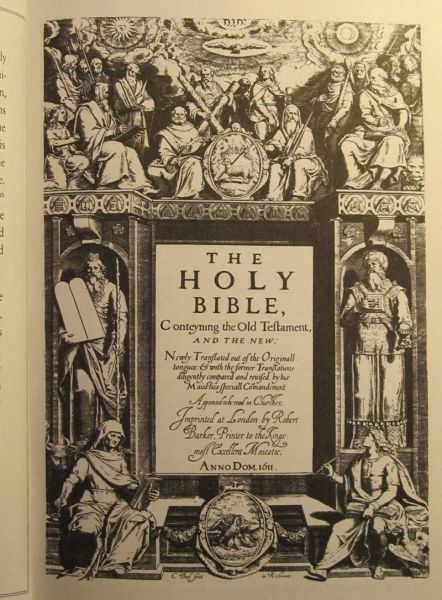
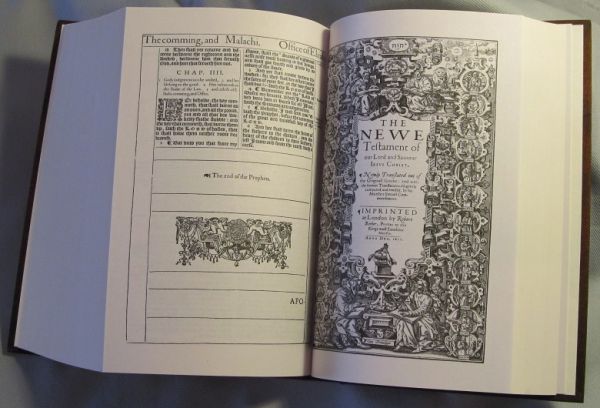
Now, another edition, widely available and quite inexpensive, has appeared. This one is made by Zondervan and sold at Wal-Mart (and perhaps other retail outlets). The ISBN is 978-0-310-44029-1. It is a facsimile—an exact reproduction in the original black letter script—of the 1611 edition, but in a reduced size, and with one feature of the original omitted—the thirteen books of the Apocrypha (as noted on p. viii of the Introduction to this new edition). That the 1611 KJV originally did have the Apocrypha can be visually confirmed in this edition on the page containing Malachi 4, where the “catch-word” at the bottom of the page is “APO-” which points to “APOCRYPHA” which is at the top of the next page in the original (and in my 1911 reprint), after which originally followed the complete text of those non-canonical books.

Image of Holy Bible, 1611 King James Version: 400th Anniversary Edition
by Zondervan
Zondervan 2011
Hardcover, 1312 pp.

The printed retail price of this Zondervan 2011 facsimile reprint is $7.99, though I have bought several copies at Wal-Mart in Kansas for $4.97. I have heard it priced about a dollar higher elsewhere (and I suspect they hope to make a profit on the publication of the KJV at that price). I would strongly urge every preacher, every Christian reader and every church and Christian college library to get a copy at once. If you have any KJVO friends, buy and give them a copy. There is no quicker cure for KJVOism that the direct and extended study of the 1611 edition, introductory material and all.

One finds in the actual, original, genuine 1611 KJV (no doubt “preserved in the form God wants us to have”) an introductory essay that states the translators’ perspective on their own and other translations (they, at least, were decidedly not “KJV-only”). If I could do just one thing to combat KJVOism, I would have every KJVO believer carefully read those eleven, highly informative pages. The original translators’ English Bible text has literally thousands of variant marginal renderings (showing that they did not believe their translation as found in the text was infallibly correct), plus variant manuscript readings, showing that they did not believe that the manuscript reading given in their text was necessarily always right. One will also find numerous places where words are “omitted,” “added” or altered as compared with all modern editions of the KJV, to say nothing of a considerable number of printer’s errors (are these also part of the “perfect preservation” we hear so much about?). And one can discover on the title page of the NT those revealing words: “cum privilegio” (Latin: “with privilege”) which demonstrate the fact that this translation was copyrighted from the day it was first published (contrary to the misrepresentation on this point that is often part of KJVO teaching).

I am quite sure that the quickest “cure” for KJVOism is the close and careful study of the actual original KJV itself. I would challenge—even dare—everyone of KJVO persuasion to get this facsimile of the original KJV and study it cover to cover and margin to margin, spending a year and more in the process, and try to prove me wrong.

(Photos of a copy of the Zondervan 400th anniversary facsimie 1611. Click to enlarge.)
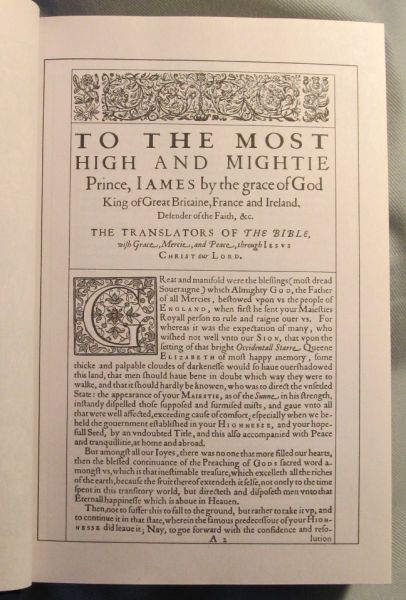
dedication page

apo


Notes

1 See A. S. Herbert, Historical Catalogue of Printed Editions of the English Bible 1525-1961. London: British and Foreign Bible Society, 1968; p. 377.

2 Ibid., p. 458.


Doug Kutilek is the editor of www.kjvonly.org, a website dedicated to opposing KJVOism. He has been researching and writing in the area of Bible texts and versions for more than 35 years. He has a BA in Bible from Baptist Bible College (Springfield, MO), an MA in Hebrew Bible from Hebrew Union College (Cincinnati. Completed all requirements for a PhD except the dissertation) and a ThM in Bible exposition from Central Baptist Theological Seminary (Plymouth, MN). His writings have appeared in numerous publications. He is the father of four grown children and four granddaughters and resides with his wife Naomi near Wichita, KS.

B-Lowry
B-Lowry's picture
Offline
User
Joined: Wed, Jun 17 2009
Posts: 20
Well done, brother!

As you say, the Translators' Preface would be especially valuable to read and understand. (And the second word "understand" is the key one.) Merely reading and understanding the section on "An Answer to the Imputations of our Adversaries" would do the trick, I think.

And if they did not understand the older English, they could purchase the booklet from the ABS that contains the original preface in a facsimile, the same in Roman type and an updated "translation" of the preface.

Then again, perhaps the whole KJVO thing is a judgment on the arrogance of Americans.

Aaron Blumer
Aaron Blumer's picture
Offline
UserEditorAdmin
Joined: Mon, Jun 1 2009
Posts: 5367
A little lump & dump repellant

Just want to point out that there are several varieties of KJVO and not all of them believe that the KJV contains no translation errors, no alternative textual selection, etc.
But for those that do, a 1611 facsimile is a great eye opener. The margins are full of "or this" and "or that" alternatives.

(The very unprofessional photos are mine. Picked up a copy yesterday for the church library.)

Bill... I'm curious: what does "the arrogance of Americans" have to do with it?

Steve Newman
Offline
User
Joined: Thu, Jun 4 2009
Posts: 108
Makes more sense than most of the KJVO arguments on both sides..

I appreciate the way the author related the issues to the "fault lines" of KJVO positions today.
I also appreciate knowing there are inexpensive copies out there. Everyone's looking for a deal!

Bob Hayton
Bob Hayton's picture
Offline
UserEditor
Joined: Mon, Jul 27 2009
Posts: 487
Could "arrogance of the

Could "arrogance of the Americans" refer to our assumption of the superiority of English? As in, those living in Europe or other parts of the world, cannot but rub shoulders with other languages frequently. They thus are intimately aware of the issues inherent in translation. Most people in Europe are bilingual. Contrast that with Americans who believe earnestly that their country is superior to all others, and that people coming to their country should just learn English. In that mindset, why shouldn't English be the last best thing when it comes to languages and Bibles, for that matter? And not understanding how translation works, many assume any deviation from the English of one translation is necessarily a capitulation from God's Word.

Is that what you're getting after, Bill?

__________________

Striving for the unity of the faith, for the glory of God ~ Eph. 4:3, 13; Rom. 15:5-7

I blog at Fundamentally Reformed. Follow me on Twitter.

dcbii
dcbii's picture
Offline
ModeratorUserEditor
Joined: Wed, May 6 2009
Posts: 574
1611

I used to attend a church that went to KJVO while I was there. I bought one of the older reprints (with Roman type and the included Apocrypha) as a bit of a tweak for both sides. The non-KJVO side couldn't tell me that 1. I didn't really have a 1611 copy and 2. that it would be impossible for people today to read it. I used it as my main church Bible for probably about 8 years or so until I switched to an iPhone as my main Bible. For the KJVO side, I had the preface to the reader, the notes about variants in the margins, and so on, so when I heard all about the best texts, I could point out that the KJV scholars weren't 100% sure about every word either (fewer mistakes is little help when your contention is that the text behind the translation is perfect).

In short, I agree with the author that having a copy is a good defense against most unthinking KJVO-ism, but it also shows just how good and usable the 1611 still is, even though it isn't ideal for many who aren't educated in reading skills. I'd like to have one of these in e-format to add to my iPhone, but that probably seems backwards to most.

I did just order one of the new reprints to be able to have one with the old Gothic type.

__________________

Dave Barnhart

Ron Bean
Offline
User
Joined: Tue, Jun 2 2009
Posts: 308
Because the supporting texts

Because the supporting texts are the issue for me, I carry my 1599 Geneva as my tweak. If it was good enough for the Pilgrims it's good enough for me.

__________________

"Some things are of that nature as to make one's fancy chuckle, while his heart doth ache." John Bunyan

dcbii
dcbii's picture
Offline
ModeratorUserEditor
Joined: Wed, May 6 2009
Posts: 574
Official language(s)
Bob Hayton wrote:

Most people in Europe are bilingual. Contrast that with Americans who believe earnestly that their country is superior to all others, and that people coming to their country should just learn English.

Well, since I married a German citizen, I determined to learn German and I did. I fully expect to use it and I do when I am in Germany, which is fairly frequently. However, by the same token, I do in fact expect people coming here to learn English. That's not just an American perspective. Germans expect that people immigrating there learn German. I've read plenty about that in their news and commentary. Like us, they are concerned about immigrants not integrating themselves into the culture. For an extreme example of this, try traveling to France sometime. I've noticed that many will only attempt English with you if you demonstrate that you know another besides English, even if it isn't French. (When I did that, they almost invariably concluded that I was Swiss, not American, since of course, Americans are anything but bilingual.)

I do appreciate the perspective that learning another language has given me on the whole Bible translation issue, and how difficult and complex it is, and why the KJV doesn't really matter to non-English speakers.

(By the way, even though I think immigrants to America should learn good English, I'm not one of those who thinks we should take the KJV to other countries and attempt to force them to learn English to read the Bible, just in case the argument in your post was going that way.)

So I do think your point about Americans' arrogance and English is well taken, though I think believing people should speak English in America is not really part of that problem.

__________________

Dave Barnhart

Kevin Subra
Kevin Subra's picture
Offline
User
Joined: Tue, Jun 2 2009
Posts: 88
Yes!

For years I've used the KJV's Letter to the Translators and excerpts from my 1611 KJV facsimile copy by Nelson (apparently now out of print: http://www.amazon.com/Holy-Bible-1611-James-Version/dp/0840700415/) as core tools to teach a proper view of the origins of the Bible, and to counter the KJVO views. The original 1611 has the marginal translation variations and included Apocrypha (!), which for some reason is not referenced in KJVO circles much.

(In "another life," I was a bookstore manager at FBBC. People would come in looking for the 1611, and I'd take them to the only copy we had - the Nelson facsimile. The puzzled looks were rewarding. ;>D)

I am for accurate, literal translations, of which the KJV is one (of the few), but it is just that -- a translation (or more accurately, the 5th revision of the Tyndale NT). I like to jokingly refer to myself as "New King James Only," as I admire the marginal references to the NU and M texts (in the spirit of the KJV translators in giving accurate information about alternative or ambiguous translating options).

Thanks for writing the article. An honest look at the true "original KJV" would silence most KJVO views and statements. The Letter to the Translators is wonderfully written, and could precede any newer (good) translation or revision. It is definitely something worth promoting (it has been published by itself, as I have a copy, but I cannot find reference to it on Amazon). Along with facsimile pages, these are GREAT tools for teaching the truth about translations.

__________________

For the Shepherd and His sheep,
Kevin
Grateful husband of a Proverbs 31 wife, and the father of 15 blessings.
http://captive-thinker.blogspot.com

wdlowry
wdlowry's picture
Offline
User
Joined: Tue, Jun 2 2009
Posts: 11
I can't claim to speak for

I can't claim to speak for Dr. Lowry, but I have had the opportunity to have slightly-greater-than-passing acquaintance with him. Smile I trust I'm not misrepresenting him, but I think Bob pretty much nailed what he was getting at, at least in the context of this discussion. I imagine my dad was also making a broader generalization about how the rest of the world or at least Europe perceives Americans. We tend to see ourselves as always right and to think our way of doing things is always the best way. The KJVO issue is merely one example of that problem.

We've asked Germans before how they would describe Americans in one word and inevitably the word seems to be "proud." The same might be said about all sinful humans, but we Americans seem to take the lead.

B-Lowry
B-Lowry's picture
Offline
User
Joined: Wed, Jun 17 2009
Posts: 20
My son, David, correctly spoke for me

Aaron, et al, the fact that most Americans speak only English and their attitudes towards all other languages, etc. was what I was referring to. And yes, more than once we heard the word "proud" or "arrogant" used of Americans while we were in Germany.

But that point was also a generalization - always dangerous and REALLY dangerous on a blog. Smile

dcbii
dcbii's picture
Offline
ModeratorUserEditor
Joined: Wed, May 6 2009
Posts: 574
Generalizations...
B-Lowry wrote:

Aaron, et al, the fact that most Americans speak only English and their attitudes towards all other languages, etc. was what I was referring to. And yes, more than once we heard the word "proud" or "arrogant" used of Americans while we were in Germany.

Yes, it's kind of sad. I pretty much WAS one of those before I married a European... I mean, of course everything is always better here, isn't it? Amazing how actual information shoots down a lot of your assumptions.

Quote:

But that point was also a generalization - always dangerous and REALLY dangerous on a blog. Smile

Well, that particular generalization is pretty easy since Americans generally make themselves easy targets in this area.

Originally, I was really only responding to the part of Bob's post that mentioned expecting people to speak English when they come here. I think that's a separate topic from being arrogant about thinking the whole world should just learn English, even when we are visiting *their* country.

__________________

Dave Barnhart

Bob Hayton
Bob Hayton's picture
Offline
UserEditor
Joined: Mon, Jul 27 2009
Posts: 487
Yes generalizations can be

Yes generalizations can be dangerous! And I probably over did my treatment too....

Dave (dcbii) said:

"So I do think your point about Americans' arrogance and English is well taken, though I think believing people should speak English in America is not really part of that problem."

I would actually agree, to a certain extent, with the last line. I was more describing America and how it might be perceived that this is not wise. However, while I think immigrants should seek to learn English, it often will take more than one generation. Sometimes our insistence on English smacks of racism, to a degree. It took the Swedes two or three generations before the Swedish speaking churches around here in Minneapolis, adopted English. I find that thought enlightening in the whole immigration debate. But that is definitely a topic for another day and another thread!

Thanks again,

Bob

__________________

Striving for the unity of the faith, for the glory of God ~ Eph. 4:3, 13; Rom. 15:5-7

I blog at Fundamentally Reformed. Follow me on Twitter.

Aaron Blumer
Aaron Blumer's picture
Offline
UserEditorAdmin
Joined: Mon, Jun 1 2009
Posts: 5367
English

There are other languages? When did that happen?

Kevin Subra
Kevin Subra's picture
Offline
User
Joined: Tue, Jun 2 2009
Posts: 88
Other Languages

Aaron,

Rest easy. The other languages are just fictitious (Klingon, Hobbitese). No need to worry. (worry-eth?)

__________________

For the Shepherd and His sheep,
Kevin
Grateful husband of a Proverbs 31 wife, and the father of 15 blessings.
http://captive-thinker.blogspot.com

RPittman
RPittman's picture
Offline
Former member
Joined: Tue, Sep 15 2009
Posts: 1170
A two-edged knife cuts both ways . . . . .
B-Lowry wrote:

As you say, the Translators' Preface would be especially valuable to read and understand. (And the second word "understand" is the key one.) Merely reading and understanding the section on "An Answer to the Imputations of our Adversaries" would do the trick, I think.

And if they did not understand the older English, they could purchase the booklet from the ABS that contains the original preface in a facsimile, the same in Roman type and an updated "translation" of the preface.

Then again, perhaps the whole KJVO thing is a judgment on the arrogance of Americans.[emphasis added]

Yeah, it applies to both sides of the issue. I find a certain smugness and arrogance by the critics of the KJVO position. There's a certain stereotyping of KJVO proponents so that ignorance and inaccuracies abound.

RPittman
RPittman's picture
Offline
Former member
Joined: Tue, Sep 15 2009
Posts: 1170
Depends on your presuppositions . . . .
Kevin Subra wrote:

For years I've used the KJV's [b]Letter to the Translators and excerpts from my 1611 KJV facsimile copy by Nelson (apparently now out of print: http://www.amazon.com/Holy-Bible-1611-James-Version/dp/0840700415/) as core tools to teach a proper view of the origins of the Bible, and to counter the KJVO views. The original 1611 has the marginal translation variations and included Apocrypha (!), which for some reason is not referenced in KJVO circles much.[/b][emphasis added]

(In "another life," I was a bookstore manager at FBBC. People would come in looking for the 1611, and I'd take them to the only copy we had - the Nelson facsimile. The puzzled looks were rewarding. ;>D)

I am for accurate, literal translations, of which the KJV is one (of the few), but it is just that -- a translation (or more accurately, the 5th revision of the Tyndale NT). I like to jokingly refer to myself as "New King James Only," as I admire the marginal references to the NU and M texts (in the spirit of the KJV translators in giving accurate information about alternative or ambiguous translating options).

Thanks for writing the article. An honest look at the true "original KJV" would silence most KJVO views and statements. The Letter to the Translators is wonderfully written, and could precede any newer (good) translation or revision. It is definitely something worth promoting (it has been published by itself, as I have a copy, but I cannot find reference to it on Amazon). Along with facsimile pages, these are GREAT tools for teaching the truth about translations.

Evidently, you're assuming that the KJV translators were conscious of their role in preservation. This point doesn't carry much weight if we view preservation as God working through the actions of men to preserve His word, which does not require the men's intended purpose or their awareness of their role. You implied argument may be cogent for you in your paradigm but others have reason to question and discount it. Sorry, but it simply doesn't clinch your case.

RPittman
RPittman's picture
Offline
Former member
Joined: Tue, Sep 15 2009
Posts: 1170
Specious reasoning . . . . .
Douglas K. Kutilek wrote:

I am quite sure that the quickest “cure” for KJVOism is the close and careful study of the actual original KJV itself. I would challenge—even dare—everyone of KJVO persuasion to get this facsimile of the original KJV and study it cover to cover and margin to margin, spending a year and more in the process, and try to prove me wrong.

Many KJVOs proudly own and carefully peruse their facsimile of the 1611 KJV. I fail to see how this would affect their belief in a received text and a preserved Scripture.

Jeff Brown
Jeff Brown's picture
Offline
User
Joined: Fri, Jun 5 2009
Posts: 214
American Arrogance

Since most discussions about KJV Only get polarized, and since Bill, David and I know each other well and share similar experiences, I am happy to give a little relief to the discussion by relativizing what they have said:

Ask an Irishman what he thinks of the Birtish; ask most Europeans their impression of the French; ask the Turkish, Dutch or African people what they think of the Germans; Ask the Germans what they think of the Chinese. They will all answer with "Arrogant" or "Proud." I have had South American Christians tell me that certain other South American Christians who come to Europe trying to change everything are "arrogant." Americans do not have a corner on pride. Pride often has to do with power, or the perception of power.

Germans have likewise told me to my face that Americans are stupid, and that the downfall of the US is imminent because Americans practice such poor nutrition. Whenever my freinds begin to wax eloquent this way, I respond, "Like McDonalds, you mean." "Yes, that too," they respond. "Well," I answer, "that's your problem. We all know that there is only one superpower in the world, the US, and that the Americans have been devouring McDonalds hamburgers for decades. Maybe people here are missing something!"

All that said, it is a bit of arrogance to propound to people of a different language that one of your English translations is better than anything they have ever produced. After all, how many American preachers had the entire Latin NT memorized, like Martin Luther, before they began translating?

Bill and David: die Ablenkung bitte verzeihen!

__________________

Jeff Brown

Aaron Blumer
Aaron Blumer's picture
Offline
UserEditorAdmin
Joined: Mon, Jun 1 2009
Posts: 5367
Hamburger

How'd we get to McDonalds? Oh yeah... KJVO & American arrogance.
FWIW, Jeff, tell your German friends that McD's sells so much stuff now you can actually eat "healthy" there now if you want to. I was visiting relatives in Illinois a couple weeks ago. We were out and about a good bit and grabbing fast food. It was so hot all I wanted to eat was "fruit smoothies" - with real fruit and yogurt, no less. Had a lot of them. I'm pretty sure they did me little more good than the Big Mac, but Mrs. Obama would have been proud.

Anyway, Roland, I've heard the counterargument before that the KJVO translators just didn't happen to be clued in on how perfect their work was and the fact that it represented the preserved word of God in English.
I'm not too worried about it. Their own words deflate that argument at a gut level. It is possible to see the translators' view of things and still hold to a "perfect KJV" view of some kind, but once you know how they viewed it, the sails are much lacking in wind.

What we actually have is gracious providential use of the KJV by God in mighty ways for generations. We should rejoice in that. I don't think we're improving the scenario by trying to make something "more" out of it.

Kevin Subra
Kevin Subra's picture
Offline
User
Joined: Tue, Jun 2 2009
Posts: 88
I Not Connecting with Your Comment
RPittman wrote:

Evidently, you're assuming that the KJV translators were conscious of their role in preservation. This point doesn't carry much weight if we view preservation as God working through the actions of men to preserve His word, which does not require the men's intended purpose or their awareness of their role. You implied argument may be cogent for you in your paradigm but others have reason to question and discount it. Sorry, but it simply doesn't clinch your case.

I've present no "case" or any argument whatsoever. I've only affirmed thoughts in the article by my own practices.

I am wholly against the KJVO movement, having been exposed to it early in my adult life, and working through it over several years in my own mind. When I first had the opportunity to preach in a small southern (small "s") Baptist church and referred to a Greek definition from the Strong's, I was gently chided that I was undermining the authority of the KJV...

I believe that the KJVO movement does precisely what it attempts to prevent by adding to the Word of God.

The Letter to the Translators simply counters a large number of arguments posited by KJVO proponents and arguments that I have been exposed to, all of which are profoundly ignorant if compared to the Letter. From memory only, the Letter to the Translators preemptively argues against many objections, a few of which are: (1) the need for a "new" translation when other good translations exist; (2) the desire to translate into understandable language so that even the vulgar man behind the plow can understand it; (3) the value of previously translated works (answering the question, "Is what we have had not the Word of God then?"), etc. The Letter to the Translators is profoundly opposed to the KJVO movement on many fronts.

The original with the Apocrypha and the marginal variants is a huge counter to many arguments of KJVO-ism today. The fact that proponents do not use the 1611 (which is largely unreadable by the average person today without much difficulty) is another brazen example of the shallowness of many KJVO people.

I am an ardent proponent of accurate, literal translations, of which there are few. To the best of pastors' ability, I believe they are required to study from the original languages before coming to conclusions. Translations are only best efforts of the translators, but they cannot replace original language study, which is essential to proper interpretation.

I am not sure what you are talking about in the KJV translators' role in preservation. No idea.

__________________

For the Shepherd and His sheep,
Kevin
Grateful husband of a Proverbs 31 wife, and the father of 15 blessings.
http://captive-thinker.blogspot.com

RPittman
RPittman's picture
Offline
Former member
Joined: Tue, Sep 15 2009
Posts: 1170
Arguing no arguments . . . . ??? :-/
Kevin Subra wrote:
RPittman wrote:

Evidently, you're assuming that the KJV translators were conscious of their role in preservation. This point doesn't carry much weight if we view preservation as God working through the actions of men to preserve His word, which does not require the men's intended purpose or their awareness of their role. You implied argument may be cogent for you in your paradigm but others have reason to question and discount it. Sorry, but it simply doesn't clinch your case.

I've present no "case" or any argument whatsoever. I've only affirmed thoughts in the article by my own practices.

I am wholly against the KJVO movement, having been exposed to it early in my adult life, and working through it over several years in my own mind. When I first had the opportunity to preach in a small southern (small "s") Baptist church and referred to a Greek definition from the Strong's, I was gently chided that I was undermining the authority of the KJV...

I believe that the KJVO movement does precisely what it attempts to prevent by adding to the Word of God.

The Letter to the Translators simply counters a large number of arguments posited by KJVO proponents and arguments that I have been exposed to, all of which are profoundly ignorant if compared to the Letter. From memory only, the Letter to the Translators preemptively argues against many objections, a few of which are: (1) the need for a "new" translation when other good translations exist; (2) the desire to translate into understandable language so that even the vulgar man behind the plow can understand it; (3) the value of previously translated works (answering the question, "Is what we have had not the Word of God then?"), etc. The Letter to the Translators is profoundly opposed to the KJVO movement on many fronts.

The original with the Apocrypha and the marginal variants is a huge counter to many arguments of KJVO-ism today. The fact that proponents do not use the 1611 (which is largely unreadable by the average person today without much difficulty) is another brazen example of the shallowness of many KJVO people.

I am an ardent proponent of accurate, literal translations, of which there are few. To the best of pastors' ability, I believe they are required to study from the original languages before coming to conclusions. Translations are only best efforts of the translators, but they cannot replace original language study, which is essential to proper interpretation.

I am not sure what you are talking about in the KJV translators' role in preservation. No idea.

My point was simply that the argument from the translators' preface does not necessarily refute a KJVO position. What most KJV opponents fail to realize is that the KJVO is not a monolithic movement. KJVO describes people of differing views of what KJVO means and for differing reasons. Thus, for arguments against a KJVO position to be effective, one must accurately state the KJVO position and then refute it. For many in the KJVO camp, the issue is more about preservation and a received text rather than what you perceive as the standard KJVO position. Quite frankly, none of your arguments move me. It's more of the same old pabulum. I think too many KJVO opponents are listening to one another for their take on what KJVO is.

RPittman
RPittman's picture
Offline
Former member
Joined: Tue, Sep 15 2009
Posts: 1170
Limiting the debate . . . . .
Aaron wrote:

Anyway, Roland, I've heard the counterargument before that the KJVO translators just didn't happen to be clued in on how perfect their work was and the fact that it represented the preserved word of God in English.
I'm not too worried about it. Their own words deflate that argument at a gut level. It is possible to see the translators' view of things and still hold to a "perfect KJV" view of some kind, but once you know how they viewed it, the sails are much lacking in wind.

What we actually have is gracious providential use of the KJV by God in mighty ways for generations. We should rejoice in that. I don't think we're improving the scenario by trying to make something "more" out of it.

Aaron, let's limit the debate to what I said and the single point that I addressed. Otherwise, you're morphing my views into things that I have never said or believed. My chief complaint about discussing the KJVO issue with you and others is that I make a simple argument confined to a single point and end up explaining and defending things that I never said or do not believe because folks assume that I hold this or that view. I'm very uncomfortable the way you use the word "perfect" regarding the KJV. What do you mean by this? Whereas I will say the KJV is the inspired Word of God, I do not use the word "perfect" in this context because it is so vague and undefined.

Furthermore, my observation was limited to the fact that the translators' preface does not necessarily refute KJVO arguments if the arguments are about divine preservation and the continuity of a received text. Did the translators have to be consciously aware of divine preserving influence if preservation is true? For sake of argument, were the inspired writers of Scriptural necessarily aware of divine inspiration at the moment of their writing? How do you know? Did they all say, "We are writing divinely inspired Scripture," or did we reason that? Either way, you must admit that the translators preface carries no more weight than any other men's opinions, modern or ancient. It does not carry the force of Scripture. Furthermore, the translators said exactly what we would expect them to say given their time and place in history.

RPittman
RPittman's picture
Offline
Former member
Joined: Tue, Sep 15 2009
Posts: 1170
Not representative . . . . .
Jeff wrote:

All that said, it is a bit of arrogance to propound to people of a different language that one of your English translations is better than anything they have ever produced.

I don't think this attitude and position is representative of most KJVOs. Most will say something like this: "The KJV is God's Word for the English-speaking people."

Kevin Subra
Kevin Subra's picture
Offline
User
Joined: Tue, Jun 2 2009
Posts: 88
More Pabulum
RPittman wrote:

My point was simply that the argument from the translators' preface does not necessarily refute a KJVO position. What most KJV opponents fail to realize is that the KJVO is not a monolithic movement. KJVO describes people of differing views of what KJVO means and for differing reasons. Thus, for arguments against a KJVO position to be effective, one must accurately state the KJVO position and then refute it. For many in the KJVO camp, the issue is more about preservation and a received text rather than what you perceive as the standard KJVO position. Quite frankly, none of your arguments move me. It's more of the same old pabulum. I think too many KJVO opponents are listening to one another for their take on what KJVO is.

I've made no attempt to argue. I have simply stated, briefly, a few of my own views which relate directly to the posting. The nature of this posting does not appear to attempt to be the end all for the KJVO controversy.

I do believe that the Letter to the Translators does counter and refute many of the KJVO arguments (that I have heard first hand), as does an examination the original 1611 itself. It may not address views of the KJVO believers in their entirety. It most certainly does address a large number.

I also consider the arguments of the Received Text (or the Majority Text) at a different level than the preservation arguments of the KJV, and have not commented on this at all, as it is outside the scope of the brief posting about a particular piece of evidence regarding the KJVO discussion.

I understand that men can work under the direction without being aware of it. I also understand that men can overstate what the Word does say, and create new "fundamentals" which did not historically exist.

I am further aware that categorizing comments as "the same old pabulum" does not consist of evidence or argument itself, and really is a comment that serves no beneficial purpose in this short discussion.

I have not listened to any KJVO opponents, nor have I read their books. I have come up through the ranks of them as a young adult and drawn my own conclusions from my own study and observations, in part of which was my own discovery of the Letter to the Translators.

I do believe that the KJVO arguments at all levels have been used to create needless division in the body of Christ, and they have separated well-intended people (and thus weakened the cause of Christ), and they have distracted the Church from making of disciples to the arguing over something that simply is not clearly stated Scripture.

Feel free not to be moved. I make no effort to do so.

__________________

For the Shepherd and His sheep,
Kevin
Grateful husband of a Proverbs 31 wife, and the father of 15 blessings.
http://captive-thinker.blogspot.com

Kevin Subra
Kevin Subra's picture
Offline
User
Joined: Tue, Jun 2 2009
Posts: 88
Men's Words
RPittman wrote:

Furthermore, my observation was limited to the fact that the translators' preface does not necessarily refute KJVO arguments if the arguments are about divine preservation and the continuity of a received text. Did the translators have to be consciously aware of divine preserving influence if preservation is true? For sake of argument, were the inspired writers of Scriptural necessarily aware of divine inspiration at the moment of their writing? How do you know? Did they all say, "We are writing divinely inspired Scripture," or did we reason that? Either way, you must admit that the translators preface carries no more weight than any other men's opinions, modern or ancient. It does not carry the force of Scripture. Furthermore, the translators said exactly what we would expect them to say given their time and place in history.

This would equally apply to the words and views of those holding the KJVO only positions. The Word never says that the KJV is/will be the word of God for the English speaking people, either implied or explicitly stated. That, in my opinion, results in adding to the Word of God that they attempt to defend.

__________________

For the Shepherd and His sheep,
Kevin
Grateful husband of a Proverbs 31 wife, and the father of 15 blessings.
http://captive-thinker.blogspot.com

Susan R
Susan R's picture
Offline
ModeratorUserUser accounts adminAdmin
Joined: Wed, May 6 2009
Posts: 3424
Perfect

How about in the same sense that God described His creation as 'good'? Was it perfect? It was exactly what He wanted it to be, wasn't it? Just a thought.

__________________

Susan R

Blogging at At Home and School and Shelf Discoveries
"Like" my Facebook page

RPittman
RPittman's picture
Offline
Former member
Joined: Tue, Sep 15 2009
Posts: 1170
Not true . . . . .
Kevin wrote:

This would equally apply to the words and views of those holding the KJVO only positions. The Word never says that the KJV is/will be the word of God for the English speaking people, either implied or explicitly stated. That, in my opinion, results in adding to the Word of God that they attempt to defend.

By the same standard, Scripture does not specify the books of the canon but we have no problem is believing the canon is complete. It is NOT adding to God's Word to believe the KJV is God's Word for English-speaking people if the proponents do not attribute it to Scripture, which is not necessary for their argument. Kevin, you're missing a piece of your logic puzzle.

RPittman
RPittman's picture
Offline
Former member
Joined: Tue, Sep 15 2009
Posts: 1170
Good idea . . . .
Susan R wrote:

How about in the same sense that God described His creation as 'good'? Was it perfect? It was exactly what He wanted it to be, wasn't it? Just a thought.

Yeah, it's a good thought but I don't think most are thinking of "perfect" in this way.

RPittman
RPittman's picture
Offline
Former member
Joined: Tue, Sep 15 2009
Posts: 1170
Flavoring for the pabulum . . . . .
Kevin wrote:

I've made no attempt to argue. I have simply stated, briefly, a few of my own views which relate directly to the posting. The nature of this posting does not appear to attempt to be the end all for the KJVO controversy.

This is the second time that you've denying engaging in argument. What's so important about this that you argue that you "made no attempt to argue"? If you post a response either in support or contrary to another posted item, then you are supporting one side or the other and engaging in argument.

Quote:

I have not listened to any KJVO opponents, nor have I read their books. I have come up through the ranks of them as a young adult and drawn my own conclusions from my own study and observations, in part of which was my own discovery of the Letter to the Translators.

One doesn't form opinions in a vacuum. I don't find your ideas necessarily original. It's basically the usual response of anti-KJVOs. I dare say that you've heard them other places. So, what are you trying to prove? The ideas are your own?

Quote:

I do believe that the KJVO arguments at all levels have been used to create needless division in the body of Christ, and they have separated well-intended people (and thus weakened the cause of Christ), and they have distracted the Church from making of disciples to the arguing over something that simply is not clearly stated Scripture.

Oh, this old shoe again! The MVs have had their fair share of creating the division by blasting the KJVO position and ridiculing its proponents. The MVs have needlessly divided many churches when the enlightened few set out change everyone else. Agitating for change and pushing for the MVs has precipitated much of the division. Of course, there are a few KJVO extremists (e.g. Peter Ruckman et. al.) who are abrasive and glory in creating controversy but you cannot judge everyone by them.

Anyway, Kevin, I'm glad that you learned a new vocab word from this--pabulum. LOL Smile

Jeff Brown
Jeff Brown's picture
Offline
User
Joined: Fri, Jun 5 2009
Posts: 214
Response to Roland

So Roland, do you live here in Europe?

__________________

Jeff Brown

Jeff Brown
Jeff Brown's picture
Offline
User
Joined: Fri, Jun 5 2009
Posts: 214
Aaron nr. 19

I think I would have to agree with the president's wife on getting American youth in shape. Still, all those changes at McDonalds! To think that they aren't running full-throttle carb-salt-fat menu really makes you sad. If they are losing their identity, maybe America really is going downhill.

__________________

Jeff Brown

Kevin Subra
Kevin Subra's picture
Offline
User
Joined: Tue, Jun 2 2009
Posts: 88
Words to No Profit
RPittman wrote:

LOL Smile

Argument: I've written nothing to document, persuade, or move. If showing affirmation to the article is presenting an argument in your view, enjoy.

Vacuum: The arguments against the KJVO movement are not created in a vacuum, but by those that study the Word (both what it says and what it does NOT say). I would suggest that it is possible to anyone to come to similar conclusions presented in this article by anyone exposed to some of the KJVO arguments by reading the Letter to the Translators and/or viewing the original 1611 without input. I did (having attended a KJVO church for 2 years). Truth is not a vacuum.

Blasting: If calling something "old shoe" is a form of argument, you've won - I'm not sure how to respond. I have not blasted or ridiculed anyone. I have shared my experiences and observations and conclusions. Don't take it personal. Personally, I do consider the KJVO a divisive heresy, which is extreme by its very nature, that has caused more harm than those who seek to correct it (by my own experiences).

Pabulum: You have my biography detailing my life's experiences AND my vocabulary list? LOL Wink

The field is all yours, my friend. I'm afraid there is more heat than light here. I do agree with the premise of the posting, and have agreed with its ideas long ago, and have regularly taught such as part of my 25 years of pastoring to help believers avoid the ditches of KJVOism. (No LOL here...)

__________________

For the Shepherd and His sheep,
Kevin
Grateful husband of a Proverbs 31 wife, and the father of 15 blessings.
http://captive-thinker.blogspot.com

RPittman
RPittman's picture
Offline
Former member
Joined: Tue, Sep 15 2009
Posts: 1170
Domicile . . . . .
Jeff Brown wrote:

So Roland, do you live here in Europe?

No.

J Ng
J Ng's picture
Offline
User
Joined: Tue, Jun 16 2009
Posts: 104
Meaning?
RPittman wrote:

I don't think this attitude and position is representative of most KJVOs. Most will say something like this: "The KJV is God's Word for the English-speaking people."

We hear what's said, but we're not so naive as to not know the implications.

Smile

Greg Long
Greg Long's picture
Offline
User
Joined: Tue, Jun 2 2009
Posts: 516
Let's see, the Roland Pittman

Let's see, the Roland Pittman KJVO check list...

Calling your opponents' arguments pabulum, fiddle faddle, hogwash, humdrum, balderdash, hokum, poppycock, twaddle, horsefeathers, etc...CHECK!

Objecting to an opponent's argument but not staying what, specifically, you believe about the matter...CHECK!

Next up...stating that your opponents' arguments are all based on rationalism!

__________________

Pastor of Adult Ministries
Grace Church, Des Moines, IA

dcbii
dcbii's picture
Offline
ModeratorUserEditor
Joined: Wed, May 6 2009
Posts: 574
:)
RPittman wrote:

Let's see, the Roland Pittman KJVO check list...

Calling your opponents' arguments pabulum, fiddle faddle, hogwash, humdrum, balderdash, hokum, poppycock, twaddle, horsefeathers, etc...CHECK!

Objecting to an opponent's argument but not staying what, specifically, you believe about the matter...CHECK!

Next up...stating that your opponents' arguments are all based on rationalism!

While I do get some sharpening from Roland's arguments on occasion, I had to laugh at this. You nailed it!

__________________

Dave Barnhart

Aaron Blumer
Aaron Blumer's picture
Offline
UserEditorAdmin
Joined: Mon, Jun 1 2009
Posts: 5367
Maybe I missed something
RPittman wrote:

Furthermore, my observation was limited to the fact that the translators' preface does not necessarily refute KJVO arguments if the arguments are about divine preservation and the continuity of a received text.

Yes, a "KJVO argument" that doesn't claim a word perfect translation or a word perfect text would not find any difficulties with the translators' stated views. I think I pretty much said that in my first post in the thread.
But most variants of KJVO claim one or the other or both. It's pretty rare to find a preservation or text argument that does not strongly imply that the TR used for KJV is a word-perfect preserved edition of the Greek NT... and that the KJV is the word-perfect preserved English version.

But I have met some who use the KJV exclusively and believe using other versions is "wrong," even though they acknowledge that the KJV has a translation error here and there and that the TR is incorrect here and there. For them, the TR is the right text "type" and the KJV is an especially blessed rendering of it into English. "KJVO" is probably not the best term for this attitude given how it differs from views that have come to characterize--apparently--the majority of KJVO folks.

RPittman
RPittman's picture
Offline
Former member
Joined: Tue, Sep 15 2009
Posts: 1170
Definition please . . . . .
Aaron Blumer wrote:
RPittman wrote:

Furthermore, my observation was limited to the fact that the translators' preface does not necessarily refute KJVO arguments if the arguments are about divine preservation and the continuity of a received text.

Yes, a "KJVO argument" that doesn't claim a word perfect translation or a word perfect text would not find any difficulties with the translators' stated views. I think I pretty much said that in my first post in the thread.
But most variants of KJVO claim one or the other or both. It's pretty rare to find a preservation or text argument that does not strongly imply that the TR used for KJV is a word-perfect preserved edition of the Greek NT... and that the KJV is the word-perfect preserved English version.

But I have met some who use the KJV exclusively and believe using other versions is "wrong," even though they acknowledge that the KJV has a translation error here and there and that the TR is incorrect here and there. For them, the TR is the right text "type" and the KJV is an especially blessed rendering of it into English. "KJVO" is probably not the best term for this attitude given how it differs from views that have come to characterize--apparently--the majority of KJVO folks.

What is a translation error? Aaron, would you please define it for me? Is it not the exact word, although it may be synonymous? Or, does it translate the wrong thought or idea? Or, is it an incorrect grammatical construction?

Also, what is "a word perfect text?" Are you saying there is a one-to-one word correspondence to the Greek NT? Are you are arguing for static semantic word content? Or, do you see it in more fluid terms where the semantic content is determined by the context? If so, can you see the argument for a possible meaning of "a word perfect text" where the words are defined by the Biblical context itself? Furthermore, there is the pervasive influence of the KJV on the development of the English language so that English words are infused with theological content. Could it be that the English language has been so strongly pressed into the mold of Biblical language from the KJV that the context of the words give the words semantic content that comprise "a word perfect text?"

My final point is that one doesn't necessarily need to claim "a word perfect text," in the way it is commonly understood, to be KJVO and believe the KJV to be the inspired Word of God preserved for modern speakers of English.

RPittman
RPittman's picture
Offline
Former member
Joined: Tue, Sep 15 2009
Posts: 1170
Clairvoyance?
J Ng wrote:
RPittman wrote:

I don't think this attitude and position is representative of most KJVOs. Most will say something like this: "The KJV is God's Word for the English-speaking people."

We hear what's said, but we're not so naive as to not know the implications.

Smile

So, how do you know? Puzzled

Jeff Brown
Jeff Brown's picture
Offline
User
Joined: Fri, Jun 5 2009
Posts: 214
Living in Europe
RPittman wrote:
Jeff Brown wrote:

So Roland, do you live here in Europe?

No.

Roland

Please excuse my delayed response. I only asked because I did not want to negate your evaluation on the basis of your own experience if you lived here. I have experienced several preachers teaching exactly what I have mentioned here in Europe (i.e. the KJV is superior to any translation in your other language). I have also experienced Germans believing it.

__________________

Jeff Brown

RPittman
RPittman's picture
Offline
Former member
Joined: Tue, Sep 15 2009
Posts: 1170
Fringe elements . . . .
Jeff Brown wrote:
RPittman wrote:
Jeff Brown wrote:

So Roland, do you live here in Europe?

No.

Roland

Please excuse my delayed response. I only asked because I did not want to negate your evaluation on the basis of your own experience if you lived here. I have experienced several preachers teaching exactly what I have mentioned here in Europe (i.e. the KJV is superior to any translation in your other language). I have also experienced Germans believing it.

I understand but I think you are experiencing some of the KJVO fringe elements. I hope this is not representative of the majority. Are you near an American military facility? If so, Ruckman has a following among the military. Also, I've heard of missionaries who only made translations into native languages from the KJV.

Aaron Blumer
Aaron Blumer's picture
Offline
UserEditorAdmin
Joined: Mon, Jun 1 2009
Posts: 5367
Irrelevancies
RP wrote:

What is a translation error? Aaron, would you please define it for me? Is it not the exact word, although it may be synonymous?...

They take many forms. We don't have to define it to know that it exists. Human beings make mistakes.

RP wrote:

Also, what is "a word perfect text?" Are you saying there is a one-to-one word correspondence to the Greek NT?

That would be a good question for those who claim they have such a text. I can't speak for them.

But to clarify, "text" refers to the Greek itself, not any translation of it. "Text" is what you begin with; "translation" is what you end with. But I don't think any of those who hold to "word perfect translation" define that in terms of the number of words used in the receptor language. But you'd have to ask them I guess.
Most KJVO advocates today claim two things:

  • word perfect Hebrew and Greek texts
  • a word perfect translation of those texts

RP wrote:

... Could it be that the English language has been so strongly pressed into the mold of Biblical language from the KJV that the context of the words give the words semantic content that comprise "a word perfect text?"

I don't know what this has to do with anything. In any case, it's circular. The English language could not possibly have been in this KJV-influenced condition when the KJV was created. (I'm assuming here that by "text" you mean "translation")

RP wrote:

My final point is that one doesn't necessarily need to claim "a word perfect text," in the way it is commonly understood, to be KJVO and believe the KJV to be the inspired Word of God preserved for modern speakers of English.

Yes. I've already stated that a couple of times. But why anybody who believes the KJV is imperfect would want to claim to be "KJVO" is a bit of a head-scratcher for me. A case for exclusive use of KJV that makes no claim to KJV perfection is a very different view from what is now the majority KJVO perspective.

Aaron Blumer
Aaron Blumer's picture
Offline
UserEditorAdmin
Joined: Mon, Jun 1 2009
Posts: 5367
"the inspired word"

One more thing...
It isn't really possible to claim that KJV is "the" inspired word (as in "the one" inspired word in English) and simultaneously deny that it is "a word perfect translation."

Well, I should say, it's possible to claim that, but it's not possible to make any sense claiming it.
If it is not word perfect, then some other English translation might be made that is a bit better--or one might already exist that is a bit better. So a denial of "word perfect" status effectively claims the possibility of improvement and legitimizes the effort to make something better.

Can't really reject 'word perfect' and also reject alternative translation work.

RPittman
RPittman's picture
Offline
Former member
Joined: Tue, Sep 15 2009
Posts: 1170
Do we know what we're talking about?
Aaron Blumer wrote:
RP wrote:

What is a translation error? Aaron, would you please define it for me? Is it not the exact word, although it may be synonymous?...

They take many forms. We don't have to define it to know that it exists. Human beings make mistakes.

Well, Aaron, if we can't define it, then it tells me that we're coming up short somewhere. How can we have meaningful discussion? I cannot agree there are translation errors until I know what I'm agreeing to. Puzzled

RPittman
RPittman's picture
Offline
Former member
Joined: Tue, Sep 15 2009
Posts: 1170
How do you know?
Aaron Blumer wrote:

Can't really reject 'word perfect' and also reject alternative translation work.

Why? It's not apparent to me.

RPittman
RPittman's picture
Offline
Former member
Joined: Tue, Sep 15 2009
Posts: 1170
Explain to me . . . .
Aaron Blumer wrote:

One more thing...
It isn't really possible to claim that KJV is "the" inspired word (as in "the one" inspired word in English) and simultaneously deny that it is "a word perfect translation."

Well, I should say, it's possible to claim that, but it's not possible to make any sense claiming it.
If it is not word perfect, then some other English translation might be made that is a bit better--or one might already exist that is a bit better. So a denial of "word perfect" status effectively claims the possibility of improvement and legitimizes the effort to make something better.

Can't really reject 'word perfect' and also reject alternative translation work.

It seems to me that you're back to your antiquated static semantic content of words. If you can get past this obstacle to a more modern view of language, then you could see that the context defines and limits semantic content. If so, the context of the KJV could possibly tolerate minor variants of word choice, especially in the matter of articles, etc. Changes have been made in the KJV from the original 1611 version to our present version. This is no problem with semantic content controlled by context. As for alternative translation work using dynamic equivalence and an eclectic text, the context is changed. You don't have to believe this argument but I'm surprised that you don't understand it.

RPittman
RPittman's picture
Offline
Former member
Joined: Tue, Sep 15 2009
Posts: 1170
Who drew the circle?
Aaron Blumer wrote:
RP wrote:

... Could it be that the English language has been so strongly pressed into the mold of Biblical language from the KJV that the context of the words give the words semantic content that comprise "a word perfect text?"

I don't know what this has to do with anything. In any case, it's circular. The English language could not possibly have been in this KJV-influenced condition when the KJV was created. (I'm assuming here that by "text" you mean "translation")

Who said this was present at translation? You drew the circle, not me. Could it be progressive? After all, the 1611 version was changed in later versions of the KJV.

RPittman
RPittman's picture
Offline
Former member
Joined: Tue, Sep 15 2009
Posts: 1170
Define your terms . . . . .
Aaron Blumer wrote:
RP wrote:

My final point is that one doesn't necessarily need to claim "a word perfect text," in the way it is commonly understood, to be KJVO and believe the KJV to be the inspired Word of God preserved for modern speakers of English.

Yes. I've already stated that a couple of times. But why anybody who believes the KJV is imperfect would want to claim to be "KJVO" is a bit of a head-scratcher for me. A case for exclusive use of KJV that makes no claim to KJV perfection is a very different view from what is now the majority KJVO perspective.

We still haven't agreedd on what comprises "a word perfect text." So, it does NOT necessarily follow that the KJV is imperfect. A strict word-for-word correspondence, without any variants of articles, etc., is not necessary for one to believe the KJV is inspired Word of God. After all, what is the benchmark for judging "a word perfect text" without any deviations?

Let me approach it from a different angle. Would you please thoughtfully answer this question: Do you believe that the Word of God is bound eternally in static semantic content of human language represented by the Hebrew, Aramaic, and Greek of the original autographs written over hundreds of years in the style and vocabulary of the human amanuensis? If so, how can you say any translation is the inspired Word of God?

Jeff Brown
Jeff Brown's picture
Offline
User
Joined: Fri, Jun 5 2009
Posts: 214
Not fringe Roland
Quote:

I understand but I think you are experiencing some of the KJVO fringe elements. I hope this is not representative of the majority. Are you near an American military facility? If so, Ruckman has a following among the military. Also, I've heard of missionaries who only made translations into native languages from the KJV.

The instances of which I am thinking occurred in ministries of American missionaries in Germany and France. In no case that I know of, did they have anything to do with American military facilities. The writings of Ruckman had an influence on the missionary in one of those instances.

But my point is validated. Coming to a country with the view that your particular translation is better than anything in their language is arrogance. If I have experienced several of those, it has doubtless happened many times.

Enough said, I think.

__________________

Jeff Brown

RPittman
RPittman's picture
Offline
Former member
Joined: Tue, Sep 15 2009
Posts: 1170
Strange . . . .
Jeff Brown wrote:
Quote:

I understand but I think you are experiencing some of the KJVO fringe elements. I hope this is not representative of the majority. Are you near an American military facility? If so, Ruckman has a following among the military. Also, I've heard of missionaries who only made translations into native languages from the KJV.

The instances of which I am thinking occurred in ministries of American missionaries in Germany and France. In no case that I know of, did they have anything to do with American military facilities. The writings of Ruckman had an influence on the missionary in one of those instances.

But my point is validated. Coming to a country with the view that your particular translation is better than anything in their language is arrogance. If I have experienced several of those, it has doubtless happened many times.

Enough said, I think.

Strange . . . I've never really encountered it in KJVO circles although I've heard it existed on the fringe . . . . I still question that it is representative . . . . .

Aaron Blumer
Aaron Blumer's picture
Offline
UserEditorAdmin
Joined: Mon, Jun 1 2009
Posts: 5367
OK, I'll bite...

Roland, I think it's obvious what these terms mean... and also obvious that defining them precisely is not necessary. Any reasonable range of definitions works just fine, and you can take your pick.

Nevertheless, some very basic definitions...
"Translation errors" are mistakes made by translators in the process of translating.
"Word perfect" means every word is there either as God inspired it (in the case of the texts) or as God providentially produced it (in the case of translations).

Of course, some KJVOs believe the translators were inspired. But many, maybe most now, do not.

I don't know how to make my other main point any clearer than I already have. It has nothing to do with any particular idea of the meanings of words. If a translation is perfect, then there is no reason to seek an alternative. If it is imperfect, then there is reason to seek an alternative.
Therefore, if one believes a translation is not perfect, one may not categorically reject subsequent translation work.

Unless... a possible counter-argument (which you haven't made, so I guess I'll argue both sides of this!) might be to take the position that the KJV is not perfect but is as perfect as it is possible for any translation to be. This view would allow someone to deny that the translation is perfect and simultaneously claim that no other translation ought to be attempted.

But there's a downside to that: as hard as it is to make a case that the KJV is perfect, it's even harder to make one that it's imperfect but cannot be improved upon.

RP wrote:

Let me approach it from a different angle. Would you please thoughtfully answer this question: Do you believe that the Word of God is bound eternally in static semantic content of human language represented by the Hebrew, Aramaic, and Greek of the original autographs written over hundreds of years in the style and vocabulary of the human amanuensis? If so, how can you say any translation is the inspired Word of God?

It can be said far more plainly.
God inspired the Scriptures in Hebrew, Aramaic and Greek. Men of old spoke as they were moved by the Holy Spirit. He did not inspire any translations.

RPittman
RPittman's picture
Offline
Former member
Joined: Tue, Sep 15 2009
Posts: 1170
Thanks, Aaron . . . . .
Aaron Blumer wrote:

Roland, I think it's obvious what these terms mean... and also obvious that defining them precisely is not necessary. Any reasonable range of definitions works just fine, and you can take your pick.

No, the term must mean something or it means nothing--parodying C. S. Lewis.

Quote:

Nevertheless, some very basic definitions...
"Translation errors" are mistakes made by translators in the process of translating.

So, it follows, I think, that we must have a standard for determining a "translation error" exists. What is the benchmark? How do we differentiate between error and non-error?

Quote:

"Word perfect" means every word is there either as God inspired it (in the case of the texts) or as God providentially produced it (in the case of translations).

Are you speaking of English words or Greek words? Does "providentially produced" mean the same as preserved? My point in asking for a definition of "word perfect" is to differentiate between being a single word that God chose as opposed to the word that accurately, fully expresses God's meaning. For example, burnt has been changed to burn a number of times in the KJV. Does this violate the idea of "word perfect?"

Quote:

Of course, some KJVOs believe the translators were inspired. But many, maybe most now, do not.

So what? Some still believe that man has never gone to the moon.

Quote:

I don't know how to make my other main point any clearer than I already have. It has nothing to do with any particular idea of the meanings of words. If a translation is perfect, then there is no reason to seek an alternative. If it is imperfect, then there is reason to seek an alternative.
Therefore, if one believes a translation is not perfect, one may not categorically reject subsequent translation work.

Have I categorically rejected subsequent translation work? NO! I do reject translation based on faulty modern textual critical theory. Furthermore, we need to agree to a clear definition of perfection and note that not to claim perfection for its connotative value is not to admit imperfection.

Quote:

Unless... a possible counter-argument (which you haven't made, so I guess I'll argue both sides of this!) might be to take the position that the KJV is not perfect but is as perfect as it is possible for any translation to be. This view would allow someone to deny that the translation is perfect and simultaneously claim that no other translation ought to be attempted.

Throw this one out. I'm not grasping for straws.

Quote:

But there's a downside to that: as hard as it is to make a case that the KJV is perfect, it's even harder to make one that it's imperfect but cannot be improved upon.

I have never said it was imperfect. You need a standard for comparison to say it is imperfect. One can't measure without an instrument and scale for comparison.

Quote:
RP wrote:

Let me approach it from a different angle. Would you please thoughtfully answer this question: Do you believe that the Word of God is bound eternally in static semantic content of human language represented by the Hebrew, Aramaic, and Greek of the original autographs written over hundreds of years in the style and vocabulary of the human amanuensis? If so, how can you say any translation is the inspired Word of God?

It can be said far more plainly.
God inspired the Scriptures in Hebrew, Aramaic and Greek. Men of old spoke as they were moved by the Holy Spirit. He did not inspire any translations.

Very good, Aaron. Although you avoid the tough parts of my questions and you took refuge in a limited statement close to Scripture, you fumbled on the last one. You said, "He did not inspire any translations." Does this mean than no translations are inspired? But, I thought you agreed in earlier posts that the KJV was "the inspired Word of God." Are you saying the KJV is NOT inspired? Please explain.

Also, are the Scriptures mentioned in II Timothy 3:15 that were able to make one wise unto salvation the same as the inspired Scriptures in II Timothy 3:16? If so, did Paul or Timothy have access to the original OT autographs or was Paul referring to copies and translations? If so, how can you say no copy or translation of Scripture is inspired?

Looking forward to your answers, Aaron. Have a wonderful day. . . . .

J Ng
J Ng's picture
Offline
User
Joined: Tue, Jun 16 2009
Posts: 104
RPittman wrote: So, it
RPittman wrote:

So, it follows, I think, that we must have a standard for determining a "translation error" exists. What is the benchmark? How do we differentiate between error and non-error? .... You need a standard for comparison to say it is imperfect. One can't measure without an instrument and scale for comparison.
....

Have I categorically rejected subsequent translation work? NO! I do reject translation based on faulty modern textual critical theory.

A lot of talk about standards, benchmarks, instruments, and such, but how was "modern textual critical theory" determined as "faulty"?

And if it can't be proven to be faulty, what do we do? Find another standard by which to whack the modern versions?

Aaron Blumer
Aaron Blumer's picture
Offline
UserEditorAdmin
Joined: Mon, Jun 1 2009
Posts: 5367
Not engaging

Roland, I appreciate your tenacity, but there's just no argument in your reply that I can identify. I provided definitions and you're acting like I didn't. I explained that any simple definition would do, but you reply as though I were claiming no definition exists.
You're producing alot of words but not engaging.

I've made a few very simple, clear assertions. As far as I can tell, they still stand. I think I'll not bother to repeat them.

Nobody who holds to an orthodox view of inspiration believes that God has inspired any translations.

Edit.. OK, I will repeat some of them. I seem to have some kind of genetic compulsion.

Here's the whole argument I've made in lots of other threads... and parts of it in this thread already.

Premise1: the KJV translators made mistakes
Argument:

  • Humans make mistakes
  • The KJV translators were humans.
  • Ergo, the KJV translators made mistakes

Objection: God could keep them from making mistakes.
Defense: He can, but we would need authority for claiming that He did. The authority would be the Scriptures. Do the Scriptures teach that God will keep translators from making mistakes? They do not.
The premise stands.

Objection: Define "mistakes"
Defense: Any ordinary definition will do. Webster is fine.
The premise stands.

Objection: If there's no definition the argument fails (or something like that)
Defense: The objection is spurious because saying "any def. will do" is not saying "there is no def."
The premise stands.

Premise2: in principle, new translation work in English is a worthy pursuit
Argument:

  • The KJV is not perfect (see Premise1)
  • We should strive for a translation that is as excellent as possible
  • Ergo, efforts to make better translations are worth attempting.

Objection: define "perfect"
Defense: any standard dictionary definition will do
The premise stands.

Restatement/application of Premise2: it doesn't make sense to admit the KJV is imperfect and also insist that it cannot be improved on and that no other translations should be made or used.

RPittman
RPittman's picture
Offline
Former member
Joined: Tue, Sep 15 2009
Posts: 1170
Mixing measurement and theory . . . . .
J Ng wrote:
RPittman wrote:

So, it follows, I think, that we must have a standard for determining a "translation error" exists. What is the benchmark? How do we differentiate between error and non-error? .... You need a standard for comparison to say it is imperfect. One can't measure without an instrument and scale for comparison.
....

Have I categorically rejected subsequent translation work? NO! I do reject translation based on faulty modern textual critical theory.

A lot of talk about standards, benchmarks, instruments, and such, but how was "modern textual critical theory" determined as "faulty"?

And if it can't be proven to be faulty, what do we do? Find another standard by which to whack the modern versions?

Good question! You are perceptive to understand what I'm doing and have called me to account. I hope that you will as effectively understand my answer.

I assume that you understand the concept of paradigms. For an idea to be credible, it must be coherent, consistent, and cogent within its own paradigm. However, the same concept may not be so in another paradigm. Allow me to specify that I do not consider myself to think and operate in the paradigm of Modernity. As D. A. Carson has recognized, epistemology may be thought of as Pre-Modern, Modern (Modernity), and Post-Modern. Modernity is based on rationalism. Given the data, man can put the pieces together. Most modern Christians are modernist in this sense although they must inject an idea of presuppositionalism to make it work for their Christian faith.

One poster on SI boasted, "Give me the presuppositions that the Bible is the Word of God and it is true and I can prove everything else." Well, that is just not true because there has to be hundreds, perhaps thousands, of other presuppositions along the way. Furthermore, the same poster said that "he knew the Bible was true because the Holy Spirit provided confirmation in bringing him to faith in Christ." Now, this is a good answer but it simply doesn't square with his rationalism in establishing other things. I deny that Modernist methodology and rationalism give us truth. Modernity believed that if methodology properly applied would result in knowledge with certainty. This methodology was defined in the scientific method, which has given us great advances in science and technology. Even so, we have not and never will arrive at an absolute understanding of even the physical universe, much less things beyond our observations. Thus, I reject the Modernist paradigm. I hold to a paradigm of faith and reason.

Additionally, I switch between paradigms in my arguments. Because most posters do not share my paradigm, I use the Modernism paradigm in many of my arguments. Rationalism can be used to defeat rationalistic ideas. This is legitimate because ideas may be judged false if they fail to be cohesive and consistent in their own paradigm. In supporting my own ideas, however, I must change the paradigm, which most fail to understand.

Regarding translation errors, my point, obviously, is that one must have a standard or benchmark to judge something called error. A translation or text is a physical entity that is comparable to a standard or benchmark (i.e. another text that is the correct one). In other words, it is measurable. we must have a standard to declare that a thing does not meet the standard. This is consistent in a rationalistic paradigm, I think. This is not a problem for me because I accept by faith on reasonable evidence before me the concept of divine preservation in a received text. Because I am not a Modernist, I don't need to explain every question or detail for certainty. On the other hand, the Modernist has a problem because the evidence falls short of the demands of his rationalistic methodology. I think my argument holds here. You didn't seem to contest this idea though.

A theory, on the other hand, is not measurable as a physical entity. It is simply ideation. However, we do have a means of testing theories of physical phenomenon by the scientific method. Theories are accepted when they prove workable. However, the problem with a theory of textual criticism, we must have some way to measure its workability. Theory that cannot be shown to be workable is discarded as faulty. How can you prove the modern theories of textual criticism are workable--i.e. we are closer to the originals? The modern theories textual criticism fall short of their own paradigm's requirements.

There are lots of gaps and more to be said but I'm tired and have something else to do.

RPittman
RPittman's picture
Offline
Former member
Joined: Tue, Sep 15 2009
Posts: 1170
One question . . . . .
Aaron wrote:

Nobody who holds to an orthodox view of inspiration believes that God has inspired any translations.

Aaron, do you believe the KJV to be the inspired Word of God?

RPittman
RPittman's picture
Offline
Former member
Joined: Tue, Sep 15 2009
Posts: 1170
Another question . . . . .
Aaron wrote:

Premise2: in principle, new translation work in English is a worthy pursuit
Argument:
The KJV is not perfect (see Premise1)
We should strive for a translation that is as excellent as possible
Ergo, efforts to make better translations are worth attempting.
Objection: define "perfect"
Defense: any standard dictionary definition will do
The premise stands.

Aaron, if I'm not mistaken, you assented to the concept of divine preservation of Scripture. Where is divine preservation in the above reasoning?

RPittman
RPittman's picture
Offline
Former member
Joined: Tue, Sep 15 2009
Posts: 1170
Unsupported assumptions . . . . . .
Aaron wrote:

Premise1: the KJV translators made mistakes
Argument:
Humans make mistakes
The KJV translators were humans.
Ergo, the KJV translators made mistakes
Objection: God could keep them from making mistakes.
Defense: He can, but we would need authority for claiming that He did. The authority would be the Scriptures. Do the Scriptures teach that God will keep translators from making mistakes? They do not.
The premise stands.

Why must the Scriptures say that "God will keep translators from making mistakes?" This is an unsupported assumption. Did God preserve all the books of the Bible? Or, are there some lost books of Scripture such as the Laodicean letter?" Does Scripture specify that all the books are preserved or do we accept this as reasonable faith? Unsupported assumptions and specious reasoning--premise unsubstantiated.

RPittman
RPittman's picture
Offline
Former member
Joined: Tue, Sep 15 2009
Posts: 1170
What's to fear in a definition?
Aaron wrote:

Objection: Define "mistakes"
Defense: Any ordinary definition will do. Webster is fine.
The premise stands.

Objection: If there's no definition the argument fails (or something like that)
Defense: The objection is spurious because saying "any def. will do" is not saying "there is no def."
The premise stands.

So, how do you know it's a mistake? And yes, saying "any def. will do" is saying "there is no def." Once again, parody C. S. Lewis, a word must mean something or it means nothing. A definition must limit what is not as well as what is. "Any definition will do" draws no boundaries and leave an open, undefined field. It means nothing because it can mean anything.

RPittman
RPittman's picture
Offline
Former member
Joined: Tue, Sep 15 2009
Posts: 1170
Conforming language to Scripture . . . . .
Aaron wrote:

Premise1: the KJV translators made mistakes
Argument:
Humans make mistakes
The KJV translators were humans.
Ergo, the KJV translators made mistakes
Objection: God could keep them from making mistakes.
Defense: He can, but we would need authority for claiming that He did. The authority would be the Scriptures. Do the Scriptures teach that God will keep translators from making mistakes? They do not.
The premise stands.

Why do you need authority from the Scriptures? You accept the canon without any more Scriptural authority than here.

Aaron, either you are ignoring or missing some of my suggestions along the way. This may be the reason for lack of connection. You are not eliminating other possibilities before concluding your reasoning and declaring victory. You will notice that I have NEVER stated that God re-inspired the KJV as produced by the original translators. I have not even said that He protected them from making errors. I really don't know how He did it but I do know there are lots more possibilities than you are seeing. For the sake of argument, let's just assume that the translators made some errors although we don't know what errors are and what specific errors they made. Could God have conformed the English language around the KJV to make it His inspired Word? Also, I have suggested that the whole context of the KJV may have corrected any errors by ascribing the proper limits of semantic context. Why don't you interface here if you want connection instead repeating the same. The sand just washed out from underneath your premise.

J Ng
J Ng's picture
Offline
User
Joined: Tue, Jun 16 2009
Posts: 104
I'm sorry, but I guess I'm

I'm sorry, but I guess I'm slightly daft. But based on the response below, I can't find the standard, benchmark, instrument, or whatever by which to judge "modern critical theory" as "faulty."

Was it the Scriptures? Was it a presuppositional something (which Mister Brandenburg proposes and his disciple Ferguson promotes)? Or was it something even more convoluted than that?

But why not take a step back?

Why worry over "modern critical theory" if God has been fulfilling His promise of preservation even if heaven and earth pass away? He preserved it through the hands of card-carrying Alexandrians who doubtless doctored the nonexistent LXX and the Qumran community. He preserved the text through the non-Masoretic-leaning hands of the first-century scribes and the Apostles. He did so through Jerome's redactive hand. And right on through Popes Clement and Sixtus something, Erasmus and Beza, Luther, the Tridentine Councillors, the Anglo-Catholic Lancelot Andrewes, the Baptist-biting Bishop Bancroft, Tischendorf, the evil twin brothers Westcott and Hort, the High Anglican Dean Burgon, the SDA Don Ben Wilkinson, right on through our time, the DAs Waite and Carson, and so on and so forth.

In each of those ages, Bible believers have always affirmed the preserved Word/s as the very Word/s of God, sometimes at the cost of their lives at the hands of the pious establishment, who always found some clever argument against the most readily accessible Word/s. But time seems to have proven those establishments wrong and vindicated God's Word to the ploughboys over and again.

RPittman wrote:
J Ng wrote:
RPittman wrote:

So, it follows, I think, that we must have a standard for determining a "translation error" exists. What is the benchmark? How do we differentiate between error and non-error? .... You need a standard for comparison to say it is imperfect. One can't measure without an instrument and scale for comparison.
....

Have I categorically rejected subsequent translation work? NO! I do reject translation based on faulty modern textual critical theory.

A lot of talk about standards, benchmarks, instruments, and such, but how was "modern textual critical theory" determined as "faulty"?

And if it can't be proven to be faulty, what do we do? Find another standard by which to whack the modern versions?

Good question! You are perceptive to understand what I'm doing and have called me to account. I hope that you will as effectively understand my answer.

I assume that you understand the concept of paradigms. For an idea to be credible, it must be coherent, consistent, and cogent within its own paradigm. However, the same concept may not be so in another paradigm. Allow me to specify that I do not consider myself to think and operate in the paradigm of Modernity. As D. A. Carson has recognized, epistemology may be thought of as Pre-Modern, Modern (Modernity), and Post-Modern. Modernity is based on rationalism. Given the data, man can put the pieces together. Most modern Christians are modernist in this sense although they must inject an idea of presuppositionalism to make it work for their Christian faith.

One poster on SI boasted, "Give me the presuppositions that the Bible is the Word of God and it is true and I can prove everything else." Well, that is just not true because there has to be hundreds, perhaps thousands, of other presuppositions along the way. Furthermore, the same poster said that "he knew the Bible was true because the Holy Spirit provided confirmation in bringing him to faith in Christ." Now, this is a good answer but it simply doesn't square with his rationalism in establishing other things. I deny that Modernist methodology and rationalism give us truth. Modernity believed that if methodology properly applied would result in knowledge with certainty. This methodology was defined in the scientific method, which has given us great advances in science and technology. Even so, we have not and never will arrive at an absolute understanding of even the physical universe, much less things beyond our observations. Thus, I reject the Modernist paradigm. I hold to a paradigm of faith and reason.

Additionally, I switch between paradigms in my arguments. Because most posters do not share my paradigm, I use the Modernism paradigm in many of my arguments. Rationalism can be used to defeat rationalistic ideas. This is legitimate because ideas may be judged false if they fail to be cohesive and consistent in their own paradigm. In supporting my own ideas, however, I must change the paradigm, which most fail to understand.

Regarding translation errors, my point, obviously, is that one must have a standard or benchmark to judge something called error. A translation or text is a physical entity that is comparable to a standard or benchmark (i.e. another text that is the correct one). In other words, it is measurable. we must have a standard to declare that a thing does not meet the standard. This is consistent in a rationalistic paradigm, I think. This is not a problem for me because I accept by faith on reasonable evidence before me the concept of divine preservation in a received text. Because I am not a Modernist, I don't need to explain every question or detail for certainty. On the other hand, the Modernist has a problem because the evidence falls short of the demands of his rationalistic methodology. I think my argument holds here. You didn't seem to contest this idea though.

A theory, on the other hand, is not measurable as a physical entity. It is simply ideation. However, we do have a means of testing theories of physical phenomenon by the scientific method. Theories are accepted when they prove workable. However, the problem with a theory of textual criticism, we must have some way to measure its workability. Theory that cannot be shown to be workable is discarded as faulty. How can you prove the modern theories of textual criticism are workable--i.e. we are closer to the originals? The modern theories textual criticism fall short of their own paradigm's requirements.

There are lots of gaps and more to be said but I'm tired and have something else to do.

Aaron Blumer
Aaron Blumer's picture
Offline
UserEditorAdmin
Joined: Mon, Jun 1 2009
Posts: 5367
RP wrote:I have not even
RP wrote:

I have not even said that He protected them from making errors. I really don't know how He did it but I do know there are lots more possibilities than you are seeing. For the sake of argument, let's just assume that the translators made some errors although we don't know what errors are and what specific errors they made. Could God have conformed the English language around the KJV to make it His inspired Word?

On other possibilities... with respect to error in translation, there are only two. It either has errors or it doesn't.
God did not inspire any translations. Translations partake of the quality of inspiration to the degree they are faithful to the original languages. KJV is not special in that regard. It is "inspired" in the same sense that the NASB, ESV or NKJV are.
As I've said before, I prefer not to use the word "inspired" in reference to any translation unless I have time to explain what I mean. It's usually not worth the trouble to say it at all.
Since we believe in verbal inspiration, and words in any non-original language are different words, these translated words are not the words God inspired. They can only approximate them.

About preservation, I've explained my view on that at some length in the past. It hasn't changed. God did not promise that we would have His word preserved in any translation or even that we would have every word of it in an original language text that we know for certain has every word.

As for authority for the claim that KJV is perfect. One could argue that Scriptural authority is not necessary to back that claim. But neither I nor anyone else is required to accept whatever authority is being used instead. It cannot rise to the level of biblical doctrine if it is not taught in the Bible.

RPittman
RPittman's picture
Offline
Former member
Joined: Tue, Sep 15 2009
Posts: 1170
Textual Criticism Theory . . . . .
J Ng wrote:

I'm sorry, but I guess I'm slightly daft. But based on the response below, I can't find the standard, benchmark, instrument, or whatever by which to judge "modern critical theory" as "faulty."

Perhaps I was so wordy that it got lost. It's really quite simple: modern critical text theory doesn't live up to its own paradigm. No one can show that it is workable.

J Ng
J Ng's picture
Offline
User
Joined: Tue, Jun 16 2009
Posts: 104
RPittman wrote: J Ng
RPittman wrote:
J Ng wrote:

I'm sorry, but I guess I'm slightly daft. But based on the response below, I can't find the standard, benchmark, instrument, or whatever by which to judge "modern critical theory" as "faulty."

Perhaps I was so wordy that it got lost. It's really quite simple: modern critical text theory doesn't live up to its own paradigm. No one can show that it is workable.

So, by this attempt to find internal contradictions, can we assume that you have no external standard by which to judge modern critical theory?

Cuz, frankly, the various and constantly morphing King James Only theories don't quite come across as internally coherent either to outsiders.

To be candid, I don't think there exists an inspired, infallible theory of textual criticism outside of biblical assurances that God does preserve His Word. Some Christians adopt a more scientific approach in trying to determine the "original text." Others take a more mystical/fideistic approach. Time will tell, but the Spirit, I believe, will still lead Jesus' followers into all truth.

RPittman
RPittman's picture
Offline
Former member
Joined: Tue, Sep 15 2009
Posts: 1170
Nonsensical results of
Aaron wrote:

Objection: Define "mistakes"
Defense: Any ordinary definition will do. Webster is fine.

Aaron, you have steadfastly refused to give firm definitions. One can't pin you down if you keep slithering all over the place. Ok, I want to define "mistakes" and "errors" as being synonymous meaning any word that is different from what God has spoken in the original autographs. You said any definition would do.

Aaron wrote:

Since we believe in verbal inspiration, and words in any non-original language are different words, these translated words are not the words God inspired. They can only approximate them.

If this is true, then all the translated words are errors according to our definition.

Aaron wrote:

On other possibilities... with respect to error in translation, there are only two. It either has errors or it doesn't.

No, this is not true in the sense and way it is stated if God's inspired Word can be expressed in different words other than the exact original words of the Hebrew/Aramaic/Greek autographs. I have tried to get you to see that different does not necessarily mean error or mistake. That's why I pushed for a definition of mistake or error. Do you think God's Word is limited to Hebrew/Aramaic/Greek? How do you know? You have consistently avoided the question of whether you think that God's Word is forever statically bound in the semantic content of words in ancient languages whose meanings have changed with time and place. It's time for you to deal with basic issues rather than playing with trivia.

Whereas there is not necessarily a one-to-one correspondence between two languages, two different words of two different languages in context can express the same thing or have the same semantic content. In some cases, the correspondence is one-to-one. For example, the English word dog is Hund in German. Now, supposing God used English as His revelatory language and inspired the word dog, would not Hund also be inspired? Is it the form, spelling, or pronunciation of the word that is inspired or does it have to do with the semantic content, which is determined by context?

RPittman
RPittman's picture
Offline
Former member
Joined: Tue, Sep 15 2009
Posts: 1170
Points of agreement . . . . . .
J Ng wrote:

To be candid, I don't think there exists an inspired, infallible theory of textual criticism outside of biblical assurances that God does preserve His Word. Some Christians adopt a more scientific approach in trying to determine the "original text." Others take a more mystical/fideistic approach. Time will tell, but the Spirit, I believe, will still lead Jesus' followers into all truth.

One of my major criticism of modern textual criticism is the role of the Holy Spirit? Where is the Holy Spirit in modern rationalistic scholarship?

RPittman
RPittman's picture
Offline
Former member
Joined: Tue, Sep 15 2009
Posts: 1170
Good perception . . . . .
J Ng wrote:

So, by this attempt to find internal contradictions, can we assume that you have no external standard by which to judge modern critical theory?

Yes, this is correct. We judge modern critical theory by its own paradigm of Modernity.

Quote:

Cuz, frankly, the various and constantly morphing King James Only theories don't quite come across as internally coherent either to outsiders.

Yes, this is true and to be expected because outsiders are trying to enforce a different paradigm on KJVO. KJVO is not coherent and consistent within a rationalistic paradigm. It is based on reasoning from a faith-based position of preservation.

J Ng
J Ng's picture
Offline
User
Joined: Tue, Jun 16 2009
Posts: 104
RPittman wrote: Yes, this is
RPittman wrote:

Yes, this is true and to be expected because outsiders are trying to enforce a different paradigm on KJVO. KJVO is not coherent and consistent within a rationalistic paradigm. It is based on reasoning from a faith-based position of preservation.

Well, in that case, those of us who believe the Scripture to make good reasonable sense to the Spirit-enabled mind and reject the self-validating fideism of other "faith-based" platforms (Ozmanian Pentecostalism comes to mind) will simply have to treat KJBOism in that same category.

While a non-KJBO bibliology is (I believe) more logically coherent and consistent (though not perfectly so, though it attempts to be), what's far more important is whether it is consistent with the teaching and example of the external standard called the Scriptures. The Bible nowhere tells us to reject the evidence that God leaves through His creation and His Word, to suspend the use of our mental faculties for some esoteric "faith-based" (yet revelation-rejecting!) theory, and insist on a theory of Onlyism that departs from the biblical record and concurs most closely, ironically enough, with the Romish (Tridentine) dogma on the Scriptures.

If I may so boldly suggest, let's have a closer look at Luke, Paul, our Lord Himself also, and see how they approach and esteem the Scriptures, and compare all that with the bibliology of KJBOism and Trent. Then apply those findings to the extant MS evidence all around us. I think the level of concurrence between Scripture and realia will be surprisingly substantial, and one need not concoct a "faith-based" (which I think is anything but) position of a single-version onlyism to be faithful.

J Ng
J Ng's picture
Offline
User
Joined: Tue, Jun 16 2009
Posts: 104
RPittman wrote: J Ng
RPittman wrote:
J Ng wrote:

To be candid, I don't think there exists an inspired, infallible theory of textual criticism outside of biblical assurances that God does preserve His Word. Some Christians adopt a more scientific approach in trying to determine the "original text." Others take a more mystical/fideistic approach. Time will tell, but the Spirit, I believe, will still lead Jesus' followers into all truth.

One of my major criticism of modern textual criticism is the role of the Holy Spirit? Where is the Holy Spirit in modern rationalistic scholarship?

If I may reframe the question, where is the Holy Spirit in any kind of scholarship at all?

If one must take a blind (sans Scripture/reason) leap of faith on bibliology, why stop there?

Yet I believe there is sufficient (though perhaps not to our depraved minds satisfaction at times) evidence/guidance in the Word (2 Tim. 3:15 - 17) for bibliology as for any other part of Christian faith and practice. The question is whether we're willing to accept that evidence rather than our own concocted "faith-based" paradigm.

Greg Long
Greg Long's picture
Offline
User
Joined: Tue, Jun 2 2009
Posts: 516
Thank you, Aaron, for clearly

Thank you, Aaron, for clearly stating your position. I'm not sure why it is so difficult to understand. It is the orthodox view of Scriptural inspiration and translation that has been held down through the centuries.

__________________

Pastor of Adult Ministries
Grace Church, Des Moines, IA

RPittman
RPittman's picture
Offline
Former member
Joined: Tue, Sep 15 2009
Posts: 1170
Whoa!
J Ng wrote:
RPittman wrote:

Yes, this is true and to be expected because outsiders are trying to enforce a different paradigm on KJVO. KJVO is not coherent and consistent within a rationalistic paradigm. It is based on reasoning from a faith-based position of preservation.

Well, in that case, those of us who believe the Scripture to make good reasonable sense to the Spirit-enabled mind and reject the self-validating fideism of other "faith-based" platforms (Ozmanian Pentecostalism comes to mind) will simply have to treat KJBOism in that same category.

While a non-KJBO bibliology is (I believe) more logically coherent and consistent (though not perfectly so, though it attempts to be), what's far more important is whether it is consistent with the teaching and example of the external standard called the Scriptures. The Bible nowhere tells us to reject the evidence that God leaves through His creation and His Word, to suspend the use of our mental faculties for some esoteric "faith-based" (yet revelation-rejecting!) theory, and insist on a theory of Onlyism that departs from the biblical record and concurs most closely, ironically enough, with the Romish (Tridentine) dogma on the Scriptures.

If I may so boldly suggest, let's have a closer look at Luke, Paul, our Lord Himself also, and see how they approach and esteem the Scriptures, and compare all that with the bibliology of KJBOism and Trent. Then apply those findings to the extant MS evidence all around us. I think the level of concurrence between Scripture and realia will be surprisingly substantial, and one need not concoct a "faith-based" (which I think is anything but) position of a single-version onlyism to be faithful.

Whoa! You've just pulled a slick one and sucked the whole argument back into a rationalistic Modernist paradigm. This is a slight of hand trick. Maybe I misunderstood you or maybe you tricked me. You're not using Scripture as an external standard but you are interpreting it by rationalism within your own paradigm. You try to make your argument credible and close your case by avowing your view is Scriptural, yet you've given no Scriptural evidence or proof, only your generalizations. Your whole argument is built on your own inferences, reasoning, and conclusions rather than statements from God's Word. This makes my views only contrary to your opinions, not against the Word of God.

Furthermore, much of what you say is an inaccurate portrayal of what we believe. You try to win your argument by extremes. Nowhere have I advocated rejecting observable evidence or suspending the "use of our mental faculties." But I do believe that revelation trumps reason. Of course, you may say that we have to suspend the use of our mental facilities to believe in miracles because they go against what we observe and reason. And there's the little insertion of "yet revelation-rejecting!" What part of revelation does the KJVO reject? Please specify? It only goes against your human reasoning of "if God doesn't say it in Scripture, then it's isn't so." Now, where does Scripture teach this? It doesn't. It's only your opinion, which is not on the same level as Scripture. This accusation of rejecting revelation can be turned and hurled at you just as easily because you are trying to make the Scriptures say what they don't say.

Furthermore, you are inconsistent in denigrating the KJVO faith-based beliefs because the Scriptures do not specify them, yet you accept the process of canonization, which embodies the same idea of preservation, that is not specified in the Scriptures either. Do you accept the Apocrypha as inspired Scripture? How do you know? Where does the Bible say? A similar process for rejecting the Apocrypha is used in acceptance of the KJV and rejecting MVs, yet you deny it is valid in the KJVO argument. Where is your internal consistency, man? Furthermore, I challenge you to find one quote in any of my posts where I say the Scriptures teach the KJVO position. The Scriptures provide a reasonable basis for faith in preservation, which may eventually come down to a KJVO position.

J Ng
J Ng's picture
Offline
User
Joined: Tue, Jun 16 2009
Posts: 104
RPittman wrote: If I may so
RPittman wrote:

If I may so boldly suggest, let's have a closer look at Luke, Paul, our Lord Himself also, and see how they approach and esteem the Scriptures, and compare all that with the bibliology of KJBOism and Trent. Then apply those findings to the extant MS evidence all around us. I think the level of concurrence between Scripture and realia will be surprisingly substantial, and one need not concoct a "faith-based" (which I think is anything but) position of a single-version onlyism to be faithful.

Whoa! You've just pulled a slick one and sucked the whole argument back into a rationalistic Modernist paradigm. This is a slight of hand trick. Maybe I misunderstood you or maybe you tricked me. You're not using Scripture as an external standard but you are interpreting it by rationalism within your own paradigm. You try to make your argument credible and close your case by avowing your view is Scriptural, yet you've given no Scriptural evidence or proof, only your generalizations. Your whole argument is built on your own inferences, reasoning, and conclusions rather than statements from God's Word. This makes my views only contrary to your opinions, not against the Word of God.

Furthermore, much of what you say is an inaccurate portrayal of what we believe. You try to win your argument by extremes. Nowhere have I advocated rejecting observable evidence or suspending the "use of our mental faculties." But I do believe that revelation trumps reason. Of course, you may say that we have to suspend the use of our mental facilities to believe in miracles because they go against what we observe and reason. And there's the little insertion of "yet revelation-rejecting!" What part of revelation does the KJVO reject? Please specify? It only goes against your human reasoning of "if God doesn't say it in Scripture, then it's isn't so." Now, where does Scripture teach this? It doesn't. It's only your opinion, which is not on the same level as Scripture. This accusation of rejecting revelation can be turned and hurled at you just as easily because you are trying to make the Scriptures say what they don't say.

Furthermore, you are inconsistent in denigrating the KJVO faith-based beliefs because the Scriptures do not specify them, yet you accept the process of canonization, which embodies the same idea of preservation, that is not specified in the Scriptures either. Do you accept the Apocrypha as inspired Scripture? How do you know? Where does the Bible say? A similar process for rejecting the Apocrypha is used in acceptance of the KJV and rejecting MVs, yet you deny it is valid in the KJVO argument. Where is your internal consistency, man? Furthermore, I challenge you to find one quote in any of my posts where I say the Scriptures teach the KJVO position. The Scriptures provide a reasonable basis for faith in preservation, which may eventually come down to a KJVO position.

Easy there. I think you may have missed out the Scriptural teaching part I mentioned (but didn't proceed to list). So before we bail and grasp Mister Brandenburg's straw of trying to tie textual transmission to the recognition of the canon, a desperate last-minute trick of KJBOism, let's look at the Bible's own teachings/examples:

  1. In Luke 4:17 - 21, Jesus accepts as Scripture the text of a Bible in Isaiah 61 that is neither the Masoretic nor LXX texts. The dynamic equivalent meaning is there, but the forms are quite different (drastically, as in whole phrases).
  2. In Galatians 3:6 (and Romans 4), Paul leans away from the Masoretic towards the LXX in quoting Gen. 15:6.
  3. In 1 Peter 4:18, Peter stands with the LXX over the Masoretic when quoting Prov. 11:31

So here we have a divine standard that's external to ourselves. It may not be good enough for the KJBOs, frankly. Perhaps the OT should've been inscribed on golden plates and installed in the Smithsonian. But it's good enough for the rest of us who believe the Bible is sufficiently well preserved and translated. Nowhere do we see Christ or Peter or Paul snubbing a verse and saying it's a mere paraphrase or an Alexandrian corruption or some product of modern critical analysis. They rather affirmed those quotes, be they from the LXX, Masoretic, or someplace else, as no less than Scripture, i.e. God's very word/s.

That's the reason we need to take a step back and not be too hasty to concoct a manmade theory, hence perhaps inadvertently ignoring or rejecting the divine revelation. Yes, we need to interact with the MSS and their translations and also use our heads in working out a usable text, but then we also need to affirm with the NT writers and our Lord Himself that what we're dealing with are God's Word and not poor wannabes of some arbitrary textual standard (magically conferred the patina of "accepted" or "received") that isn't even represented in any single MS.

Sadly, what often happens is that KJBOs come into churches and, using their favourite version as standard, point to readable versions of God's Word in people's hands and hiss, "Yea hath God said?" creating doubt, confusion, and even church splits. That's something we do not see in Christ's or His apostles' ministries.

Aaron Blumer
Aaron Blumer's picture
Offline
UserEditorAdmin
Joined: Mon, Jun 1 2009
Posts: 5367
Roland: on definitions.

Roland: on definitions. Seriously, grab a dictionary and pick one. The argument I'm using does not require any special definitions.

"Mistakes" - gaffs, oversights, missteps, errors, miscalculations, misjudgments, goof ups, boo boos.
"Perfect" - not having any mistakes.
"Word perfect text" - I'm pretty sure I already defined that one: an edition of original language OT or NT (or both) in which every single word is exactly the word God inspired.
"Word perfect translation" - defined that already, too. It's tougher to define, because there really can be no such thing. But speaking for those who believe the KJV is such a translation (weird that I have to provide definitions on behalf of a view that is not my own... but anyway...) what they usually mean, apparently, is that every single word of the KJV is an exactly correct representation of the meaning of the underlying Heb/Grk text. "Exactly correct" means that translating it any other way would be to make it incorrect. Hence, the translation cannot be improved. It's perfect.
Again, I'm aware not all KJVOs take this position, but, again, it's odd to me that someone would want to claim to be "KJVO" if they do not take this position. If you believe the KJV is not perfect you have to at least be somewhat open to the idea that someone may eventually improve upon it (whether anyone has yet is another issue).

RPittman wrote:

One of my major criticism of modern textual criticism is the role of the Holy Spirit? Where is the Holy Spirit in modern rationalistic scholarship?

This is an interesting angle. The question wasn't aimed at me but I'll take a stab at it.
First, I'd ask Where is it written that we should expect the aid of the Spirit in doing this kind of work? Second (obviates the first) I would ask, where is it written that the Spirit cannot work through the intellect and can only guide in "nonrational" ways? It seems to me to be an odd limitation to place on the God who created the intellect to insist that He cannot operate through it but must only guide in mysterious and intuitive or "felt" ways.

It's not like infidels invented reasoning. The "rational" is God's creation and must be brought under His dominion. (2Cor.10:5. "Imaginations" is logismos and means something like "arguments" or "reasonings.") But we do not bring it under His dominion by taking what He created and declared good and calling it evil. Rather we do so by yielding it to what He reveals and employing in His service.

RPittman
RPittman's picture
Offline
Former member
Joined: Tue, Sep 15 2009
Posts: 1170
Lots missing . . . . . .
J Ng wrote:
RPittman wrote:

If I may so boldly suggest, let's have a closer look at Luke, Paul, our Lord Himself also, and see how they approach and esteem the Scriptures, and compare all that with the bibliology of KJBOism and Trent. Then apply those findings to the extant MS evidence all around us. I think the level of concurrence between Scripture and realia will be surprisingly substantial, and one need not concoct a "faith-based" (which I think is anything but) position of a single-version onlyism to be faithful.

Whoa! You've just pulled a slick one and sucked the whole argument back into a rationalistic Modernist paradigm. This is a slight of hand trick. Maybe I misunderstood you or maybe you tricked me. You're not using Scripture as an external standard but you are interpreting it by rationalism within your own paradigm. You try to make your argument credible and close your case by avowing your view is Scriptural, yet you've given no Scriptural evidence or proof, only your generalizations. Your whole argument is built on your own inferences, reasoning, and conclusions rather than statements from God's Word. This makes my views only contrary to your opinions, not against the Word of God.

Furthermore, much of what you say is an inaccurate portrayal of what we believe. You try to win your argument by extremes. Nowhere have I advocated rejecting observable evidence or suspending the "use of our mental faculties." But I do believe that revelation trumps reason. Of course, you may say that we have to suspend the use of our mental facilities to believe in miracles because they go against what we observe and reason. And there's the little insertion of "yet revelation-rejecting!" What part of revelation does the KJVO reject? Please specify? It only goes against your human reasoning of "if God doesn't say it in Scripture, then it's isn't so." Now, where does Scripture teach this? It doesn't. It's only your opinion, which is not on the same level as Scripture. This accusation of rejecting revelation can be turned and hurled at you just as easily because you are trying to make the Scriptures say what they don't say.

Furthermore, you are inconsistent in denigrating the KJVO faith-based beliefs because the Scriptures do not specify them, yet you accept the process of canonization, which embodies the same idea of preservation, that is not specified in the Scriptures either. Do you accept the Apocrypha as inspired Scripture? How do you know? Where does the Bible say? A similar process for rejecting the Apocrypha is used in acceptance of the KJV and rejecting MVs, yet you deny it is valid in the KJVO argument. Where is your internal consistency, man? Furthermore, I challenge you to find one quote in any of my posts where I say the Scriptures teach the KJVO position. The Scriptures provide a reasonable basis for faith in preservation, which may eventually come down to a KJVO position.

Easy there. I think you may have missed out the Scriptural teaching part I mentioned (but didn't proceed to list). So before we bail and grasp Mister Brandenburg's straw of trying to tie textual transmission to the recognition of the canon, a desperate last-minute trick of KJBOism,

Did Brandenburg make this argument? I wasn't aware that he did. Could you please document the place because I would be interested in reading what he had to say about it.

Quote:

let's look at the Bible's own teachings/examples:

  1. In Luke 4:17 - 21, Jesus accepts as Scripture the text of a Bible in Isaiah 61 that is neither the Masoretic nor LXX texts. The dynamic equivalent meaning is there, but the forms are quite different (drastically, as in whole phrases).
  2. In Galatians 3:6 (and Romans 4), Paul leans away from the Masoretic towards the LXX in quoting Gen. 15:6.
  3. In 1 Peter 4:18, Peter stands with the LXX over the Masoretic when quoting Prov. 11:31

You know, I really have no problem with this because it fits perfectly with what I propose.

Quote:

So here we have a divine standard that's external to ourselves. It may not be good enough for the KJBOs, frankly. Perhaps the OT should've been inscribed on golden plates and installed in the Smithsonian. But it's good enough for the rest of us who believe the Bible is sufficiently well preserved and translated. Nowhere do we see Christ or Peter or Paul snubbing a verse and saying it's a mere paraphrase or an Alexandrian corruption or some product of modern critical analysis.

Now your bias that clouds your thinking is showing. This is not the talk of a thinker and seeker of understanding but the confident crowing of a rooster challenging the sun. This is really an argument from silence--it's what they didn't do. But the circumstances are different.

Quote:

They rather affirmed those quotes, be they from the LXX, Masoretic, or someplace else, as no less than Scripture, i.e. God's very word/s.

No problem!

Quote:

That's the reason we need to take a step back and not be too hasty to concoct a manmade theory, hence perhaps inadvertently ignoring or rejecting the divine revelation. Yes, we need to interact with the MSS and their translations and also use our heads in working out a usable text, but then we also need to affirm with the NT writers and our Lord Himself that what we're dealing with are God's Word and not poor wannabes of some arbitrary textual standard (magically conferred the patina of "accepted" or "received") that isn't even represented in any single MS.

All that you've given is more rationalistic arguments without any Scriptural statement. I know you've given examples and inferences you claim are Scriptural but these are inferences nonetheless and do not carry the weight of Scripture. You argument is just as much "manmade theory" as any KJVO arguments are. You are not holding more closely to Scripture than your opposition.

Quote:

Sadly, what often happens is that KJBOs come into churches and, using their favourite version as standard, point to readable versions of God's Word in people's hands and hiss, "Yea hath God said?" creating doubt, confusion, and even church splits. That's something we do not see in Christ's or His apostles' ministries.

This has nothing to do with what we're discussing. This has nothing to do with me. So, you've wasted your energy in posting.

RPittman
RPittman's picture
Offline
Former member
Joined: Tue, Sep 15 2009
Posts: 1170
Dbl post . . . . . .

Some technical malfunction . . . . doesn't seem to post, then dbl post . . . . sorry . . . . . .

J Ng
J Ng's picture
Offline
User
Joined: Tue, Jun 16 2009
Posts: 104
RPittman wrote: All that
RPittman wrote:

All that you've given is more rationalistic arguments without any Scriptural statement. I know you've given examples and inferences you claim are Scriptural but these are inferences nonetheless and do not carry the weight of Scripture. You argument is just as much "manmade theory" as any KJVO arguments are. You are not holding more closely to Scripture than your opposition.

The problem here is not inferring from Scripture. That's something we ought to do, and the Spirit helps us do that--some call it illumination (but maybe you don't believe in that either). The problem, really, is inferring from one's own construct, however pious that might be, which is what KJBOs have done, without--and in opposition to--the numerous examples in Scripture.

When we follow the examples of our Lord and the Apostles, we do not follow a "manmade theory" as you allege. We did not come up with any theory. We simply ask WWJD. So, when Jesus and Paul and Peter and John look at a non-KJB Bible, they affirm it as God's Word, the Scripture. When we look at non-KJB Bibles, we affirm the same thing. But when KJBOs look at a non-KJB Bible, what do you say/hiss?

(as for Brandenburg, he's googlable, all over)

RPittman
RPittman's picture
Offline
Former member
Joined: Tue, Sep 15 2009
Posts: 1170
Tired of the KJVO debate . . . . . . . .

I am tired of the whole KJVO debate. I was getting ready to bail out of this thing when I thought I had found a thinker in J Ng who was willing to consider and bat around new ideas. However, I was sadly mistaken although he does attempt to give more Scripture support than most. SI is supposedly a place where folks are willing to listen and sharpen one another by discussion and debate. However, it is more about one defending his own turf and personal beliefs. Most are simply regurgitating what they learned in school. I heard the same from the same people when I was in school. Regardless of what we tell ourselves, this is not deep thinking folks because we fail to see and understand our opponent's arguments, we are remiss in recognizing other possible solutions other our own, we argue about trivia instead of the main points, we chew the same old cud over and over, and we are ignorant of the larger world of ideas outside our own Fundamentalism. I am tired of posting a question that I want discussed but what I receive is a harangue of the same old arguments.

I would be happy to discuss and read comments on the following questions. However, if you think you have irrefutable arguments that will slam the door on the KJVO issue, please don't waste my time and the bandwidth.

  1. How does the canonization of Scripture relate to the preservation of Scripture?
  2. If we believe that God preserved the Scriptures in canonization (i.e. no books were lost and no extraneous books were added), is it as reasonable to believe that he further preserved His Word through a specific line of texts and a specific translation?
  3. Is the Word of God forever bound in the Hebrew/Aramaic/Greek words of a human language whose semantic content has changed with time.
  4. What Scriptural evidence is there for the idea that inspiration is limited to the original autographs.
  5. Is there any evidence in Scripture that copies and translations were also considered inspired?
  6. What is the role of the Holy Spirit in our translation and understanding of the Scriptures?
  7. How is our presuppositional belief in the Bible as the inspired Word of God essentially different from a presuppositional belief in the KJV as the inspired Word of God?
  8. Is Modernity (i.e. according to a Pre-Modern, Modern, Post-Modern view of epistemology) compatible to rightly dividing the Word of Truth?
  9. How can a Christian be consistent with Modernity (i.e. accepting a naturalistic, rationalistic epistemology) and believe in an inerrant and infallible Scripture, especially in the matter of miracles?

    There are other questions but there is no use wasting time if no one wants to intelligently discuss them. I'm outa here!

J Ng
J Ng's picture
Offline
User
Joined: Tue, Jun 16 2009
Posts: 104
RPittman wrote: I am tired of
RPittman wrote:

I am tired of the whole KJVO debate. .... There are other questions but there is no use wasting time if no one wants to intelligently discuss them. I'm outa here!

This is quite sad, but I guess I'll have to let it go. As my dad, a dear servant of the Lord, always stressed from the example of the Temptation of Christ, always stick with the Scripture--"It is written ... it is written ... it is written," thrice.

We could speculate all we want on whether or not there's some philosophical connection between canonization and preservation, or whether the KJB or Latin Vulgate or NIV should be accepted presuppositionally, or any of a whole pile of debatable things. As is increasingly evident, a thinker over such things I am not.

However, where the Scripture and its implications are painfully plain, and keep getting shafted as "own turf and personal beliefs," "trivia," "a harangue of the same old arguments," I'm sticking with Scripture and its implications. What I did get from this exchange was how much more scholastic KJBO wishes to be (as compared to their "mindworshipping" counterparts) and how little Bible, inferred or otherwise, it has for a basis or wishes to interact with.

RPittman
RPittman's picture
Offline
Former member
Joined: Tue, Sep 15 2009
Posts: 1170
Out of courtesy . . . . .

Aaron, this is a reply after I opted out because I realized you had written this before I withdrew. So, I won't ignore you.

Aaron Blumer wrote:

Roland: on definitions. Seriously, grab a dictionary and pick one. The argument I'm using does not require any special definitions.
"Mistakes" - gaffs, oversights, missteps, errors, miscalculations, misjudgments, goof ups, boo boos.
"Perfect" - not having any mistakes.
"Word perfect text" - I'm pretty sure I already defined that one: an edition of original language OT or NT (or both) in which every single word is exactly the word God inspired.
"Word perfect translation" - defined that already, too. It's tougher to define, because there really can be no such thing. But speaking for those who believe the KJV is such a translation (weird that I have to provide definitions on behalf of a view that is not my own... but anyway...) what they usually mean, apparently, is that every single word of the KJV is an exactly correct representation of the meaning of the underlying Heb/Grk text. "Exactly correct" means that translating it any other way would be to make it incorrect. Hence, the translation cannot be improved. It's perfect.
Again, I'm aware not all KJVOs take this position, but, again, it's odd to me that someone would want to claim to be "KJVO" if they do not take this position. If you believe the KJV is not perfect you have to at least be somewhat open to the idea that someone may eventually improve upon it (whether anyone has yet is another issue).

This is totally irrelevant now. This has gotten so sidetracked that the main point was lost long ago. I was headed toward pressing you to rationally prove there are mistakes in the KJV translation if you have no standard to compare. How can you know there are mistakes? Also, there are different understandings of word perfect.

Quote:
RPittman wrote:

One of my major criticism of modern textual criticism is the role of the Holy Spirit? Where is the Holy Spirit in modern rationalistic scholarship?

This is an interesting angle. The question wasn't aimed at me but I'll take a stab at it.
First, I'd ask Where is it written that we should expect the aid of the Spirit in doing this kind of work? Second (obviates the first) I would ask, where is it written that the Spirit cannot work through the intellect and can only guide in "nonrational" ways? It seems to me to be an odd limitation to place on the God who created the intellect to insist that He cannot operate through it but must only guide in mysterious and intuitive or "felt" ways.

This is specious argument by implicitly asking "who says God cannot . . . .?" This type of question can be posed for any outlandish idea such as "Can God put His Word in skywriting?" Of course, God can do what He pleases! My premise is that the Bible is not understood by intellect alone. The Holy Spirit plays a role as the Spirit of Truth in our illumination and understanding of the Scriptures. Most have reduced it to mere scholarship and reason. How the Holy Spirit illumines us in our reading of Scripture is as enigmatic as how He brings us to faith in Christ.

Quote:

It's not like infidels invented reasoning. The "rational" is God's creation and must be brought under His dominion. (2Cor.10:5. "Imaginations" is logismos and means something like "arguments" or "reasonings.") But we do not bring it under His dominion by taking what He created and declared good and calling it evil. Rather we do so by yielding it to what He reveals and employing in His service.

Man's reasoning is fallible and does not necessarily arrive at the right conclusion given the proper data. This is apparent in that two individuals of equal intellect and education may arrive at opposing conclusions given the same data. What you've stated is the standard Christian justification of rationalism. Aaron, I've been telling you all the time that you're essentially a rationalist. Furthermore, II Corinthians 10:5 is a good condemnation of your argument, not support. Man's reasoning exalts itself against God.

Aaron Blumer
Aaron Blumer's picture
Offline
UserEditorAdmin
Joined: Mon, Jun 1 2009
Posts: 5367
RP wrote:Did Brandenburg
J Ng wrote:

So before we bail and grasp Mister Brandenburg's straw of trying to tie textual transmission to the recognition of the canon, a desperate last-minute trick of KJBOism,

RP wrote:

Did Brandenburg make this argument? I wasn't aware that he did. Could you please document the place because I would be interested in reading what he had to say about it.

Thou Shalt Keep Them, p.197

RP wrote:

This is totally irrelevant now. This has gotten so sidetracked that the main point was lost long ago. I was headed toward pressing you to rationally prove there are mistakes in the KJV translation if you have no standard to compare. How can you know there are mistakes? Also, there are different understandings of word perfect.

Of course, now that I've done it it's irrelevant.

How can we know there are mistakes. Already made that argument:
1. People make mistkes
2. The KJV translators were people
3. The KJV translators made mistakes

RPittman
RPittman's picture
Offline
Former member
Joined: Tue, Sep 15 2009
Posts: 1170
Didn't think . . . . . . .
Aaron Blumer][quote=J Ng wrote:

So before we bail and grasp Mister Brandenburg's straw of trying to tie textual transmission to the recognition of the canon, a desperate last-minute trick of KJBOism,

RP wrote:

Did Brandenburg make this argument? I wasn't aware that he did. Could you please document the place because I would be interested in reading what he had to say about it.

Thou Shalt Keep Them, p.197

You're right and I knew it but just wasn't thinking . . . . . .thank you . . . . . . .

Aaron Blumer
Aaron Blumer's picture
Offline
UserEditorAdmin
Joined: Mon, Jun 1 2009
Posts: 5367
Glad to help

He makes that argument on his blog with some regularity as well.

Aaron wrote:

How can we know there are mistakes. Already made that argument:
1. People make mistkes [Just noticed an irony there... I misspelled 'mistakes']
2. The KJV translators were people
3. The KJV translators made mistakes

Just thought of a flaw in this, so I'll argue with myself a little. It can be fun. (When you argue with yourself, you're guaranteed to win.)

Premise 1 has a flaw. Even though people make mistakes (and premise 2 is rock solid, I think!), they do not make them continuously, and they occasionally do something without mistakes, per se... and even more often, do something without mistakes of a particular kind.

I once wrote a (very short) post with no typos in it.

Defense: the more complex the activity, the more likely mistakes become. In the case of translating the entire Bible from Hebrew, Greek and Aramaic--pretty complex. The likelihood of zero mistakes is really, really small.

(Which brings us back to the article: the translators themselves were confident enough that they had not made every judgment call flawlessly that they included gobs of "or this" notes in the margins.)